

Member of Commission II of the DPR from the Gerindra Faction, Azis Subekti, assessed that the uncertainty experienced by non-ASN teachers, including those that emerged from the statement of the Purworejo Regency Education Office, was not merely a technical personnel issue.
According to him, this is a constitutional issue, a matter of justice and a matter of how the state interprets its own presence in the world of education.
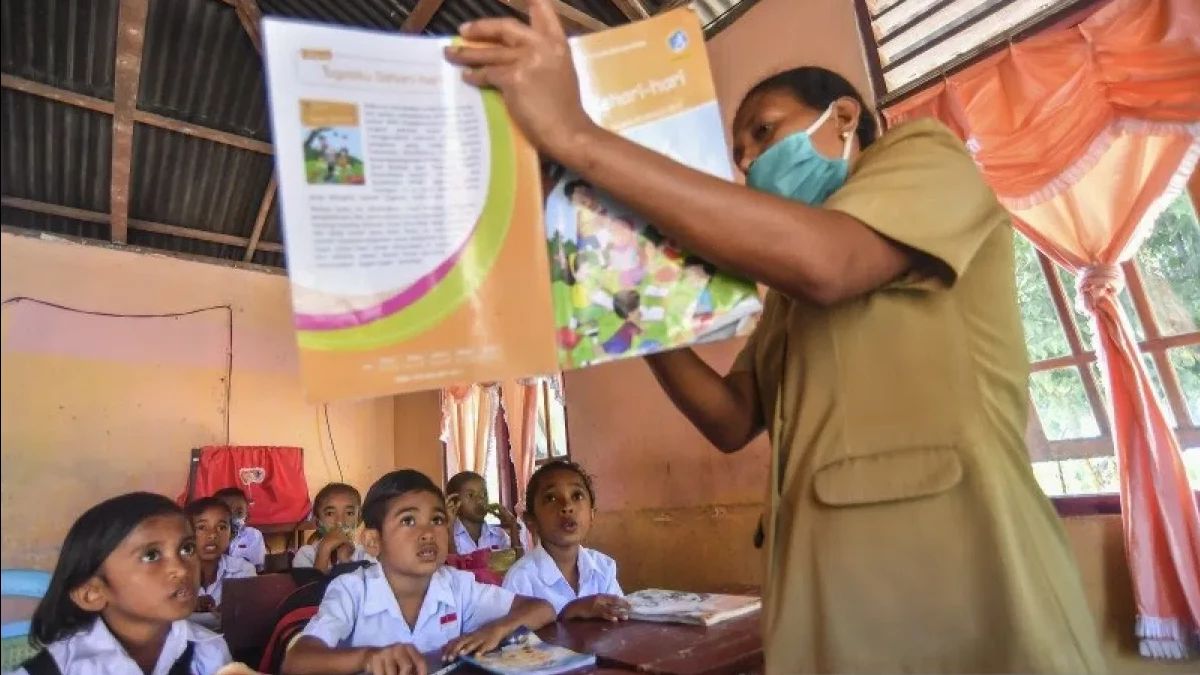
Azis said that throughout Indonesia, there are around 1.6 million honor teachers who have been the backbone of national education, especially in areas that lack ASN teachers.
"They are present not because the system is ideal, but because the country has not been able to fully meet its basic needs: ensuring that every child of the nation receives a decent education. But ironically, they live in uncertainty. Many of them receive income far below the standard, some of them only around Rp. 300 thousand per month," said Azis Subekti in his statement, Tuesday, May 5.
"Other surveys show that 42 percent of teachers earn less than IDR 2 million, and some even less than IDR 500 thousand. In some areas, their salaries are delayed for months, and some have been dismissed unilaterally without clear certainty. This is not just an economic inequality. This is a denial of the dignity of the teaching profession," he continued.
Azis said that the country had actually laid a very strong foundation in its constitution.
In the 1945 Constitution, Article 31 explicitly states "Every citizen has the right to education, the State must finance it, the State must prioritize the education budget of at least 20 percent of the State Budget".
"However, the mandate of the constitution will never be complete if the main actors of education, teachers, do not get certainty and protection," he said.
Azis explained, in Law Number 14 of 2005 concerning Teachers and Lecturers, the state guarantees four forms of protection for teachers: professional protection, law, work safety, and welfare rights. This means, said Azis, normatively, the state never considers teachers as temporary workers but in practice, some of them are treated the opposite.
According to the Gerindra Legislator from the Central Java VI District, the policy of arranging through the PPPK scheme has indeed been an initial step. More than 544 thousand teachers have been appointed as PPPK in recent years. However, according to him, this figure has not been able to answer the whole problem.
"There are still hundreds of thousands to millions of non-ASN teachers who have not received certainty of status, especially due to data problems, limited formation, and the lack of synchronization of central and regional policies. Even the policy of removing the status of honorer in the latest ASN Law has the potential to create new uncertainty for those who are not accommodated in the system," he explained.
"If it is not handled carefully, this is not just a regulation, but can turn into legalized neglect. Therefore, the state is not enough just to regulate. The state must be present in a tangible way," added Azis.
Azis then emphasized several important notes. First, the state has a moral and constitutional debt to non-ASN teachers. "They have filled the state's vacancy for years. This dedication should not be removed by a rigid administrative mechanism," he said.
Second, the settlement must be carried out fairly, comprehensively, and based on real data, not just bureaucratic assumptions. According to Azis, transparency in the number, status, and needs of teachers is a major prerequisite.
Third, a clear and measurable national roadmap is needed for the completion of all non-ASN teachers with an affirmation scheme for those who have served for a long time. Fourth, welfare guarantees must be a priority, not a budget residue.
"Education cannot be built on the uncertainty of its educators," said Azis.
Fifth, the state must respect all teachers, both in state and private schools. Because in essence, said Azis, they carry out the state's function, namely to educate the nation's life.
"In the end, this issue is not just about non-ASN teachers in Purworejo. This is a mirror of how the state treats those who work in silence, building a future without the spotlight," he said.
Azis assessed that the country could change its policy. However, the country should not change in one thing, namely respecting those who have served. "Because if teachers continue to live in uncertainty, then what is actually at stake is not only their fate, but the future of the nation itself," concluded Azis.
The English, Chinese, Japanese, Arabic, and French versions are automatically generated by the AI. So there may still be inaccuracies in translating, please always see Indonesian as our main language. (system supported by DigitalSiber.id)