

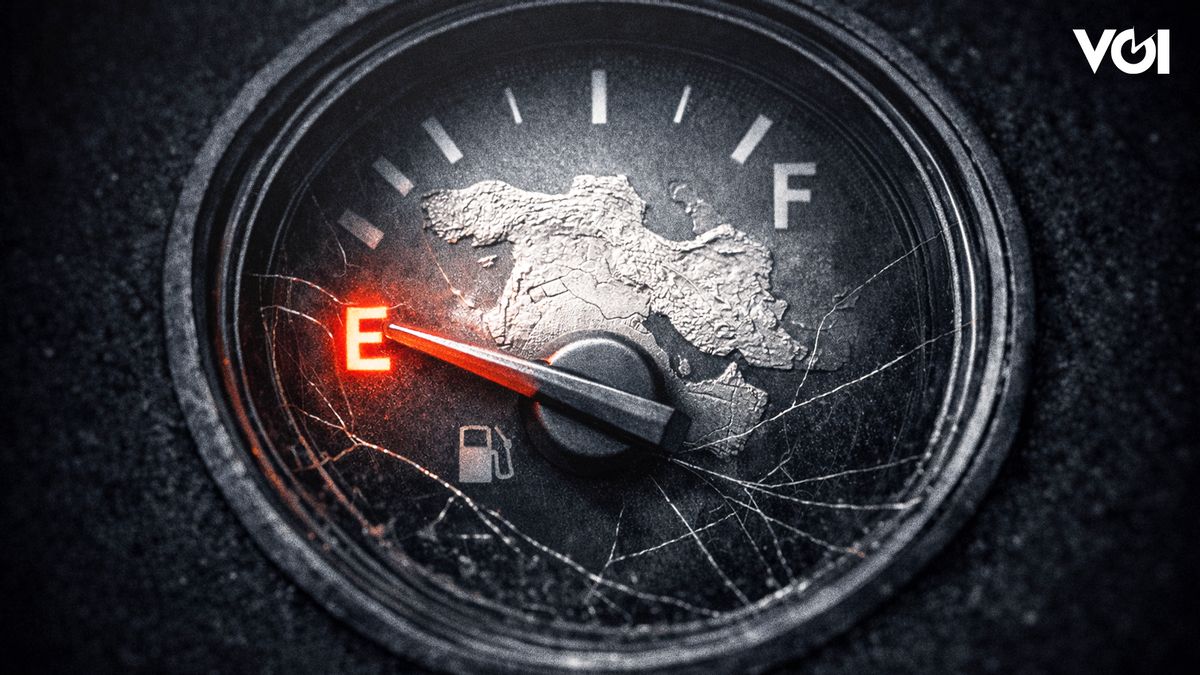
JAKARTA - The never-ending war between the United States and Israel and Iran not only affects the geopolitical situation but also the global economy. The reason is none other than the closure of the Strait of Hormuz which is the world's oil distribution route by Iran. Indonesia is also not immune from the impact of the blockage of oil supplies in the Strait of Hormuz.
So we have to find alternative energy sources, in addition to fossil energy. Some alternative fuels and energy transitions. What are some alternative fuels that can replace conventional fuels and how is the energy transition strategy so that it can run without any turmoil in Indonesia.
In the midst of a spike in global crude oil prices that has the potential to break through 150 US dollars per barrel, it is no longer just an extreme scenario, but a real threat to energy-importing countries such as Indonesia. In fact, at the end of March 2026, oil prices had touched the range of 116-118 US dollars, and the government used it as an opportunity to accelerate the energy transition.
If the price really reaches 150 dollars, the pressure on the state budget will be very large because every increase of 1 dollar can add to the burden of energy subsidies and compensation of around Rp8-10 trillion. In this context, President Prabowo Subianto's idea to convert fossil fuel vehicles to electric vehicles is becoming increasingly relevant economically, not just environmentally.
Various "Alternative Fuels and Indonesia's Energy Transition Strategy in the midst of the threat of rising oil prices reaching 150 US dollars". Alternative Fuels and Energy Transition are Indonesia's way out of the expensive fuel trap.
So far, Indonesia has designed alternative routes to overcome conventional fuels and reduce import dependence. And how is the energy transition strategy to run without any turmoil in Indonesia.
The Minister of Finance of the Republic of Indonesia, Purbaya Yudhi Sadewa together with the Coordinating Minister for the Economy Airlangga Hartarto has conveyed that this time the government will decide not to increase the price of oil, especially pertalite and solar prices.
Minister of Finance Purbaya, in a hearing with the DPR, said that currently, according to him, the Ministry of Finance is focusing on economic stability, management of the State Budget, and ensuring that fuel subsidies remain safe until the end of 2026, amid fluctuations in global oil prices. "He believes that the price will not exceed the price of Rp. 100 dollars until the end of the year, even if it rises it can still be covered by the State Budget, so the price will not be raised".
Minister of Finance Purbaya, in front of the DPR Committee, stated that his government would not increase the price of subsidized fuel. The government still has alternative fuels to replace conventional fuel such as pertalit and solar oil. Indonesia actually has several realistic alternative fuel options to replace gasoline and solar fuels that are commonly used.
Senior Economist at Paramadina University, Wijayanto Samirin, said he welcomed the decision not to increase fuel. Although he admitted that the decision was short-term in nature, for the time being.
According to him, the government has issued eight items of Work Culture Transformation as an effort to save energy and budget efficiency of the State Budget, amid increasing tensions in the Strait of Hormuz to the threat of closing Bab el-Mandeb. This situation is not just a rise in oil prices, disrupting distribution, forcing many countries to take emergency measures.
Even a number of neighboring countries have decided to take action to increase fuel prices. Alternative fuels, among others, will be carried out by a derivative program using oil palm, cassava and sugar cane, which can be converted into bioethanol.
1) Electric vehicles / Electric Vehicle (EV) This is the backbone of the long-term strategy. Cars, motorcycles, to logistics vehicles can be gradually converted to electricity. The advantage is to reduce fuel imports, reduce subsidies, and utilize domestic electricity sources from hydropower plants, geothermal energy, to PV plants.
2) Biodiesel and bioavtur Indonesia has advanced enough through the B40 to B50 program, based on palm oil. Namely, a solar biodiesel blend is a quick solution because it can go directly into diesel engines without major changes to infrastructure. In the short term, this is the most realistic substitute for the truck, heavy equipment, and agricultural sectors.
3) Bioethanol Gasoline can be mixed with ethanol from sugar cane, cassava, or molasses. The E10-E20 scheme can be a solution for motorcycles and gasoline cars without waiting for full electrification.
4) Compressed natural gas (CNG/LNG) For public transportation, city buses, and inter-island logistics, natural gas can be a transition bridge before total electrification.
5) Green Hydrogen (Green Hydrogen) It is still expensive, but it is important for heavy industry, ships, and long-distance vehicles in the future.
Energy Transition Strategy to Avoid Unrest
The biggest key to the energy transition is not in technology, but in social-economic strategies so that the community is not burdened. Some things that must be done are,
1. Gradual, don't suddenly
"Conversion should not force the public to immediately abandon fuel. Gradually, the initial phase focuses on government service motor vehicles, public transportation, state-owned logistics fleets, online motorcycle taxis through incentives," he said.
"That way the community sees the benefits first before it is required.
2. Protect subsidies for vulnerable groups
Subsidized fuel must remain for fishermen, farmers, and people's transportation during the transition period. Subsidies then shift from fuel to electricity and batteries, for example, assistance for the purchase of electric motorcycles or subsidies for night charging tariffs.
3. SPKLU infrastructure (Public Electric Vehicle Charging Station) and battery swap
Without infrastructure, electric vehicles will only be an urban elite project. The government needs to build massive SPKLU in the Java-Sumatera logistics line, tier 2 and tier 3 cities, industrial areas, eastern Indonesia
4. National battery processing
Indonesia has nickel, cobalt, and strategic minerals. Therefore, the energy transition must be linked to the national battery industry, so that it is not merely replacing vehicles, but also creating jobs and foreign exchange.
5. Stability of electricity tariffs
If electricity is expensive, people will still choose fuel. Therefore, the electricity tariff for EV charging must be kept competitive so that the cost per kilometer is much cheaper than gasoline. The key to Economic Policy, Transition Without Burdening the People.
President Prabowo's statement that he wants "total electricity" comes from the realization that internal combustion engines still make Indonesia dependent on oil imports. However, the success of the transition is not enough with the slogan of energy conversion. What determines is, the accuracy of subsidies, the readiness of the domestic industry, the electricity infrastructure, affordable vehicle prices, renewable energy supply.
If all of this goes well, then the energy transition will actually become Indonesia's fiscal shield from the shock of world oil prices and reduce the risk of domestic fuel price volatility.
In the midst of the threat of oil prices of more than 150 dollars, the best alternative fuel for Indonesia is not only electric vehicles, but a combination of EVs, biodiesel, bioethanol, and natural gas as a transitional energy. The safest strategy is gradual, targeted, and protects the purchasing power of the people. With this approach, the energy transition does not become a burden, but rather a momentum towards national energy sovereignty.
The English, Chinese, Japanese, Arabic, and French versions are automatically generated by the AI. So there may still be inaccuracies in translating, please always see Indonesian as our main language. (system supported by DigitalSiber.id)


