

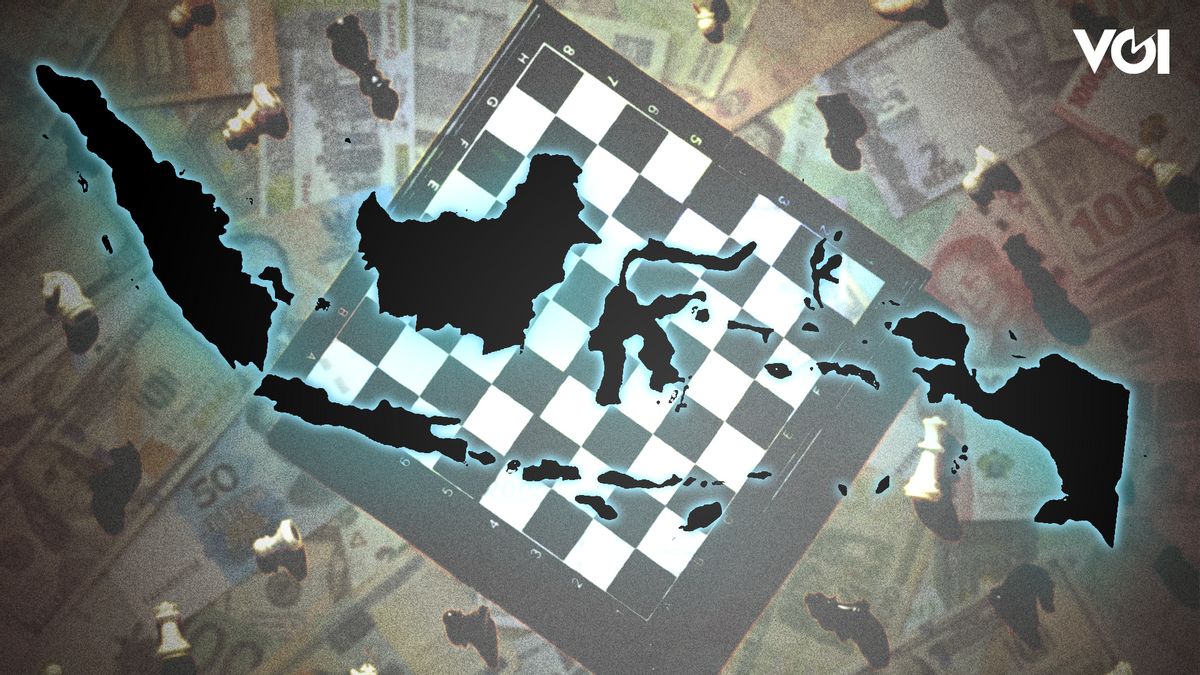
JAKARTA - The escalating global geopolitical tensions make the issue of World War III no longer sound like a conspiracy theory, but a real scenario that is beginning to be taken into account by leaders and international security experts. From Europe to Indo-Pacific, armed conflicts, trade wars, and the scramble for strategic territories create a dangerous domino effect.
US President Donald Trump's ambition to expand influence, including controversial claims to Greenland, has triggered a strong reaction from Europe, Russia, and China. This situation shows a classic pattern leading up to a major war: military show of force, formation of political blocs, and national security narratives that collide. The world seems to be moving backwards to the pre-World War phase.
In the midst of the global vortex, Indonesia is in a strategic position and vulnerable. The question is, will Indonesia be directly affected if World War III breaks out, or will it become one of the safest countries?
The unilateral claim of the US over Greenland is a symbol of a change in global political behavior. The territory, which has been under Danish sovereignty, suddenly entered Washington's national security narrative. The pretext is classic, the threat of Russia and China in the resource-rich and militarily strategic Arctic region. This step is not just a political maneuver, but a loud signal that international law is beginning to lose its force when dealing with superpowers.
If this practice is allowed, a dangerous precedent will be created and open the door to open conflict between the world's power blocs. The EU's harsh reaction shows that the Western world itself is beginning to crack. The rejection of US economic pressure and territorial claims marks a shift in the trans-Atlantic relationship, which has been relatively stable. Russia and China are using this situation to expand their influence, especially in areas that have been considered neutral.
Global polarization is becoming more apparent. Countries are forced to choose positions, while the diplomatic space is narrowing. This condition reminds the world of the dynamics before World War I and II, when alliances and economic interests became the fuel for major conflicts.
The Indo-Pacific region is now the center of the world's attention. Vital trade routes such as the Malacca Strait and the South China Sea make this region very strategic. Tensions between China, Taiwan, Japan, and the United States have the potential to drag Southeast Asian countries into a wider conflict.
Indonesia, as the Indo-Pacific axis, is unlikely to be completely passive neutral. Any escalation of conflict in this region will have a direct impact on Indonesia's economic stability, maritime security, and national resilience.
Indonesia Safe or Vulnerable?
Lecturer of the International Relations Study Program at the Islamic University of Indonesia, Mohammad Rezky Utama, assessed that militarily and geographically, Indonesia is relatively safe from direct attacks if World War III breaks out. Indonesia is not in an aggressive military alliance, is not the main target of superpower conflicts, and adheres to a free and active foreign policy that avoids involvement in war blocs.
This factor makes Indonesia unlikely to become an open battlefield. However, Indonesia remains vulnerable, especially the threat of non-military wars, such as cyber attacks, disinformation, economic pressure, and instability in the Indo-Pacific region. This means that Indonesia may be safe from bombs and missiles, but not completely safe from the impact of a modern version of World War III.
According to Rezky, the doctrine of free and active foreign policy of Indonesia is being tested again. In the midst of an increasingly harsh world, neutrality is not enough if it is not accompanied by real power. Indonesia needs to reinterpret free and active as an active strategy to maintain national interests, not just maintaining distance. Strengthening diplomacy must go hand in hand with increasing defense capacity and economic resilience. Without it, free and active risks turning into a passive position that is vulnerable to being suppressed by major powers.
"Modern warfare is no longer just about tanks and missiles. Cyber attacks, information warfare, and economic sabotage are the main weapons. Indonesia must strengthen integrated defense involving the military, intelligence, and digital security," he explained.
UI International Relations Observer, Shofwan Al-Banna Choiruzzad, revealed that President Prabowo Subianto's decision to include Indonesia in Donald Trump's Gaza Peace Council contained great risks for national interests. Because, Indonesia's involvement in the Council carries great risks for Indonesia's position in the midst of global geopolitical volatility.
He assessed that with the power so centralized on Trump and the US, US rival countries could view participation in the Gaza Peace Council as a form of siding or alignment with Washington. "China rejected the US offer and condemned the Council and this could potentially undermine Indonesia's good relations with other countries," he continued.
Shofwan also reminded that Indonesia's involvement risked damaging its international reputation. Instead of being a recognition of Indonesia's important role and value, this participation could instead create the perception that the Republic of Indonesia is easily dictated by Trump.
"If we look at other countries that have decided to join, the majority are countries that have non-democratic tendencies, so that Indonesia can be associated as part of the illiberal international," he said.
On the other hand, the Executive Director of the Center of Economic and Law Studies (Celios), Bhima Yudhistira, stated that politically Indonesia is a safe country if World War III occurs. But, a global war will actually threaten the national economy. According to him, Indonesia still has many domestic economic weaknesses that make it vulnerable to global turmoil. "Our economic fundamentals are not strong enough. The main challenge comes from within the country, ranging from fiscal resilience to a fat bureaucracy," he added.
Bhima said, Indonesia can actually benefit from increased geopolitical tensions in the Middle East, especially because of its stable and neutral position. One of them, Indonesia has the potential to become a place for investors to place their capital. The reason is, this geopolitical tension will make global investors flock to find a place that is politically and economically safe and stable, such as Indonesia.
However, this opportunity could be missed due to fundamental economic problems. These fundamental economic problems are not far from infrastructure, regulations and bureaucracy, logistics costs to credit interest rates. Bhima assessed that the bloated structure of ministries and agencies in the era of the Prabowo-Gibran government made bureaucracy increasingly ineffective and inefficient. This will affect the slow decision-making process and hinder the management of business and investment permits.
Barriers also occur in the aspect of logistics costs which are still high so that they are not as competitive as other ASEAN countries. Bhima said that the relatively high interest rates on credit also made the cost of borrowing for investment quite expensive. "So there is a waste of opportunity from the turmoil of geopolitical conditions that Indonesia should get a lot of industrial relocation," he said.
Bhima emphasized that the government must ensure that Indonesia remains in the position of a non-bloc country that does not side with any party in order to survive in the midst of conflicts. This is because the possibility of World War III could be realized by seeing the US's attitude which triggers conflicts in various countries.
This economic threat has been highlighted by member of the Commission IV of the Indonesian House of Representatives, Daniel Johan. According to him, the government must prepare food independence to energy to face the possibility of economic disruption if a world war occurs.
"In addition to taking anticipatory steps to face the worst situation by preparing food, energy, and financial independence to face possible economic disruptions due to war, including increasing the ability of troops and developing defense technology. Such as air defense and cyber defense systems," he said.
In addition, the people also need to be prepared for emergency situations and understand the importance of maintaining national security. The government must ensure the security of natural resources and infrastructure to strengthen regional and international cooperation. "The government also needs to ensure the security of important natural resources and infrastructure and strengthen regional and international cooperation to face these threats," added Daniel.
Meanwhile, the Deputy Secretary General of the Indonesian Gelora Party, Fahri Hamzah, said the uncertainty of the current global geopolitical situation makes Indonesia one of the countries that are potentially controlled by other countries. "In geopolitical calculations, Indonesia is one of the countries that are threatened, and potentially controlled by other countries, because it has many natural resources, including the largest nickel in the world as a material for making semiconductors, fuel substitutes," he said.
He explained, currently natural resources are increasingly limited, so all countries in the world are taking pragmatic survival steps to survive. Limited natural resources cause competition to become increasingly sharp and make world leaders behave pragmatically. This phenomenon occurs when the US attacks Venezuela to control the country's oil, which has been dominated by China and Russia.
It is also for these natural resources that Donald Trump plans to take over Greenland, thus causing a split between the NATO countries and the coalition with the US. Therefore, Fahri hopes that Indonesia should not be complacent anymore, and all components of the nation need to consolidate themselves to protect their natural resources. "Indonesia has been a victim of the greed of other countries who have legalized all means for economic gain to seize resources," he said.
The English, Chinese, Japanese, Arabic, and French versions are automatically generated by the AI. So there may still be inaccuracies in translating, please always see Indonesian as our main language. (system supported by DigitalSiber.id)


