

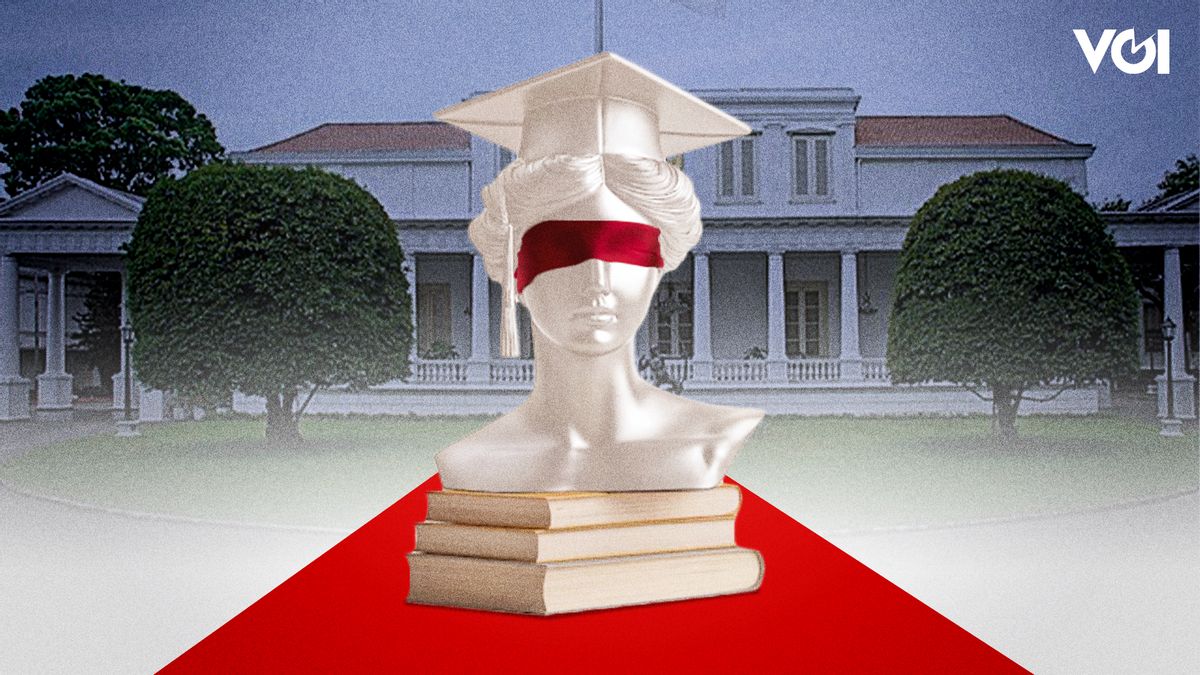
JAKARTA - The State Palace today is not just a silent witness to a ceremony, but a stage for the greatest intellectual paradox of this century. The arrival of 1,200 Professors - holders of the highest authority of truth in this country - to the heart of power invites great questions: is this a diplomacy of science for the public good, or a funeral procession for academic independence? Under the light of the crystal chandelier of the banquet hall, the boundary between devotion to science and subjugation to politics becomes blurred. When the ivory tower collapses and turns into supporting pillars of the status quo, we are forced to witness how intellectuals are no longer used to challenge injustice, but to wrap policies with sterile academic narratives.
Five years ago, where the pandemic outbreak due to Covid 19 managed to shake a number of the sustainability of the life system and also opened the opportunity for relational intimacy between power and academics in an effort to "design" the validity of science to serve partial interests. Unfortunately, at that time, there were violations in the world of campus research and publications and the alleged involvement of a number of campus leaders with power (government bureaucracy).
The findings include senior campus officials suspected of being involved in plagiarism or self-plagiarism practices. Plagiarism means copying the publication or research work of another author/researcher without adequately and completely listing the source. Self-plagiarism is the plagiarism of one's own work, such as publishing/sending the same work to several publications/journals.
Just call Muryanto Amin, the rector of the University of North Sumatra (USU) allegedly committed plagiarism for his research and publication. This academic violation is suspected to involve the palace circle because of Muryanto's closeness and a number of high officials. Not only that, a number of publications in the form of scientific journals were also found to be unreliable and allegedly ridden by a number of interests (power) to support the appointment of teaching positions.
In addition to Muryanto Amin, there was also Anggito Abimanyu, who at that time served as a lecturer at the Faculty of Economics and Business, University of Gadjah Mada (UGM) and also the Director General of Haji and Umrah Implementation of the Ministry of Religion, resigned after being accused of plagiarism. Anggito was accused of plagiarizing the opinion article belonging to Hotbonar Sinaga (UI lecturer) which was published in the Kompas daily in 2006, with his own opinion article entitled "Gerdu, Jaminan, and Dana Haji" which was published in Kompas on February 10, 2014. Anggito admitted that there was an error in the citation of references in the folder on his personal computer and stated that he was fully responsible for the error.
Based on VOI's search, there are a number of names of rectors or teaching staff of campuses and prestigious universities in Indonesia who have practiced against this academic ethics. There is Anak Agung Banyu Perwira (Catholic University of Prahyangan Bandung), Grace Kandou (Sam Ratulangi University Manado).
The Intellectualism Scandal
Universities, are envisioned as ivory towers - not in the sense of a place that is arrogant and isolated from society, but as a centre of academic excellence (centre of excellence) that is autonomous, a place where scientific truth is sought without fear and pressure. The criteria for this ideal are contained in the concept of campus autonomy, a university's freedom to manage its own household: building governance, improving quality, and ensuring academic freedom.
Autonomy, which is expected to be an empowerment tool, is often misunderstood as a gateway for privatization, turning campuses from social institutions that produce intellectuals into labor factories that are subject to market mechanisms. A slow but sure process, in which campuses lose their true independence.
One of the most obvious signs of erosion of campus autonomy is the increasingly limited academic freedom. The campus, which should be a public space for exchanging ideas, is often a repressive place for critical thinking. When the campus loses autonomy, lecturers and students are reluctant to be critical of government or authority policies, for fear of administrative impact or funding cuts.
And this has an impact on the direction of research which is dominated by industry's desire rather than the needs of the community. Science that does not make money is often ignored, reducing the role of universities to merely a place for technical training. Research driven by commercialization tends to be short-term and technical, not basic research that is fundamental for national innovation. And it will end with the campus no longer being a center for the development of critical thinking, but rather a factory of obedient and fearless labor.
On this basis, the meeting of the president and the professor at the palace in a closed manner last week, is suspected of producing an intellectual scandal. Where the professors prioritize the element of closeness with the ruler rather than integrity.
Professor and Director of Postgraduate Studies at UIN Sunan Ampel, Masdar Hilmy said the condition of higher education in this country is not good. How not! From 104 universities that have received the status of institutional accreditation "Excellent" from the National Accreditation Board for Higher Education or BAN-PT, none of them are in the top 100 of the world-class PT (World Class University/WCU) according to the QS World University Ranking (WUR) or Times Higher Education (THE).
Malaysia has long had one university (PT) that is perched in the top 100 world rankings according to the QS WUR, namely the University of Malaya which is ranked 60th.
In Singapore, two prestigious campuses have even managed to break into the top 20 in the world, namely the National University of Singapore in eighth place and Nanyang Technological University in 15th place.
"Meanwhile, we can only place three universities in the top 300 in the world. The three universities are the University of Indonesia (UI) in the 206th position, Gadjah Mada University (UGM) in the 239th position, and the Bandung Institute of Technology (ITB) in the 256th position," he said in a written message, Tuesday, January 30.
Director General of Higher Education (Dirjen Dikti), Khairul Munadi explained that the campus autonomy policy is a policy initiated by the government to support the progress of universities in Indonesia.
"This autonomy is the freedom, flexibility of universities in managing university resources, building governance, improving quality and academic freedom," said Khairul.
Critical: Prabowo Subianto Pattern Similar to Soeharto
The invitation letter for the professors invited by Prabowo is ready to be signed by the Ministry of Education, Science, Culture, and Technology (Moestopo). The ministry has invited hundreds of professors to meet Prabowo on Thursday afternoon, January 15, 2026.
In the list of professors that Prabowo invited, there were a number of professors who joined KIKA (Kaukus Indonesia for Academic Freedom). One of them is the professor of Communication Science at the Islamic University of Indonesia, Masduki. A number of UII professors, including Masduki, refused to accept Prabowo's invitation to dialogue about the role of universities in supporting Asta Cita.
Member of the KIKA Board of Directors, Herlambang Perdana Wiratraman, criticized the agenda as a waste of state funds because it invited a large number of professors in the midst of various problems that plague Indonesia. Massive cuts in education budgets, Herlambang exemplified part of the impact of free nutritious meals, Prabowo's ambitious project which shows that the government does not pay attention to the quality of education.
Masduki considered the forum to be a mere hearing of Prabowo's speech claiming success. He said the forum was not meaningful enough to encourage various substantial policies. For example, the importance of academic autonomy on campus, the welfare of lecturers, and the function of campus control over the state.
Professor of the University of Muhammadiyah Yogyakarta, Zuly Qodir, refused to come on the grounds that he was unable to listen to Prabowo's fiery speech for hours. Prabowo's invitation to the professor, according to him, was similar to the habit of President Soeharto in the New Order era. "Professors can only be scolded by Soeharto. They dare not be critical," he said.
The difference, according to Zuly, is in the style of communication. Prabowo's speech tends to be fiery, showing the success of government programs and Suharto's speeches with a calm voice. Both, according to Zuly, both want to show that they have greater power than campus intellectuals.
The presence of professors is only a tool for legitimacy and affirmation that Prabowo-Gibran has successfully carried out the Asta Cita. "In fact, the forum is not necessarily representative of the voice of scientists throughout Indonesia," said the lecturer in government science.
The English, Chinese, Japanese, Arabic, and French versions are automatically generated by the AI. So there may still be inaccuracies in translating, please always see Indonesian as our main language. (system supported by DigitalSiber.id)


