

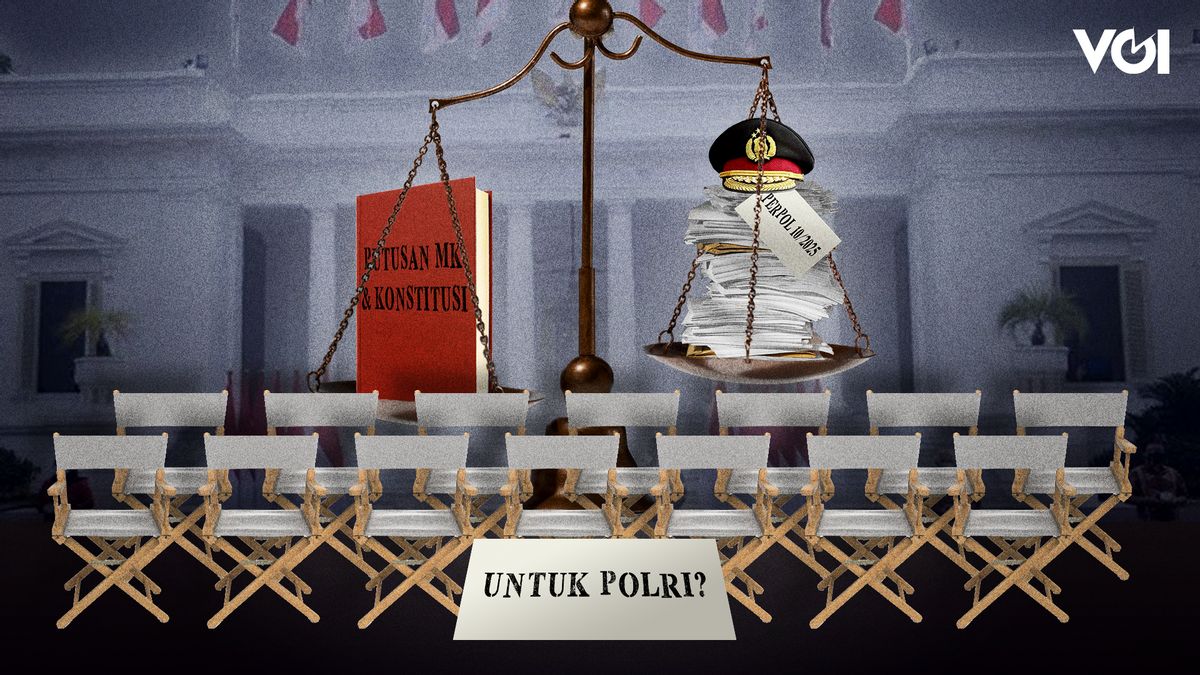
JAKARTA - When the task of the National Police Reform Acceleration Commission initiated by President Prabowo Subianto was not yet complete, the National Police Chief General Listyo Sigit Prabowo signed Police Regulation (Perpol) Number 10 of 2025 which triggered a debate in the public sphere.
The perpol, which was signed on December 9, 2025 and promulgated by the Director General of Legislation Regulations of the Ministry of Law on December 10, 2025, regulates that members of the National Police can carry out tasks outside the police, namely in 17 ministries/institutions.
The ministries/institutions that can be filled by members of the National Police, referring to the Perpol, are the Ministry of Political and Security Coordination, the Ministry of Energy and Mineral Resources, the Ministry of Law, the Ministry of Immigration and Corrections, the Ministry of Forestry, the Ministry of Maritime Affairs and Fisheries, the Ministry of Transportation, the Ministry of Protection of Indonesian Migrant Workers, the Ministry of Agrarian and Spatial Planning/National Land Agency, the National Resilience Agency, the Financial Services Authority, the Financial Transaction Reporting and Analysis Center, the National Narcotics Agency, the National Counterterrorism Agency, the National Intelligence Agency, the National Cyber Security Agency and the Corruption Eradication Commission (KPK).
Apple products
This is what then came under the spotlight of the UII constitutional law professor, Mahfud MD. According to him, the Perpol is contrary to the Constitutional Court Decision Number 114/PUU-XXIII/2025. "The Perpol is contrary to the constitutionality of Article 28 paragraph (3) of Law Number 2 of 2002 which, according to the Constitutional Court Decision 114/2025, members of the National Police if they are to enter the civil institution, then they must ask for retirement or quit the National Police. There is no longer a mechanism for assignment reasons from the police chief," he said.
In addition, the Perpol is contrary to Article 19 paragraph (3) of Law Number 20 of 2023 concerning the State Civil Apparatus (UU ASN) which regulates that ASN positions can be filled by members of the TNI and the Police in accordance with the TNI Law or the Police Law.
"The TNI Law does mention 14 civilian positions that can be occupied by TNI members, while the Police Law does not mention at all that there are civilian positions that can be occupied by members of the National Police, except for resigning or asking for retirement from the National Police service. So, Perpol has no legal and constitutional basis," said Mahfud.
English:
The member of the Commission for the Acceleration of Police Reform denied the interpretation that the National Police was a civilian institution so that it could enter any civilian institution. "That's not true because everyone must be in accordance with their field of duty and profession. For example, even though they are from the same civil institution, doctors cannot be prosecutors, lecturers cannot be prosecutors, or prosecutors cannot be doctors," he continued.
The same opinion was expressed by the Director of Amnesty International Indonesia, Usman Hamid, who assessed that Perpol 10/2025 was contrary to the Supreme Court's decision and reflected the indifference of law enforcement towards the constitution. He stated that the Perpol was an attempt to circumvent the Supreme Court's decision, which explicitly stipulates that members of the National Police can only occupy positions outside the police institution after resigning or retiring from active service.
Usman emphasized that Perpol 10/2025 had injured the spirit of the 1998 reform which placed civil supremacy as the main principle and limited the role of the security apparatus in the civil space. In addition, Perpol 10/2025 is a serious setback for the reform agenda and the protection of human rights in Indonesia. The expansion of the placement of Polri personnel through this regulation also has the potential to obscure the main mandate of the police as a protector and guardian of the community as well as the emergence of conflicts of interest especially in strategic sectors such as agriculture and natural resources.
"The presence of active security actors in civil bureaucratic positions has the potential to normalize the security approach in resolving civil issues, which often leads to repressive actions against the community," he said.
Perpol Eliminates Multiinterpretation of the Placement of the National Police in Civil Service
But, this assumption was rejected by Karo Penmas of the Public Relations Division of the National Police, Trunoyudo Wisnu Andiko. Because, the placement of active members in a number of positions at 17 ministries and agencies has been carried out in accordance with the applicable rules. According to him, the rules of Article 28 paragraph (3) of Law Number 2 of 2002 concerning the National Police and its explanation are still legally binding, even though the Constitutional Court has issued Decision 114/2025.
In addition to the Polri Law, there are other regulations that also regulate ASN positions that can be filled by police personnel. Starting from Law Number 20 of 2023 concerning ASN to PP Number 11 of 2017 concerning PNS Management. The rules explain the provisions since Article 147 which opens the opportunity for members of the National Police to fill certain positions according to their competence, and is emphasized by Article 148.
As for the names of positions, competencies, and requirements for ASN positions that can be filled by members of the National Police, they are determined by the Civil Service Development Officer (Minister/Head of Agency) with the approval of the Minister of Home Affairs as stipulated in Article 149. In Article 150 it is explained that members of the National Police who occupy ASN positions cannot switch status to civil servants.
Trunoyudo added, in Article 153, the central agency that needs Polri personnel for certain positions must submit a formal request to the National Police Chief with a copy to the Minister and Head of BKN. The detailed mechanism is in accordance with Article 154 paragraph (1), Article 154 paragraph (2), Article 157, and Article 106 paragraph (1).
Therefore, the National Police also regulates the technical aspects of assignment through Perpol 10/2025, where the mechanism requires a request from the PPK of ministries/institutions, and the personnel deployed must meet the requirements for competence, clean track record, and not currently holding other positions within the National Police.
The defense also came from the Chairman of Commission III of the DPR RI, Habiburokhman, who emphasized that Perpol 10/2025 was constitutional and did not conflict with the MK Decision 114/2025. He assessed that the MK Decision did not completely prohibit the assignment of members of the National Police outside the police organization structure. The MK only canceled the phrase "or not based on assignment from the National Police Chief" in the explanation of Article 28 paragraph (3) of Law Number 2 of 2002 concerning the National Police.
"The phrase 'a post that has nothing to do with the police' has not been canceled by the Constitutional Court at all. Thus, there is still a possibility that members of the National Police will serve in ministries or agencies as long as their duties have something to do with the National Police," he explained.
The politician from the Gerindra Party Faction, Habiburokhman, said that in assessing the legality or otherwise of the assignment of members of the National Police to ministries and agencies, the main reference was Article 30 paragraph (4) of the 1945 Constitution. The article emphasizes the duty of the National Police to protect, protect, serve the community, and enforce the law. "As long as the assignment is in the context of protecting, protecting, serving the community or enforcing the law, then it is clear that there is a connection with the police's duty," he added.
Habiburokhman explained that if Perpol 10/2025 was read in its entirety and systematically, then the rule would actually be a form of arrangement so that the assignment of members of the National Police was clearer in law and did not give rise to multiple interpretations. "As long as his duties are still related to the functions of the police, then the assignment is valid and constitutional," he said.
The President Must Take Action and Take Firm Steps
Perpol 10/2025 is the umpteenth test for the reform of the National Police. Instead of strengthening the professional and accountable police governance, this regulation has created a serious controversy because it is considered potentially in conflict with Law Number 2 of 2002 concerning the National Police and the Supreme Court's decision which is final and binding.
This controversy is not only an administrative debate, but has entered the heart of constitutional supremacy, legal certainty, and the principle of democratic policy. When the internal regulations of law enforcement institutions are perceived to exceed their delegated authority, then what is at stake is public confidence in the rule of law itself.
In the Indonesian legal system, Law Number 2 of 2002 is the main legal umbrella that regulates the functions, authorities, and structure of the National Police. Implementing regulations, including Perpol, are only justified as long as they are within the law delegation corridor.
Therefore, when Perpol 10/2025 reorganizes things that have been limitedly determined by law, or even reinterpret the limits of the authority of the National Police, then in the perspective of the rule of law, this condition indicates the potential for ultra vires, namely a regulatory action that exceeds the authority granted by the lawmaker.
If left unchecked, this has the potential to create a dangerous precedent: the internal regulations of state institutions can shift the meaning of laws and blur the principle of the hierarchy of laws as regulated in Law Number 12 of 2011 jo. Law Number 13 of 2022.
The Perpol 10/2025 controversy is a reflection of the Polri reform that has not been fully completed. In a state of law, the constitution must stand above all sectoral interests. When the Constitutional Court has set a limit, there is no room for unilateral interpretation through internal regulations.
Consistency with the Constitutional Court's decision is not merely a matter of normative compliance, but a measure of the state's commitment to maintaining democracy, civil supremacy, and the professionalism of law enforcement apparatus. Harmonization of regulations is the only way to ensure that the National Police remains within the constitutional corridor and public trust is maintained.
The above things make the researcher in the field of Police from the Institute for Security and Strategic Studies (ISESS), Bambang Rukminto, urge the President of the Republic of Indonesia, Prabowo Subianto, to take firm steps by canceling Perpol 10/2025 which is considered unconstitutional.
"The President must immediately take action by annulling the Perpol, by issuing a Presidential Regulation related to the implementation of Article 28 paragraph 3 after the Supreme Court's decision. Moreover, if you consider that the National Police Chief and the Minister of Law (Minister of Law) are also part of the Commission for the Acceleration of Police Reform," he said.
He also emphasized that the DPR had a political responsibility to summon the National Police Chief Listyo Sigit Prabowo and the Minister of Law Supratman Andi Agtas to explain the issuance of the Perpol which was said to have outwitted the Constitutional Court's decision and was considered a serious violation in the system of state system.
Bambang suggested that President Prabowo Subianto issue a Government Regulation as a temporary legal umbrella, while waiting for a revision of Law Number 2 of 2002 concerning the Police. "It must be remembered that the problem of regulating the return of Polri personnel is not only the fault of the Polri institution itself, but there is a role for the government to allow it for more than 10 years. If the police chief is not able to solve it, the president must intervene in overseeing the implementation of Law 2/2002 after the Supreme Court's decision," he concluded.
The English, Chinese, Japanese, Arabic, and French versions are automatically generated by the AI. So there may still be inaccuracies in translating, please always see Indonesian as our main language. (system supported by DigitalSiber.id)


