

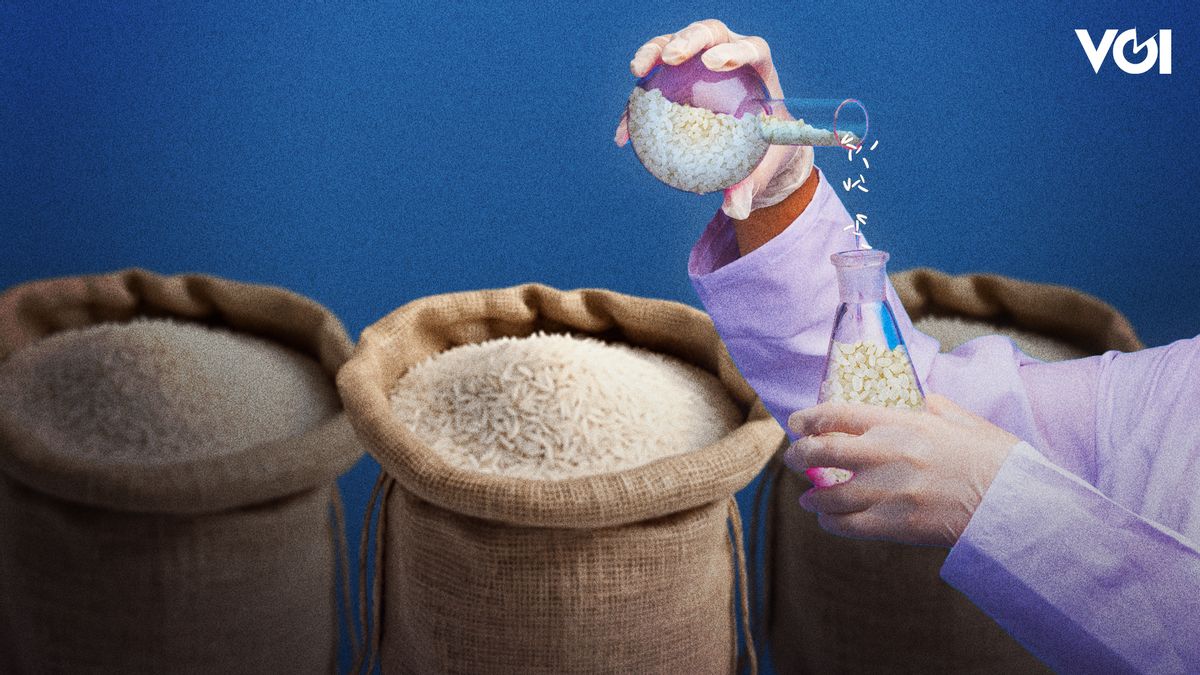
JAKARTA – In recent weeks, the issue of mixed rice has become a topic of discussion among the public, especially housewives. This occurred after the government revealed fraudulent practices involving mixed rice by a number of rice producers.
In fact, the practice of adulterating or mixing rice is common and has been going on for a long time. In this case, producers typically mix or mix broken grain rice with coarse grain rice.
"Mixing or mixing rice is a common practice in rice production. That is, mixing broken grain and coarse grain. However, this practice must be carried out in accordance with the quality standards set by the government," said the Head of the National Food Agency (Bapanas), Arif Prasetyo Adi.
"For rice, we have a maximum limit of 15 percent broken rice. If the whole grain is mixed with 15 percent broken grain, that is premium rice, and that is the quality standard. So, mixing rice without exceeding the quality standards is common and normal," he continued.
Arif explained that currently, there are provisions for premium rice quality classes in National Rice Processing Agency Regulation Number 2 of 2023. Premium rice must have a maximum of 15 percent broken grains, a maximum moisture content of 14 percent, a minimum milling degree of 95 percent, a maximum of 0.5 percent grit, a maximum of 1 percent total other grains (damaged grains, chalky grains, red/black grains), and be free of unhusked grains and other impurities.
Furthermore, he said, the Indonesian National Standard (SNI) 6128:2020 also stipulates that non-organic and organic premium rice must have quality components including a maximum of 14.50 percent broken grains, a minimum of 85.00 percent head grains, a maximum of 0.50 percent grit, a maximum of 0.50 percent red/white/black grains, a maximum of 0.50 percent damaged grains, a maximum of 0.50 percent chalky grains, a maximum of 0.50 percent foreign matter, and a maximum of 1.00 grains per 100 grams.
Unfortunately, the practice of mixing or adulterating rice has now gone too far. This is evident from findings by the Ministry of Agriculture, the National Food and Agriculture Agency (Badan Bapanas), the Food Task Force, and other relevant parties that the mixed or mixed rice does not meet government standards.

The investigation revealed that 212 brands of rice were found to be non-compliant with quality standards. The investigation, conducted from June 6 to 23, 2025, included 268 rice samples from 212 brands across 10 provinces. These samples included two categories of rice: premium and medium, with a primary focus on quality parameters such as moisture content, percentage of head rice, broken grains, and degree of milling.
According to the findings of the Ministry of Agriculture and the Food Task Force, the rice was mixed by mixing premium rice with medium rice. It was then sold at a premium price. This is despite the rice quality standards stipulated in SNI 6128:2020, which stipulate that premium rice should have a maximum moisture content of 14 percent, a minimum of 85 percent head rice, and a maximum of 14.5 percent broken grains. Meanwhile, medium rice should have a maximum moisture content of 14 percent, a minimum of 80 percent head rice, and a maximum of 22 percent broken grains.
"We deeply regret that a number of large companies are suspected of not adhering to established quality standards. People buy premium rice expecting it to meet standard quality standards, but the reality is that it's not. It's like buying 24-karat gold and receiving only 18-karat gold," said Minister of Agriculture Amran Sulaiman.
He said that these brands fail to meet the standards for packaging weight, composition, and labeling. Some brands are reported to offer 5-kg packages containing only 4.5 kg, and many claim to be premium rice when in fact, they are of ordinary quality. "This fraudulent practice not only harms consumers in terms of quality but also causes economic losses estimated at IDR 99 trillion per year," concluded the Minister of Agriculture.
So, what should the public do to avoid falling prey to the practice of mixed rice? Tajuddin Bantacut, an expert in Agricultural Industrial Technology at the Bogor Agricultural University (IPB), explained that mixed rice can actually be identified with the naked eye. mixed rice can usually be identified by its uneven color, different grain sizes, and soft texture after cooking.
"If you find rice that differs from usual in terms of color, odor, texture, and grain, you can suspect it has been mixed, meaning there is a quality defect or the presence of foreign objects," he said.
In some cases, mixed rice is also mixed with additional foreign substances, including dangerous dyes or preservatives, which can be harmful to health if consumed long-term. According to Tajuddin, there are three types of rice associated with adulteration circulating in the community.
First, mixed rice, mixed with other ingredients such as corn. Second, "blended" rice, or a mixture of several types of rice to improve taste and texture. Third, rice mixed with unusual or damaged ingredients, then polished or re-polished to make it look good again, even though its quality has actually decreased.
"That's why people must be more careful when choosing rice. Avoid buying rice without labels or from unknown sources. Wash the rice before cooking and be alert for any floating foreign objects," he concluded.
Consumer Compensation and Tightening Rice Quality Oversight
Meanwhile, the Ministry of Trade (Kemendag) stated that consumers who feel they have been harmed by purchasing rice that is of substandard quality or does not meet established standards have the right to file for compensation. This mechanism applies as stipulated in Law Number 8 of 1999 concerning Consumer Protection.
The Director General of Consumer Protection and Trade Order (PKTN) at the Ministry of Trade, Moga Simatupang, stated that consumers should get into the habit of requesting proof of purchase or an invoice every time they make a transaction. This proof serves as an important basis for filing a claim if the purchased product does not meet specifications.

He added that the compensation process can be done directly with the merchant where the goods were purchased, either by requesting an exchange or a refund. If the seller doesn't provide a solution, consumers can report their case to the Non-Governmental Consumer Protection Agency (LPKSM) or the Consumer Dispute Resolution Agency (BPSK) in their respective regions.
"The first step consumers need to take is to retain the purchase invoice as proof of the transaction. Next, consumers can return the non-conforming product to the place of purchase for an exchange or refund," he said.
Moga emphasized that this process doesn't have to go through complicated bureaucratic channels. If the merchant doesn't respond, the local consumer protection agency can take over. This has been done in previous similar cases, such as the Minyakita product whose net contents didn't match the label. "It doesn't have to be a lengthy process," he added.
Furthermore, the Ministry of Trade is also taking legal action against rice that doesn't meet quality standards. Monitoring conducted between March and April 2025 revealed violations of size and quality standards. The Ministry of Trade has issued a warning to the business operator and instructed them to withdraw the product from circulation within a maximum of 30 days.
"Regarding quality control, we are also requesting a warning, and the goods must be withdrawn from circulation within 30 days. We have issued a letter regarding quality, issued a warning, and submitted it to the Food Task Force. We have also summoned the company for clarification and the recall," Moga emphasized.
Meanwhile, Sturman Panjaitan, a member of Commission IV of the Indonesian House of Representatives (DPR RI), urged the Ministry of Agriculture to conduct regular rice quality inspections every six months to prevent a recurrence of mixed rice cases.
The politician from the Indonesian Democratic Party of Struggle (PDI-P) faction highlighted the slowness of the rice quality inspection system, which has allowed adulteration practices to continue undetected for years. He believes that supervision cannot be carried out for too long, as it risks causing large-scale state losses.
"We must conclude that inspections of rice sold in the field shouldn't be conducted every 10 years. If necessary, we should conduct inspections every six months to prevent such significant losses. Furthermore, the Ministry of Agriculture claims the last inspection was conducted in 2016. This means it was nine years ago. That's too long ago, if we're talking about inspection," Sturman emphasized.
The English, Chinese, Japanese, Arabic, and French versions are automatically generated by the AI. So there may still be inaccuracies in translating, please always see Indonesian as our main language. (system supported by DigitalSiber.id)


