

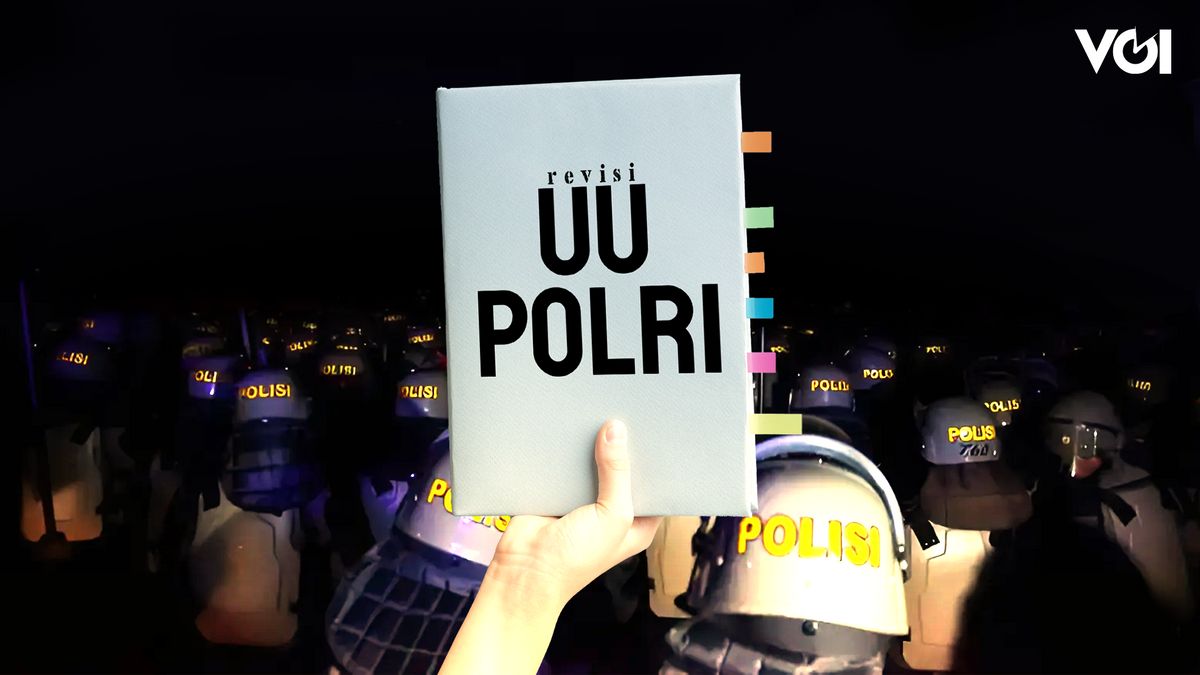
The discourse on the revision of the National Police Bill (UU NO 2 of 2002) left a public trauma related to the bad experience of ratifying the TNI Law in the DPR, because despite being opposed by many parties the DPR still passed the law. The trauma made an impression on the hearts of many people, so that not to mention at the discussion stage, many parties have highlighted the revision of the Polri Bill.
This concern has caused the plan to discuss the National Police Bill close to discussing the revision of the TNI Law to finally take a temporary step back. Due to concerns that the discussion of the Police Law has the potential to cause turmoil. The DPR also promised to discuss the National Police Bill openly by involving community participation.
The plan to revise the National Police Law has actually been discussed by the DPR for the 2019-2024 period. The DPR leadership has even received a presidential letter (supres) containing the approval of the first level of discussion of the National Police Bill in July 2024. However, in August 2024, the Legislation Body (Baleg) of the DPR decided to postpone the discussion of the National Police Bill, because the government has not submitted a list of problem inventory (DIM). about the contents of the Police Law
Although the official DIM has not yet been issued by the government, drafts have been circulated to the public as well as article analysis to be published. The public has been busy responding to the contents of the revised article.
Chairman of the House of Representatives and Chairperson of the PDIP DPP Puan Maharani chaired the Plenary Session (Nailin/VOI)
"It's okay"
"It's okay"
"It's okay"
"It's okay"
The chairman of the DPR, Puan Maharani, rejected the discussion of the National Police Bill. Puan emphasized that if there is a Surpres circulating in the public, it is not an official Surpres issued by President Prabowo Subianto. He also ensured that the Inventory List of Problems (DIM) of the National Police Bill which is currently circulating is not an official draft because the leadership of the DPR has not yet received the Presidential Decree of the bill.
Deputy Speaker of the House of Representatives, Sufmi Dasco Ahmad, also emphasized that the DPR will not discuss the National Police Bill in the near future. It is still targeting to complete the Criminal Code Bill until October.
Based on the draft obtained by Aji, from the civil society coalition for criminal justice reform. The initial draft was dated February 17, 2025 and grew into a draft on March 20, 2025. The coalition believes that the draft will be the material for revision. However, after dissecting the substance of the Draft, it is considered that many things are contrary to the substance expected. In fact, they see these articles that are far from the substance expected to be revised by the Police Law
Drafts that are expected to contain substantial improvements in principle contain a number of articles that are actually considered problematic, including the extension of reckless (excessive) police authority to make them a 'superbody' institution. For example discussing retirement age which increased from 60 to 62 years and even longer for the age of officers.
Former Chairman of the Indonesian Legal Aid Foundation (YLBHI) Muhammad Isnur said changes to the National Police Law (as published on the dpr.go.id page) were considered to have failed to answer public pressure on police reforms. In addition, the National Police Bill is also considered to have failed to highlight the fundamental problems (problems) that have occurred in the institution so far, including failures in highlighting the weak aspects of public control and control mechanisms for the power of the police which are so great (oversight mechanism) in the context of law enforcement, state security and community services.
Similar conditions can also be observed in the Indonesian Ombudsman Annual Report. In the 4th year (2020-2023) the police consistently occupy the top rank as the most reported institution. Complaints related to the National Police institution received and summarized by Kompolnas until September 2023 alone, also showed more massive data, namely 1,150 complaints.
The results of a survey of Indonesia's public trust in law enforcement institutions conducted by the Indonesian Survey Institute (LSI) in 2023 put the Police at its lowest place with 64%. Various data and series of findings place the police as institutions that have major problems.
So instead of strengthening civil control of the police, the revision of the Police Law shows a tendency to enlarge the role of the Police without balancing external supervision. This contradicts the spirit of reform and the principle of a democratic state that places law enforcement agencies under strong and independent public supervision.
Polri yang selama ini dinilai menjadi 'aktor pemegang monopolo' kekerasan, pelanggaran Hak Asasi Manusia (HAM), maladministasi, penyalahgunaan ketahanan (abuse of power) hingga praktik-praktik korupsi.
According to YLBHI records throughout 2019, 67 people died on suspicion of being victims of murder outside the legal process (extrajudial killing) in the hands of the police.
According to KontraS records, for example, in the 2020 - 2024 range involving the police. also between July 2022 - June 2023, there were 622 cases. Meanwhile, during January-April 2024, there were 198 cases of human rights violations as many as 677 cases.
The revision of the National Police Law (Unlaw of the Republic of Indonesia) should be a moment of improvement. But it does not reinforce the role of independent supervisory institutions such as Kompolnas (National Police Commission) or Komnas HAM.
Lack Of Strengthening The Authority Of Kompolnas
The revision of the National Police Law does not significantly increase or reinforce the authority of Kompolnas. In fact, one of the main criticisms of the police surveillance system so far is the weak role of Kompolnas which is only an advisory (advisory), not an oversight body with the power to carry out investigations or prosecutions.
Kompolnas does not have direct authority to investigate violations by members of the National Police. Apart from the absence of sharpening the role of Komnas HAM. Komnas HAM does have the authority to examine human rights violations, including by the police. However, in the revision of the Police Law, there is no affirmation that the Police must actively cooperate or follow the recommendations from Komnas HAM. This weakens the aspect of accountability, especially in cases of violence by the authorities.
Daily Chairman of Kompolnas Arief Wicaksono said several clauses in criminal procedural law have not been included in the Police Law. For example, the suspect's detention rules described in Article 21 paragraph 4 of the Criminal Procedure Code whose technical rules are not yet in the Police Law. The regulation stipulates that a suspect can be detained if the threat of imprisonment is more than 5 years or less with other records.
As feared by running away, eliminating evidence or repeating a criminal act. "Well (the rules) are not in the Police Law," said Arief. If the discussion of the National Police Bill is continued without waiting for the Criminal Procedure Code Bill to be completed, Arief believes that there will be uncertainty. The reason is, Arief assessed that the discussion of the Criminal Procedure Code Bill is more urgent than the Police Bill.
The bill is also considered a tendency to centralize power within the police.
The revision of the National Police Law has actually expanded the authority of the National Police Chief and the National Police institution in general, including in terms of cyber intelligence and security. This can strengthen the militaristic character and weaken civil control of the Police.
Instead of opening up external surveillance spaces, revised drafts tend to strengthen internal control. There is no serious external surveillance reform. In the context of democracy, external supervision of institutions outside the National Police is the key, to create new mechanisms, for example providing the role of the Police Ombudsman or strengthening the role of the DPR in supervising the performance of the Police more directly
It does not even touch the issue of transparency and accountability. There is no significant strengthening related to the police's obligation to disclose data on internal violations, the results of investigations, or responses to institutional recommendations such as Komnas HAM. This indicates a weak commitment to openness principles
The English, Chinese, Japanese, Arabic, and French versions are automatically generated by the AI. So there may still be inaccuracies in translating, please always see Indonesian as our main language. (system supported by DigitalSiber.id)


