

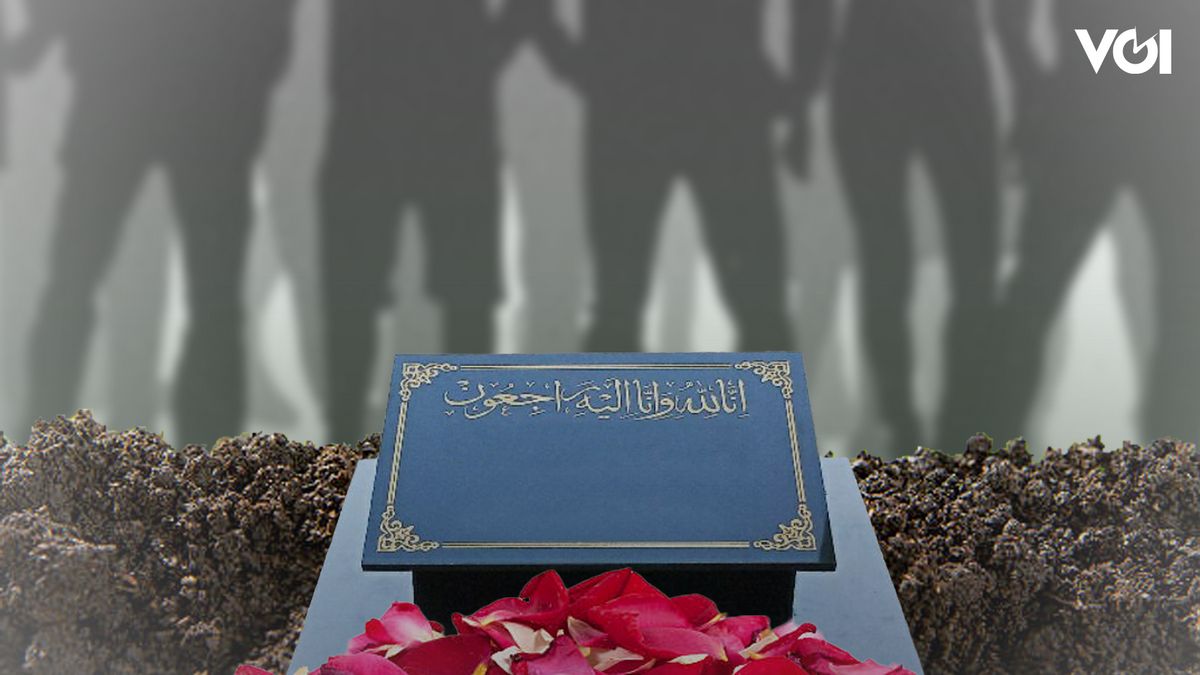
JAKARTA - Ahead of Ramadan and during Eid, public cemeteries (TPU) are usually crowded with Muslims who want to make pilgrimages or visit their families' graves. Although it is not known where the pilgrimage tradition came from at that moment, this has become a strong cultural root.
Before Islam, the people of the archipelago already had a tradition of respecting their ancestors. Original religions and beliefs such as animism and dynamics teach respect to ancestral spirits who are believed to still have relationships with living families.
When Islam entered Indonesia, this tradition of respect for ancestors was adjusted to Islamic teachings in the form of grave pilgrimage. Wali Songo when spreading Islam in Java used a cultural approach in his da'wah, one of which was introducing grave pilgrimage as a means of worship, but still in line with Islamic teachings.
Then what is the relationship of the pilgrimage of tombs, fasting and holidays. It should be understood that fasting is a means for nafs tazkiyatun or soul assassination, Eid al-Fitr is a momentum to ask each other for forgiveness, so pilgrimage is a procession considering death or dzikr al death. Thus, when people have performed fasting rituals, rituals for forgiveness among human beings, a ritual is performed to raid the graves of their grave experts, so that spiritual actions, globalism and relations are complete between the two, "wrote one of the lecturers or professors at the State Islamic University (UIN) Sunan Ampel Surabaya, Prof. Nur Syam was quoted as saying on the official website of UIN Surabaya.
Pilgrims at TPU Malaka, Duren Sawit District, East Jakarta/ Photo: IST
"It's okay"
"It's okay"
"It's okay"
"It's okay"
Meanwhile, pilgrims consider this moment a form of respect for their ancestors before entering the holy month of Ramadan. It is different when on pilgrimage during Eid, it is interpreted as an expression of gratitude and a form of respect for a family that has not at the same time invited them to feel happiness on Eid al-Fitr.
However, there are still no hadiths or verses of the Qur'an that specifically recommend circumventing (the grave pilgrimage) during Ramadan or Lebaran. However, there are several arguments that advocate grave pilgrimages in general, without being limited to a certain time. In Islamic teachings, grave pilgrimage is recommended to remember death and pray for people who have died.
The State Participates In Culture Of The Pilgrimage Tradition Of Ramadan And Eid
The tradition of pilgrimage to family graves during Lebaran is not only carried out in Indonesia, but also in several other countries with the majority Muslim population. Here are some countries that have similar traditions quoted from various sources:
Malaysia
Muslims in Malaysia make grave pilgrimages before Ramadan, similar to traditions in Indonesia. They visited the family grave to pray for the deceased.
Turkey
There, Muslims usually go to the cemetery before Ramadan while reading the Qur'an and praying for relatives who have died. They also lit candles around the tomb as a sign of respect.
Egypt
Then, this Pyramid Country also has a tradition of grave pilgrimage before Ramadan often accompanied by alms. Many families distribute food or financial assistance to the poor as a form of charity for their families who have died.
Iraq
In Iraq, grave pilgrimage traditions are very important especially ahead of Ramadan. Millions of Shia Muslims and visitors from various parts of the world gather in the city of Karbala to make Arbaeen pilgrimages, commemorating the death of Husein, the grandson of Prophet Muhammad SAW.
Suriname
In Suriname, Muslim communities, including Javanese descent, often make pilgrimages to family graves both domestically and abroad as part of Eid al-Fitr celebrations and the fasting month.
Meanwhile in Saudi Arabia, the tradition of grave pilgrimage before Ramadan is not common. Because according to them, grave pilgrimage is forbidden if it aims to pray on the grave.
Figures In RI Routinely Nyekar Ahead Of Ramadan And Eid
The Prophet Muhammad SAW himself did make a grave pilgrimage but this activity was not carried out at any particular moment. In Indonesia, there are several well-known figures and government officials who often make pilgrimages at the moment ahead of Ramadan and Eid al-Fitr. Anyone?
Megawati Soekarnoputri And Her Son Puan Maharani
The 5th President of the Republic of Indonesia (RI), Megawati Soekarnoputri routinely every time before Eid, a pilgrimage to her husband's grave, Taufiq Kiemas, which is located at TMP Kalibata, Jakarta. This pilgrimage was posted by Megawati's third child, who is the Chairman of the Indonesian House of Representatives, Puan Maharani.
"Today with big family came to Papa Alm's grave. Mr. HM Taufiq Kiemas... Alfatihah...," said Puan in her Instagram statement, Sunday, March 30.
Susilo Bambang Yudhoyono
The 6th President of the Republic of Indonesia, Susilo Bambang Yudhoyono or familiarly called SBY also has a pilgrimage routine that is carried out during the Lebaran moment. On Tuesday, April 1, SBY first attacked Siti Habibah's mother's grave at the Tanah Kusir TPU, Jakarta.
This pilgrimage moment was immortalized by his eldest son, Agus Harimurti Yudhoyono (AHY) who is a government official of the Coordinating Minister for Regional Infrastructure and Development. Then, the next day, SBY and his children went to the Christian Herawati grave or familiarly called Ani Yudhoyono. The tomb of the mother of AHY is located at TMP Kalibata, Jakarta.
We continue to miss the figure of Mrs. Ani who is so full of love and affection, on special days especially on the day of victory of Eid al-Fitr, when (Mrs. Ani) is still there, we always gather together in various situations. God willing, by being able to come to TMP Kalibata to pray for her. This is a complement to Eid al-Fitr 1446 H. I, Mr. SBY, Annisa Yudhoyono (wife of AHY) and Aira (grandson of SBY) always miss the figure of Mrs. Ani, may the deceased always be placed in a noble place with Allah SWT, and all the ideals of her life that have not been realized can be realized. Al-Fatihah.," said AHY in his IG account post.
Sri Mulyani Indrawati
Minister of Finance (Menkeu), Sri Mulyani Indrawati usually performs syadran' or pilgrimages just ahead of Ramadan. In Sri Mulyani's official Instagram post (@smindrawati), it appears that she and her extended family visit their parents' graves in Semarang, Central Java.
"Nyadran, wearing the grave of his parents before Ramadan 1446 H. Mental preparation for the holy month of Ramadan. Expressing respect, longing and affection, gratitude and gratitude for his love,mblengan and teachings. Paving Alfatihah and Yasin prayers for the deceased and the deceased," he wrote in the post, Monday, March 24.
Ahmad Muzani
The chairman of the MPR RI, Ahmad Muzani, also has routine activities ahead of Ramadan's pilgrimage to his parents' grave in Tegal, Central Java on 27 February.
Towards the holy month of Ramadan, I took the time to make a pilgrimage to the food of my beloved parents. This has become a routine for Muslims in Indonesia. Send a prayer while giving thanks to Allah SWT," he wrote, quoted from the IG account @ahmadmuzani2.
"May Allah always put our parents who have passed away in a noble place, widen their graves, and erase all sins. Amen Ya Rabbal Alamin ..," he continued.
Khofifah Indar Prawansa
Then, there is the Governor of East Java, Khofifah Indar Prawansa, who has a habit of wearing fun at the moment of Eid al-Fitr. After the Eid prayer, he immediately made a pilgrimage to his parents' grave at the Surabaya TPU, on Monday, March 31.
They have preceded us. Called by the Creator. May all be happy by Allah SWT. Our tradition is that our family pilgrimages to the graves of their parents and husbands after the Eid prayer," he wrote through the IG account @ khofifah.ip.
The English, Chinese, Japanese, Arabic, and French versions are automatically generated by the AI. So there may still be inaccuracies in translating, please always see Indonesian as our main language. (system supported by DigitalSiber.id)


