

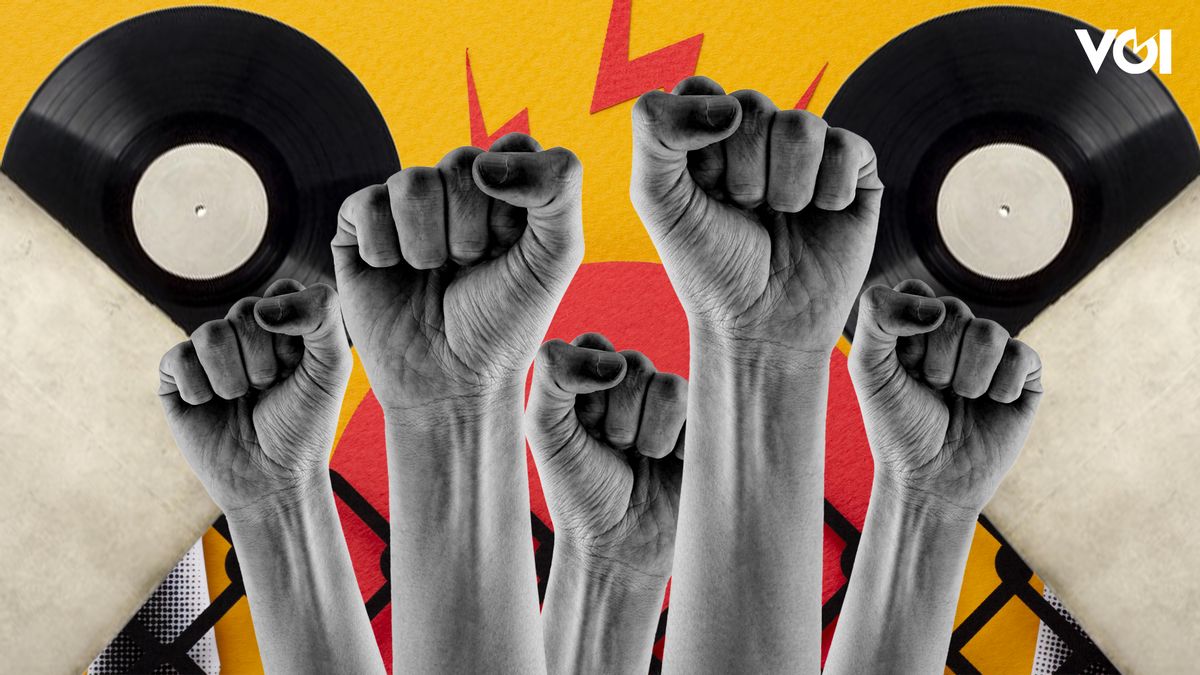
JAKARTA - Music has long been a tool for musicians to voice criticism of social, political and economic conditions. Genres such as rap, reggae, punk and alternative rock are known to have a spirit of rebellion and are often a medium of protest.
Music As A Facilities Of Resistance
Rap was born to the African-American community in Chile, New York, in the 1970s. The lyrics talk about injustice, poverty, and racial discrimination. One of the rap icons, Tupac Shakur, delivered social criticism through songs such as Change and Keep Ya Head Up, which raised the issue of racism and economic inequality.
Reggae developed in Jamaica in the 1960s, with Bob Marley as one of its pioneers. Through songs such as Redemption Song and Get Up, Stand Up, Marley called for peace, unity, and resistance to oppression, making it a symbol of human rights movement and anti-colonialism.
In the 1990s, alternative rock was also a place for social criticism. Kurt Cobain, Nirvana's vocalist, expressed his concerns about the social pressure, consumptive culture, and mental health in songs such as Smells Like Teen Spirit, which later became a symbol of the resistance of the younger generation.
Meanwhile, the punk movement emerged in the mid-1970s in reaction to increasingly complex rock music dominance and the mainstream being considered boring. Punk thrives in major cities such as New York, London, and Los Angeles, with the hallmarks of fast, aggressive music, as well as angry lyrics and social criticism.
Apart from music, punk has also developed into a lifestyle and philosophy. Some of the main values in this subculture are:
Do It Yourself (DIY): Prioritizing independence in music, releasing albums, to making your own fanzine.
Anti-establishment: Against authority and social norms that are considered oppressing.
Dressing Style: Mohawk hair, leather jackets, torn pants, and striking accessories are typical punk identities.
In the 1980s, punk developed into various subgenres such as hardcore punk (Black Flag, Minor Threat), pop punk (Green Day, Blink-182), and anarcho-punk (Crass, Dead Kennedys). Until now, punk has continued to live as a cultural and musical movement that rejects compromise with the mainstream entertainment industry.
Punk is not just a music genre, but also a symbol of resistance and freedom of expression. Despite coming from different genres, these musicians have something in common: they use music as resistance and remain relevant today.
Tragedy Behind Music Protests
Several musicians who have spoken out to face sharp criticism throughout their careers, have even experienced tragic deaths.
John Lennon (Imagine, Hey Jude). His controversial statement, including claims that The Beatles were "more popular than Jesus," drew criticism. He was shot dead by his fan, Mark David Chapman, on December 8, 1980.
Kurt Cobain (Smells Like Teen Spirit, Come as You Are). Nirvana's music is often criticized for its depressive lyrics. Cobain was found dead with a gunshot wound to his head on April 5, 1994, suspected of committing suicide.
Tupac Shakur (Changes, California Love). His lyrics highlighting violence, racism and injustice made him often criticized. He was shot in a drive-by incident in Las Vegas on September 7, 1996 and died six days later.
Selena Quintanilla (Como La Flor, Bidi Bidi Bom Bom). Her career was criticized for its transition to pop music from Tejano. She was shot by her fan club manager, Yolanda Sald
Sukatani And Controversy In Indonesia
In Indonesia, the punk group Sukatani is in the spotlight. This duo consists of Novi Citra Indriyati alias Twister Angel and Muhammad Syifa Al Lutfi alias Alectroguy. They are known for their unique appearance in wearing head coverings.
The lyrics of their songs, especially Pay Pay Payment, make the ears of several members of the National Police at the Central Java Police redden. The song quipped the practice of illegal levies by police officers, with lyrics like, "Report lost goods to the police."
As a result, Sukatani was under pressure. Twister Angel and Alectroguy even appeared on social media to apologize to the National Police Chief and the police institution. However, instead of reducing them, National Police Chief General Sigit Listyo Prabowo instead offered them to be the National Police Ambassador.
Punk: Unemployed Resistance Music
Since appearing in the 1970s, punk has been known for its sharp lyrics, full of social criticism, and resistance to authorities. Outside bands such as The Clash, Dead Kennedys, and Sex Pistols often voice issues of poverty, corruption, to individual freedom through their music.
Punk has also grown to various subgenres, such as more political anarchos and more aggressive punk hardcores. Not only in the lyrics, the spirit of Do It Yourself is also a characteristic of punk, where musicians and their fans move independently in creating music, releasing albums, and organizing concerts without relying on the mainstream music industry.
Sukatani is only one of many musicians who have proven that music remains a strong medium to voice social unrest even though the consequences are not always light.
The English, Chinese, Japanese, Arabic, and French versions are automatically generated by the AI. So there may still be inaccuracies in translating, please always see Indonesian as our main language. (system supported by DigitalSiber.id)


