

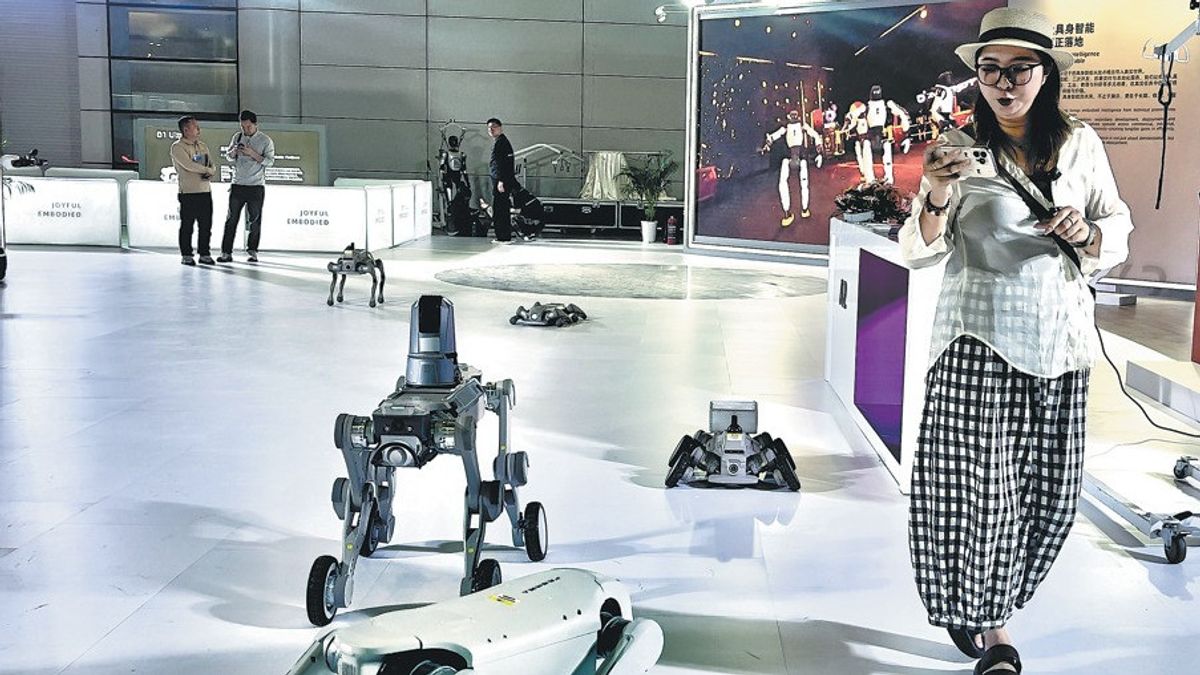


Robot humanoid can dance, drum, and pour coffee. But at China's latest technology exhibition in Fuzhou, Fujian Province, the big focus was on a scene where an operator wearing a VR device teaches a robot to pick up a paper cup.
Quoted from a report by China Daily, Thursday, May 28, the moment was considered important by Joyful Embodied, a Chinese robotics company. For them, the AI robot race is no longer about cool looks, but data.
"We are building a school for robots," said Joyful Embodied CEO Chen Yishi in an interview with China Daily.
The company is setting up a robot training facility of more than 3,000 square meters in Fujian. This place will operate around the clock.
There, humanoid robots, four-legged robots, and wheeled robots will be trained to perform real tasks. From stacking glasses, sorting objects, carrying components, to wiping tables.
Human operators will wear virtual reality or VR devices and motion control devices to remotely steer the robot. Cameras and sensors then record the robot's movements, angles, pressures, and responses.
This data is the key. Chen calls it "high-quality fuel" to train a new generation of AI embedded in physical machines.
"Without real-world data, even the most sophisticated large models are just empty brains," Chen said. "Robots don't learn by assumption. Every little movement has to be taught through data."
The term used by the industry is embodied AI, or physical embodied artificial intelligence. Simply put, this is AI that not only answers questions on the screen, but enters the robot's body to be able to see, choose actions, and work in the real world.
This direction indicates a shift in China's AI industry. After chatbots and language models, attention is beginning to shift to robots that can actually be used in homes, factories, warehouses, schools, services, and security inspections.
This sector also received political encouragement. Embodied AI was included in the 2026 Chinese Government Work Report as a strategic industry of the future.
Fujian, which has long been known as a manufacturing, electronics, and trading center, is also pushing robotics, AI infrastructure, and industrial automation.
However, the challenge is not small. Investors have indeed poured in large funds for humanoid robots. But industry players are starting to see the main problem is in the training data from the actual machine.
The data includes teleoperation and motion capture. Teleoperation means that a robot is remotely controlled by a human. Motion capture is the recording of human or machine movement so that it can be studied by an AI system.
Chen assessed that the future of the AI robot economy is not only determined by hardware. Data will actually become a costly commodity.
"High-quality embodied AI training data is already priced per hour," he said.
Joyful Embodied itself was only established in September 2025. However, this company wants to go further, not just making robots. They are also building a large AI model and a development platform called Joyful Studio.
The platform is aimed at creating customizable robot applications in various sectors, such as manufacturing, logistics, education, services, and security inspections.
According to Chen, every robot that operates continuously in a data collection system will require about three technical positions. His job includes data annotation, algorithm optimization, and device maintenance.
The company also hopes that Fujian's export strength and the business network of overseas Chinese can help expand robot and data services overseas.
For now, the biggest competition is still within the country. China's Ministry of Industry and Information Technology recently approved the first industry standard for embodied AI benchmarks. The standard went into effect on Monday.
The standard is considered to be the first step to make the evaluation and implementation of robots more organized.
Chen said the robot industry is entering an important phase.
"The competition is no longer just about which robot can walk or dance," he said. "The real question is: which robot can actually work."
There are already many robots that can entertain on stage. Now, the new size is whether the robot can be trained, given a task, and work when it is really needed.
The English, Chinese, Japanese, Arabic, and French versions are automatically generated by the AI. So there may still be inaccuracies in translating, please always see Indonesian as our main language. (system supported by DigitalSiber.id)
Most Popular Tags
#Prabowo Subianto #donald trump #firearm #8791 #giias 2026Popular


