
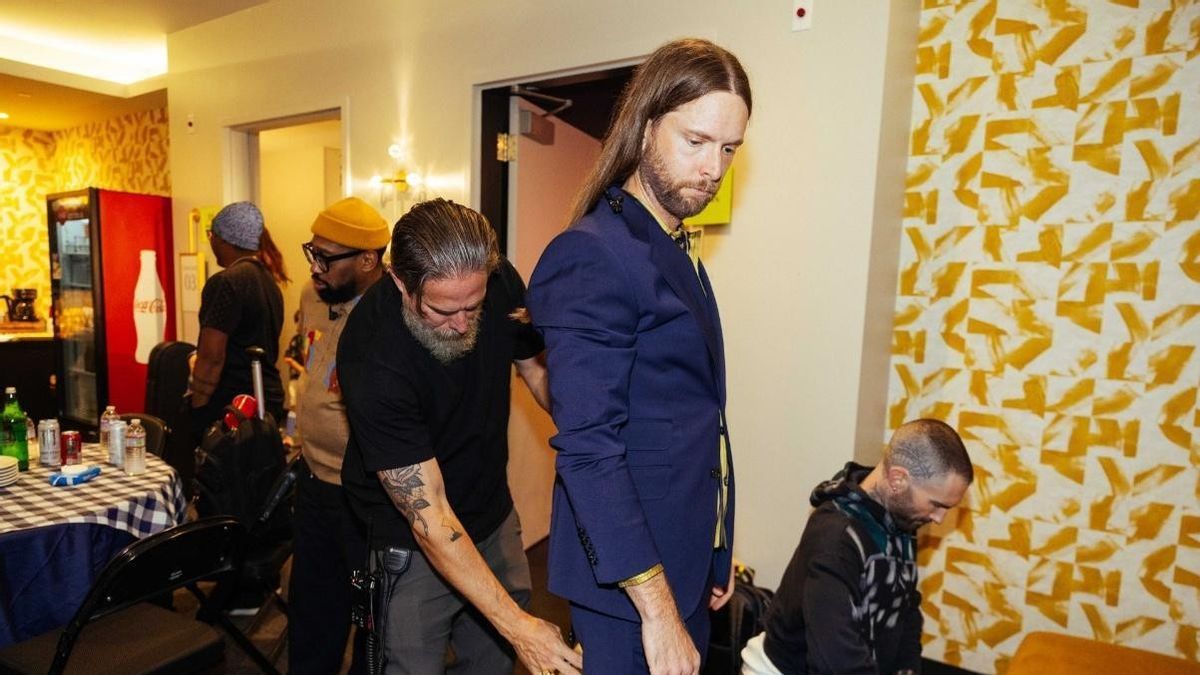


JAKARTA - The global concert audio industry is entering a new phase. Pop rock band Maroon 5 is one of the pioneers in this major transition, leaving the analog system and fully adopting digital wireless technology in their tour in 2025.
This change is not just a technical upgrade, but a strong signal that the analog era in the stage audio system - which has been the industry standard for decades - is beginning to be abandoned.
Behind this transformation is the figure of Dave Rupsch, an experienced monitor engineer who has worked with big names such as My Chemical Romance to Red Hot Chili Peppers.
For more than a decade, Rupsch has called digital in-ear monitor (IEM) systems a "white whale" - a huge goal that is difficult to achieve in the world of concert audio.
The main problem lies in the limitations of analog systems, especially in the increasingly dense UHF spectrum. Interference such as noise floor, interference, and frequency limitations are a separate pressure in large-scale production.
"Our team often experiences environmental factors such as noise floor and limited maneuvering space as additional psychological pressure on the job," said Rupsch.
Spectera and Audio Technology Leap
The solution comes via Sennheiser with the Spectera system, the world's first bidirectional wideband digital wireless technology.
Initially, the use of Spectera was only tested in a limited way during Maroon 5's tour. But the results were immediate. In a short time, the entire band switched to using the system.
Rupsch even joked, "In the Wild West, the first person to walk into a saloon door is usually the first to get shot!" - describing the initial caution in adopting new technology.
But those worries were gone in just a few minutes. "The 'trial' period was only about five minutes before Spectera was finally used at every tour show," he said.
Audio Quality Is Cleaner, Performers Are More Focused
The main advantage of this system is the elimination of analog artifacts such as noise, "swish", pop, or click that have been disturbing.
"The absence of analog RF artifacts allows performers to focus more on the subtle details in mixing," explained Rupsch.
The result is that musicians - including vocalist Adam Levine - claim to be able to hear their voices with the best clarity of their careers.
Production Efficiency and Stage Flexibility
In addition to sound quality, Spectera also changes the technical workflow. This system replaces the traditional BNC connector with Cat 5 cable, which is more flexible and easy to use.
The multi-antenna configuration allows the signal to remain stable even when the performer moves to various areas, including to the middle of the audience to the backstage.
In the arena tour, Rupsch used four antennas to ensure the connection remained seamless throughout the area. This strategy creates a stronger signal network and is adaptive to various physical obstacles.
Towards a New Industry Standard
Looking ahead, Rupsch plans to bring this system to a major stadium tour with My Chemical Romance in 2026, with a more complex configuration. For him, this technology is no longer just an innovation, but a necessity.
"We as engineers and RF coordinators have long been waiting for progress like this to materialize," he said.
With this success, the digital IEM system that has been considered a "dream" has finally become a reality. And if this trend continues, the stage of future concerts may be completely free of analog interference - cleaner, more stable, and of course... more pleasant to listen to, even for those standing in the back row
Follow VOI Whatsapp Channel
The English, Chinese, Japanese, Arabic, and French versions are automatically generated by the AI. So there may still be inaccuracies in translating, please always see Indonesian as our main language. (system supported by DigitalSiber.id)


