

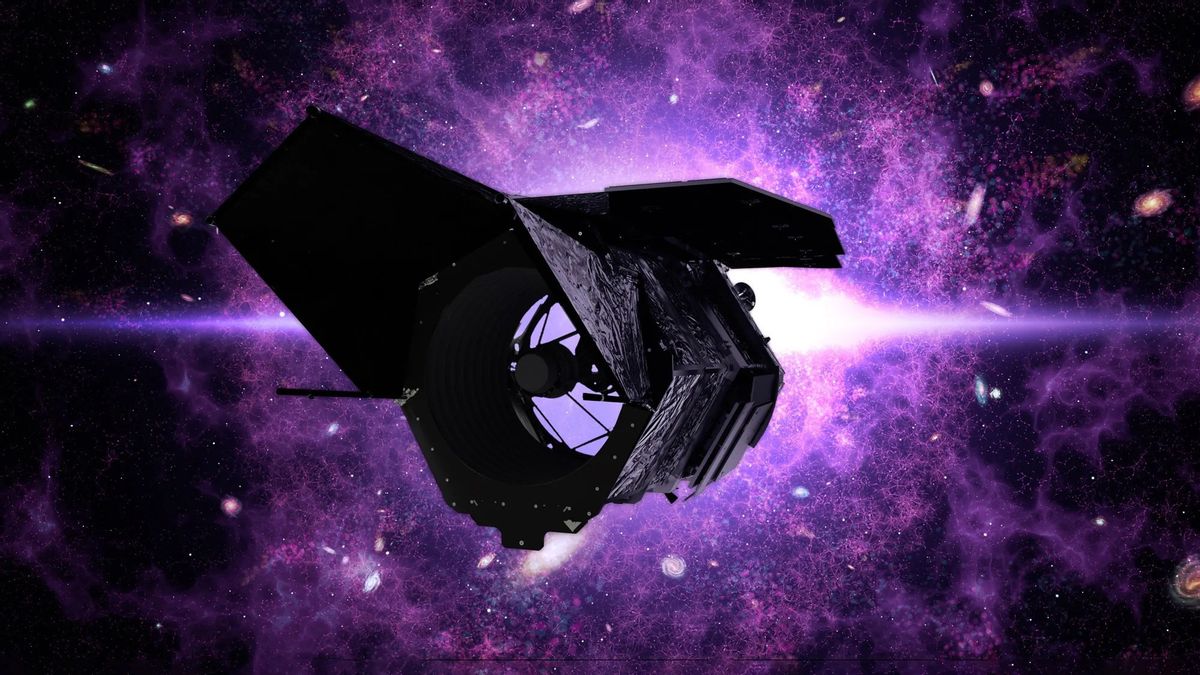


NASA revealed details of the mission of the Nancy Grace Roman Space Telescope while in space. This telescope will map the Milky Way Galaxy in detail.
This mapping will take 29 days over a two-year period. Although the ESA's Gaia spacecraft has mapped about 2 billion Milky Way stars, many parts of the galaxy are still hidden by thick dust.
To complement the mapping results, the Roman telescope will use its powerful infrared heat vision to penetrate the thick dust in space. That way, Roman can see what's behind it.
"It's amazing that we'll be able to see through the densest part of our galaxy and properly explore it for the first time," said Rachel Street, a senior scientist at the Las Cumbres Observatory, quoted from a NASA blog on Monday, December 15.
This mapping will cover almost 700 square degrees along the Milky Way's luminous band. Scientists estimate that this survey will map up to 20 billion stars. Roman will peer through the fog of star birth, or the so-called Cosmic Fog.
The telescope will observe millions of embryonic stars, newly formed stars still wrapped in dust, and toddler stars that emit unexpected light. These observations will provide a broader insight into the universe.
"This survey will study a huge number of stars in so many different stellar environments that we will sample every phase of a star's evolution," said Street.
In addition, Roman will study nearly 2,000 loosely bound young open clusters. This learning is done to understand how the spiral arms of galaxies trigger star formation.
This space observation will also map dozens of ancient ball clusters near the center of the galaxy to reconstruct the early history of the Milky Way. Roman is scheduled to take off in May 2027, but NASA is trying to launch it in the fall of 2026.
The English, Chinese, Japanese, Arabic, and French versions are automatically generated by the AI. So there may still be inaccuracies in translating, please always see Indonesian as our main language. (system supported by DigitalSiber.id)
Popular


