

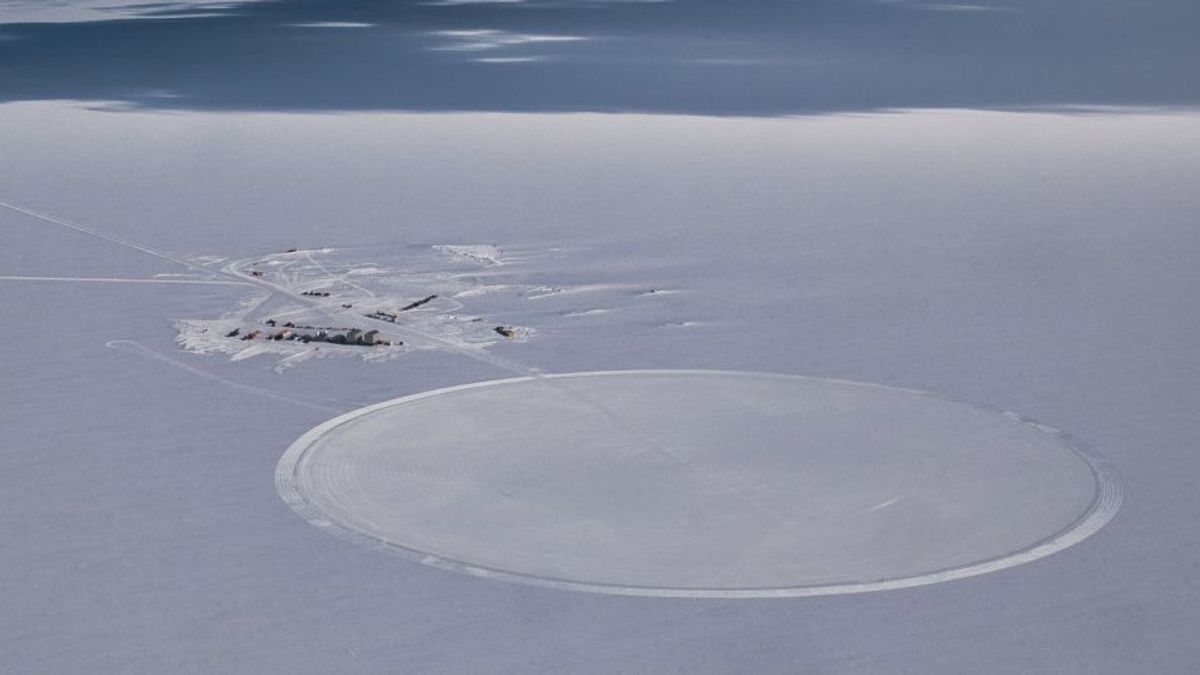


JAKARTA NASA will again hold the Scientific Balloon program in Space. This program will include two launches from the ice surface, precisely from NASA facilities near McMurdo Station.
The plan, this program will be launched in early December, but NASA has yet to reveal a date. The program this time was designed to support two scientific missions, namely the Charge for Ultra High Energy Observation (PUEO) and General Antiparticle Spectrometer (GAPS).
The first mission, PUEO, is the first balloon mission of NASA's Astrophysics Pioneers program. The program supports lower-cost astrophysical research. The PUEO payload is specifically designed to detect signals from neutrinos, high-energy particles traversing the universe.
The neutrino will bring important information about events that occur at a distance of billions of light years. During the mission, the payload will search for the radio signals produced when neutrinos from space hit Antarctic ice.
SEE ALSO:
-
 | EKONOMI
Harbolnas 2025, Pemerintah Targetkan Transaksi Tembus Rp35 Triliun
04 Desember 2025, 15:16 -
 | TEKNOLOGI
Terintegrasi dengan Privy, Tanda Tangan Digital di Microsoft Office Jadi Lebih Mudah
09 Desember 2025, 13:05 -
 | TEKNOLOGI
Telkomsel Luncurkan Implementasi Perdana Huawei RuralCow di Pulau Legundi
09 Desember 2025, 09:35 -
 | TEKNOLOGI
Elon Musk Serukan Pembubaran Uni Eropa Setelah X Didenda Rp2,3 Triliun
09 Desember 2025, 08:05
"The PUEO mission is basically like using Space ice as a big telescope," said Shawn Domagal-Goldman, acting director of NASA's Astrophysical Division, quoted on Tuesday, December 9. Shawn believes that this mission can help scientists understand how the universe works.
The second supported mission is GAPS, an experiment designed to help uncover the origins of dark matter. This material cannot be seen with the naked eye, but satisfies 80 percent of the total matter in the universe.
GAPS is developed to detect certain antimatter particles produced only when dark matter decays. Both of these charges will take advantage of zero-pressure balloons that are claimed to be suitable for long-term scientific missions.
The English, Chinese, Japanese, Arabic, and French versions are automatically generated by the AI. So there may still be inaccuracies in translating, please always see Indonesian as our main language. (system supported by DigitalSiber.id)


