
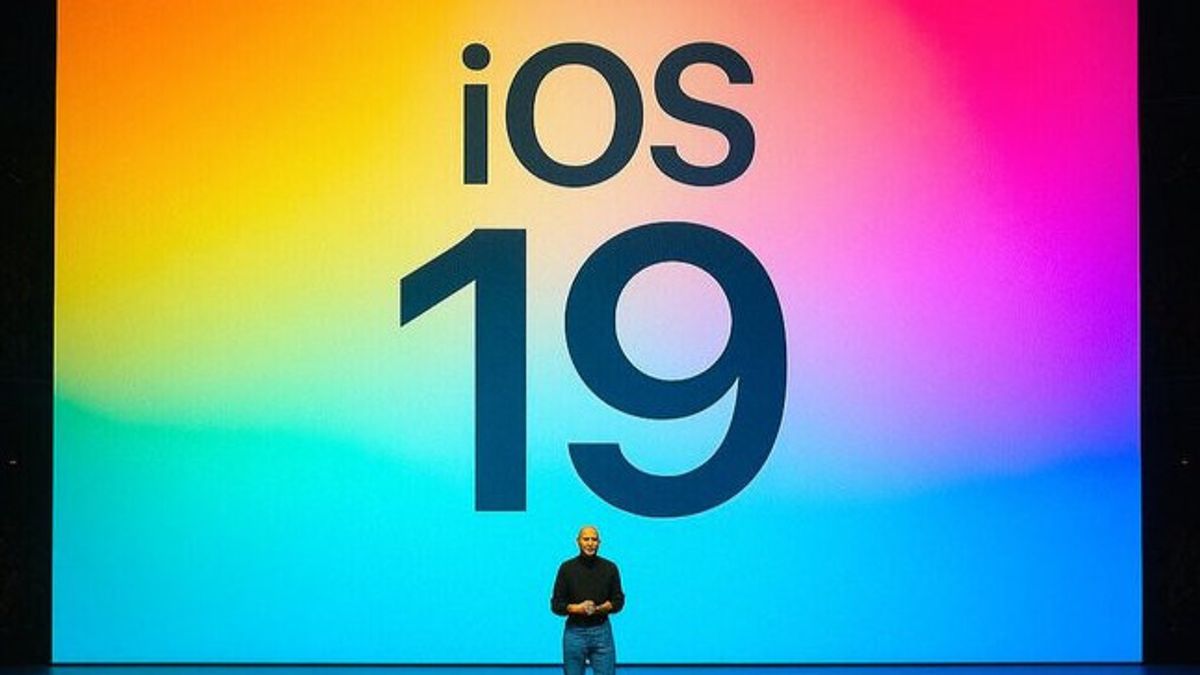


JAKARTA - The never-released version of iOS 19 finally surfaces through a rare iPhone prototype, giving an early picture of the operating system previously between iOS 18 and iOS 26 before Apple introduced the Liquid Glass design. These findings also provide clues about features that may be present on iOS 27.
At WWDC 2025, Apple introduced Liquid Glass, the controversial new design language for replacing the flat aesthetics that have been in use for years. At the same time, Apple jumped from iOS 18 directly to iOS 26, so the existence of iOS 19 seemed to just disappear.
Now, through a collector named Kyolet, AppleInsider reports it has gained exclusive access to EVT stage iPhone prototype photos running the InternalUI build iOS 19.0 which has never been seen by the public.
Unlike the iOS 26 final, this version of iOS 19 does not yet display the implementation of Liquid Glass which works, even when the Sensitive UI setting is enabled. A feature called Solarium' associated with the Liquid Glass design does look active in the Livability application, but the interface interface looks identical to iOS 18. This finding indicates that the visible version is the initial phase of iOS development, which was still called iOS 19.
SEE ALSO:
-
 | TEKNOLOGI
Komdigi dan UNP Tekankan Pembatasan Gawai untuk Anak Pascabencana Aceh dan Sumatera
07 Desember 2025, 16:45 -
 | TEKNOLOGI
Netflix Resmi Akuisisi Warner Bros Senilai Rp1.378 Triliun, Perkiraan Rampung Q3 2026
07 Desember 2025, 15:58 -
 | TEKNOLOGI
Cloudflare Tumbang Lagi untuk Kedua Kali, Ternyata Ini Penyebabnya
07 Desember 2025, 14:50 -
 | TEKNOLOGI
RI-Uni Eropa Sepakat Perangi Kekerasan Digital terhadap Perempuan dan Anak
07 Desember 2025, 13:42 -
 | TEKNOLOGI
Investor Institusional Meningkat, Tokocrypto: Fase Baru Pertumbuhan Pasar Kripto RI
07 Desember 2025, 12:22
However, the build keeps a number of internal references that provide clues about the features Apple is preparing for WWDC 2026 and even 2027. This is in line with how Apple is gradually developing features in the long term, with testing that could last for years before a function is really ready for publication.
In the Livability app on the prototype, there is a list of flag features scheduled for release in 2026 and the following year. Although it is not yet clear what specific features will be present, it can be seen that Apple is preparing upgrades for accessibility features, Messages, Photos, and the Wallet app. There are also plans for an update for CoreMedia, as well as changes to the Buddy Workout feature on Apple Watch.
In addition to feature instructions, the iPhone 16 Pro prototype also shows a mobile version of PurpleRestore 4, an internal Apple tool that has been found only on Macs. As the name suggests, Purple Store is used to restore Apple devices that use production fusion or development phase, as well as an internal virtual machine.
The existence of this mobile version makes sense and is in line with Apple's approach to increasingly centralizing device-to-device functions. For example, on iOS 18 Apple released a feature that allows users to restore iPhones using other devices around them.
Build iOS 19 also includes various Apple internal testing applications for Apple Intelligence, Private Cloud Compute, and Siri. The applications include settings for HomePod and other speakers, voice profiles, AI test results assessments, and various other utilities commonly used for feature evaluation before public release.
In terms of hardware, the discovery of the iPhone 16 Pro prototype also confirms that Apple uses many code names and placeholders before the official announcement for the release of iOS 26.
This is in accordance with AppleInsider's previous findings which show that Apple devices often use temporary names when they are still in the development phase. For example, the iPhone 16 Pro itself has the internal code name Diblo with the model number D93. Even the logo used in the early phase of development is often temporary, such as the placeholder logo found in the iPhone 14 Pro drop-test prototype.
The initial build of iOS 19 found also features an internal setting for Liquid Glass which was still an experimental option at that time. Photos and videos provided show that the unit has a unique model number starting with 994, a common marker for Apple prototype devices.
The device is also developed-fused, using development kernels as well as firmware basebandatures, which ensures that the device is truly Apple's internal unit.
Like the iOS 13 prototype, which once featured an email categorization feature years before its release, this iOS 19 prototype shows that Apple often tests features long before they are ready to be introduced to the public. Some features are finally released, while others may never have passed the prototyping phase like the Bongo project which was eventually canceled.
This finding is not only a unique piece of history about what is happening behind the iOS development screen, but also provides a small picture of the design direction and function that Apple may bring to iOS 27 and subsequent releases.
The English, Chinese, Japanese, Arabic, and French versions are automatically generated by the AI. So there may still be inaccuracies in translating, please always see Indonesian as our main language. (system supported by DigitalSiber.id)


