
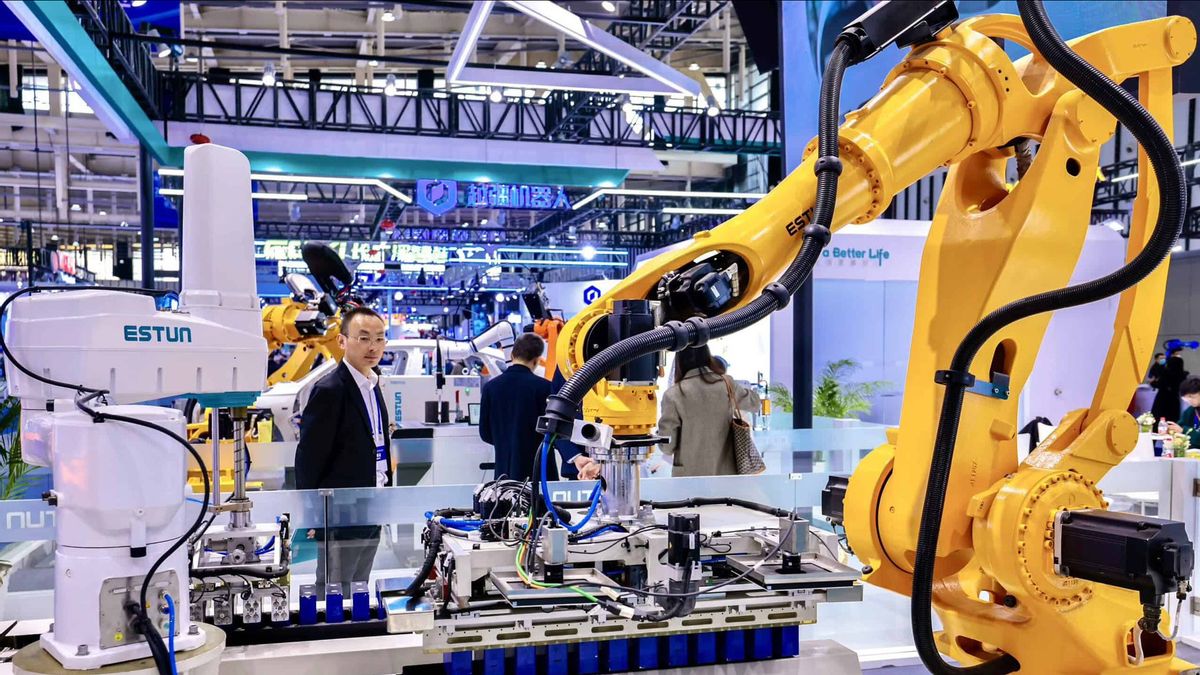


JAKARTA - China continues to lead the world in industrial robotics, setting a record 295,000 robots by 2024 alone. This accounts for more than half of the total global installation. This growth is part of a global increase in industrial robots, with a total installation of only 542,000 units worldwide, up 9% from 2023.
With the 2.03 million robots now operating, China has the world's largest industrial robotic fleet, deep ahead of Japan (450,000), the United States (400,000), and South Korea (392,000).
The widespread robot adoption helps China maintain high production efficiency in key industries such as automotive manufacturing, electronic assembly, and logistics. These machines handle tasks such as welding, relocation of heavy materials, and precision assembly, reducing dependence on human labor for repeative work.
SEE ALSO:
-
 | TEKNOLOGI
Samsung Gelar Galaxy Creator Land untuk Rayakan National Creator Day
08 Oktober 2025, 21:05 -
 | TEKNOLOGI
Samsung Siap Luncurkan Galaxy S25 FE dengan Penyimpanan 512GB, Catat Tanggalnya
08 Oktober 2025, 20:05 -
 | TEKNOLOGI
Cara Transfer Profil Netflix ke Akun Baru Tanpa Kehilangan Riwayat Tontonan
08 Oktober 2025, 19:32 -
 | TEKNOLOGI
WhatsApp Hadirkan Fitur Terjemahkan Pesan untuk iOS, Bahasa Indonesia Termasuk
08 Oktober 2025, 19:04

The increasing use of robots in China comes amid demographic challenges. In 2024, the country's population will drop by 1.39 million people, which contributes to labor shrinkage. Experts believe that automation is very important to maintain manufacturing output even though there are fewer workers.
Professor Gao Xudong of Tsinghua University noted that while simple and repeative tasks will be carried out by robots, complex and creative work will still depend on human skills.
Going forward, China faces a projected shortage of 50 million high-performance blue-collar workers by 2030, especially in areas such as robotic, programming, and maintenance operations. Labor training is considered critical to support the next phase of intelligent manufacturing.
China is not just the main consumer of robots; the country has also become the world's largest industrial robot producer, surpassing Japan by 2024. Its global production share increased from 25% by 2023 to a third by 2024.
Local manufacturing of key components such as motors, sensors, gears, and controllers allows Chinese companies to scale up robotics at a lower cost. Companies like Xiaomi and BYD operate fully automated "dark factories", demonstrating China's growing expertise in smart manufacturing.
China is also engaged in humanoid robotics. In 2024, Guangdong-based Tiantai Robot will receive orders for 10,000 humanoid robots, especially for elderly care services. This marks a shift from research and development to commercial deployment of human-like robots, signaling the next frontier in automation.
The surge in Chinese robotics highlights a significant gap between the country and other countries, especially the United States, which only installed 34,200 robots by 2024. Analysts warn that China's spread scale created a "crazy wheel effect", which resulted in valuable data to further refine AI and robotics. Experts say that the US should invest in physical robotics in addition to its AI software power to remain competitive in global manufacturing.
China's dominance in industrial robotics reflects the strategic use of automation to offset labor shortages, strengthen manufacturing, and lead innovations. Although robotic adoption is accelerating, the development of skilled workers remains essential to maintain long-term industrial growth.
The English, Chinese, Japanese, Arabic, and French versions are automatically generated by the AI. So there may still be inaccuracies in translating, please always see Indonesian as our main language. (system supported by DigitalSiber.id)
Most Popular Tags
#Prabowo Subianto #donald trump #2026 World Cup #Febrie Adriansyah #8791Popular


