
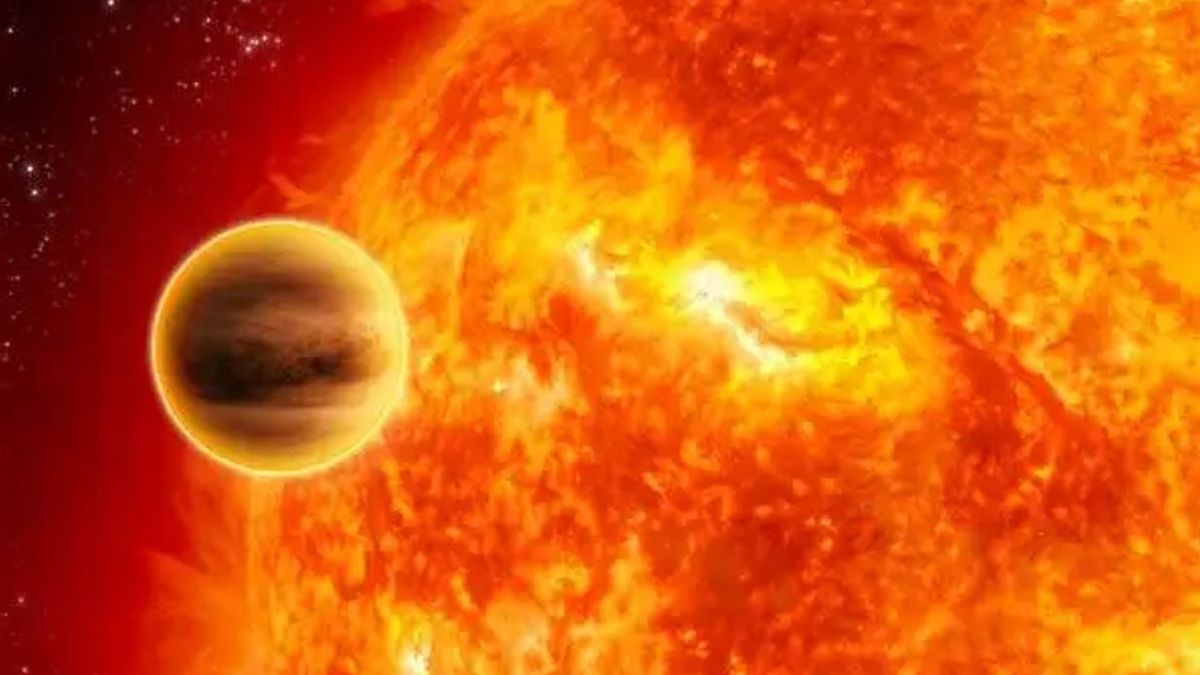


YOGYAKARTA - When imagining the hottest planet in the solar system, most people will probably immediately appoint Mercury. This is natural, because Mercury is the closest planet to the Sun, only about 58 million kilometers away.
However, the reality is not so. The hottest planet in the solar system is not Mercury, but Venus, which is actually in second place from the Sun with a distance of about 108 million kilometers. Why did this happen?
Venus is often referred to as Earth's twin because of its almost the same size and similar composition. However, the surface and atmosphere conditions of Venus are very much different from Earth.
The surface temperature of Venus can reach 471 degrees Celsius, hot enough to melt metals like lead and lead. This is what makes Venus the hottest planet in the solar system, even hotter than Mercury which is closer to the Sun.
This fact is quite surprising, considering that Venus' distance from the Sun is almost twice as far away as Mercury does. The Sun's light that Venus receives is also less if it is calculated based on the square law of distance. Then, how can Venus maintain such extreme temperatures?
The answer lies in Venus' thick atmosphere, which is mostly carbon dioxide (CO2), a greenhouse gas that traps heat. The atmosphere of Venus has a pressure about 92 times greater than Earth's atmosphere, equivalent to water pressure at a depth of nearly 1 km below sea.
The atmosphere is almost entirely made up of carbon dioxide, with layers of sulfic acid clouds reflecting light and heat.
The light of the Sun does penetrate Venus' atmosphere and is partly absorbed by the planet's surface. However, when this heat is reflected back as infrared radiation, greenhouse gases in the atmosphere capture and trap it, making the heat unable to get out into space. As a result, the temperature continues to rise and stabilize at a very high level.
More surprising, the surface temperature of Venus is relatively evenly flat, both on the side facing the Sun and on the dark side. This is because its thick atmosphere also functions to spread heat throughout the planet's surface.
Then, why does Mercury get closer to the Sun not become the hottest planet? Mercury does not have a significant atmosphere. It only has a thin exosphere, which is a very rare layer of gas and barely has the ability to trap heat.
SEE ALSO:
-
 | TEKNOLOGI
UScellular Resmi Bergabung dengan T-Mobile, Perluas Jaringan untuk Pelanggan
03 Agustus 2025, 16:45 -
 | TEKNOLOGI
Pemerintah Tetapkan Pajak Baru Kripto, Tokocrypto Soroti Keadilan dan Insentif
03 Agustus 2025, 14:07



For this reason, the temperature in Mercury varies widely between day and night. During the day, the temperature can reach 430 degC, but once the night arrives, the temperature can drop drastically to -180 degC. The absence of the atmosphere means that nothing is holding back the heat from the Sun, so Mercury heats quickly, but also cold quickly.
With this comparison, it is clear that the atmosphere is a key factor in determining the surface temperature of the planet, not merely the distance from the Sun.
Venus And Earth
Launching the BBC, scientists estimate that billions of years ago, Venus may have conditions similar to Earth. It is possible that liquid water has flowed on the surface of Venus, and its atmosphere is not as dense as it is today.
However, over time, uncontrolled greenhouse effects began to occur. The temperature increases, the water evaporates, and the water vapor (which is also greenhouse gas) exacerbates atmospheric conditions. The more heat is trapped, and the more unstable the planet's climate is.
Venus is not only attractive as an astronomical object, but also an important warning to humans on Earth. We know that carbon dioxide and other greenhouse gases also exist in Earth's atmosphere, and as a result of human activity, such as the ever-increasing burning of fossil fuels and deforestation.
Although the Earth is still far from extreme conditions such as Venus, rising global temperatures and climate change have begun to be felt. Phenomenon such as polar ice disbursement, extreme drought, and stronger tropical storms signaled that we cannot ignore the impact of global warming.
The English, Chinese, Japanese, Arabic, and French versions are automatically generated by the AI. So there may still be inaccuracies in translating, please always see Indonesian as our main language. (system supported by DigitalSiber.id)


