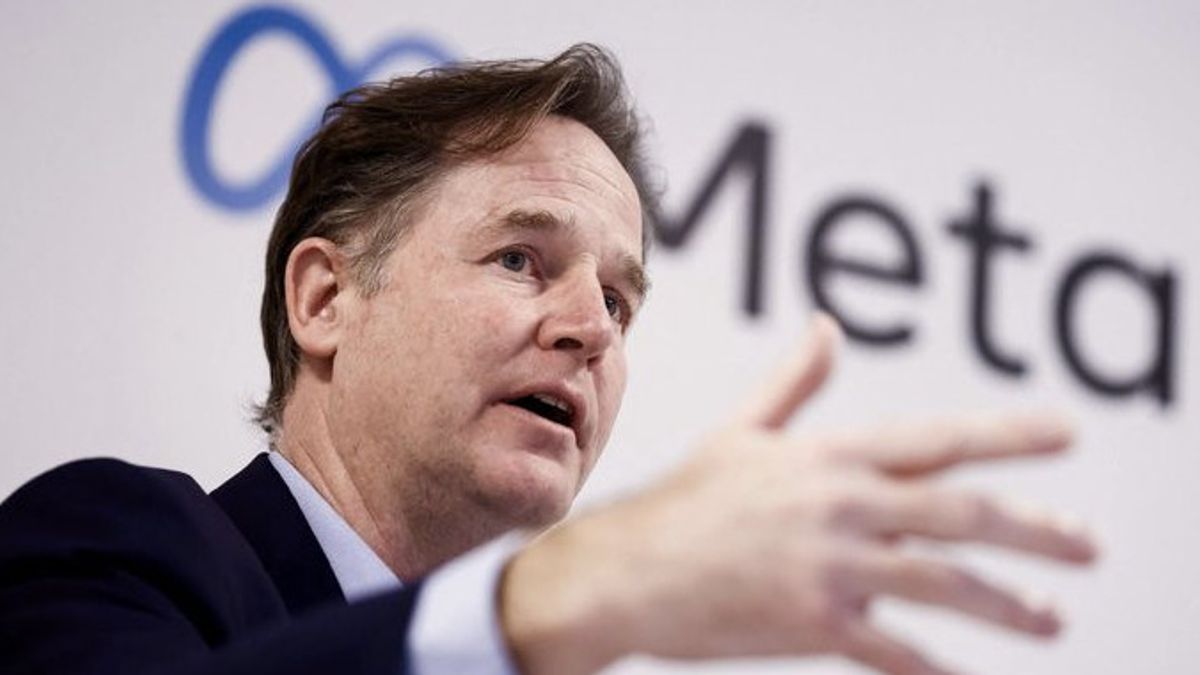


JAKARTA - Nick Clegg, former British Deputy Prime Minister and former Head of Global Meta Affairs, made a controversial statement regarding the artificial intelligence regulation (AI) being considered in the UK. At an event to promote his latest book, Clegg said that the obligation to seek permission from copyright owners before using their work to train AI models could effectively shut down the UK's AI industry overnight.
According to The Times report, Clegg admits that the creative community deserves the right to vote so that their work is not used. However, he called the request for approval before the data was trained "unrealized."
"I don't know how you can get permission from everyone first. I don't see how it can be implemented," Clegg said.
He added that if only the UK implemented such rules while other countries did not, then the local AI industry would lose competitiveness and could be completely paralyzed.
Controversy About Data Transparency To Train AI
Clegg's comments come amid debates in the UK parliament over the amendments to the Data Bill (Use and Access). These amendments aim to increase transparency, requiring tech companies to disclose what copyrighted works are used to train their AI models.
The amendment received broad support from the creative industry. Hundreds of artists, writers, designers, and journalists, including Paul McCartney, Elton John, Dua Lipa, and Andrew Lloyd totaled an open letter supporting this regulation.
SEE ALSO:





However, on Thursday 22 May, lawmakers rejected the amendment. British Technology Minister Peter Kyle stated that the UK economy needed the success of both the AI and creative sectors simultaneously. He stressed the importance of balance, not unilateral restrictions.
Beeban Kidron, a member of the House of Lords and film producer, is the figure behind the proposed amendment. In the opinion contained in The Guardian, Kidron argues that transparency will strengthen copyright law enforcement. According to him, AI companies tend to be more careful if they are required to disclose what content they use.
"This struggle is not over yet," said Kidron, referring to a follow-up session on the discussion of the bill that will return to the House of Lords in early June.
Nick Clegg's statement highlights the tension between technological advances and the protection of creator rights. While the AI industry requires large amounts of data to train their models, creative industry players demand transparency and copyright protection. This debate is likely to continue as the UK seeks the best formula to balance innovation with justice for the owner of the work.
The English, Chinese, Japanese, Arabic, and French versions are automatically generated by the AI. So there may still be inaccuracies in translating, please always see Indonesian as our main language. (system supported by DigitalSiber.id)
Most Popular Tags
#Prabowo Subianto #donald trump #firearm #8791 #giias 2026Popular