
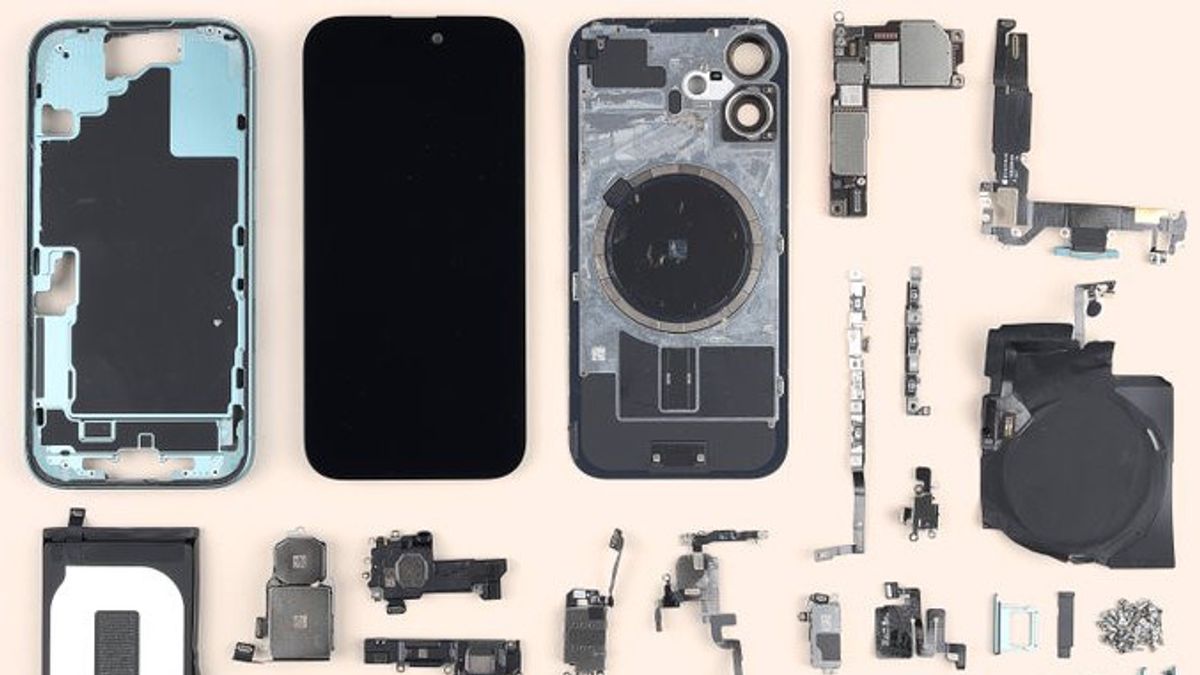


JAKARTA - The idea of an iPhone made in the United States continues to be a topic of conversation, although Apple has repeatedly explained that it is unrealistic. The Financial Times (FT) recently released an in-depth report revealing why the iPhone components claimed to be "US-made" were not actually fully produced there, and why there were 2,700 reasons that made this idea impossible to realize.
Fantasy about an iPhone made by the US is actually not new. This idea first surfaced in 2016 when Donald Trump urged Apple to move its production to the US.
At the time, the Mahasschusetts Institute of Technology (MIT) carried out calculations and found that assembling iPhones in the US would not affect much of the price, because the process would be carried out automatically so that it hardly create new jobs in the US.
Since then, various analyses and statements from related parties have continued to strengthen the impracticality of this idea. Apple's own supplier considers Trump's request unrealistic, while Apple has only applied for permission to produce less significant goods in the US. In fact, Foxconn's plans to build an iPhone factory in the US were doubtful following contradictory statements from the company's chairman.
The FT conducted a deeper analysis and found that the latest iPhone consisted of 2,700 different components, many of which were not visible in plain view because one part could consist of dozens of small elements. More than 700 production sites are spread across various countries to meet the needs of these components, and only 30 Apple suppliers are completely outside China.
This fact is the main argument why US-made iPhones are difficult to materialize. Component manufacturers in China are located close together and have formed a highly integrated supply chain. It took tens of years for China to achieve this efficiency, and it was impossible for the US or other countries to compete with it in a short time.
Indeed, some iPhone components such as screenglass and Face ID lasers are produced in the US. However, the FT reveals that the reality is not that simple. Screenscreens may be made in the US, but the technology that makes them into touchscreens such as backlight and an interactive layer is just produced in South Korea and assembled in China.
SEE ALSO:
-
 | TEKNOLOGI
Jangan Timbun Riwayat Pencarian Google Search, Ini yang Bakal Terjadi
28 April 2025, 19:35 -
 | TEKNOLOGI
RRQ Kazu Jadi Tim Indonesia yang Masuk Lima Besar di Week 1 FFWS 2025 Spring
28 April 2025, 18:09


From a political point of view, this plan also makes no sense. Although the Trump administration continues to urge Apple, the process of moving all production to the US will take a very long time "it may not even end before the president's term ends." Andy Tsay, professor of information systems at Clara University, highlighted the instability of US policy as the main barrier.
"System di AS saat ini, di mana segala kebijakan bisa berbalik setiap empat tahun, tidak mendukung investasi bisnis jangka panjang. Perusahaan dan investor membutuhkan kepastian yang lebih stabil," ujarnya.
Thus, although the discourse of the US-made iPhone continues, the complexity of global supply chains and political uncertainty make it a dream far from reality.
The English, Chinese, Japanese, Arabic, and French versions are automatically generated by the AI. So there may still be inaccuracies in translating, please always see Indonesian as our main language. (system supported by DigitalSiber.id)
Most Popular Tags
#Prabowo Subianto #donald trump #firearm #8791 #giias 2026Popular


