

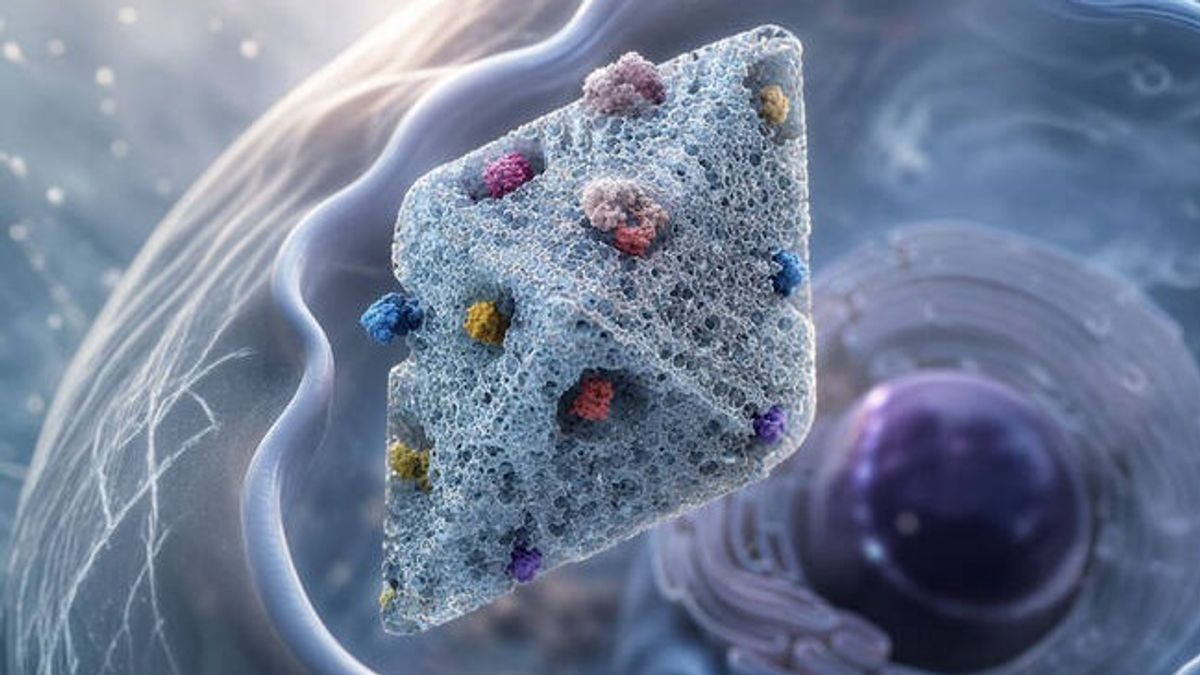


JAKARTA - Scientists at King Abdullah University of Science and Technology or KAUST have developed nanoparticles that can carry six proteins into living cells. Citing an Arab News report, Friday, May 15, the proteins then work together like a mini "drug factory" inside the cell.
The system produces violacein, a bioactive compound that is being studied for therapeutic use. The findings were published in the journal Advanced Materials.
The idea is that drugs are not only delivered to the body, but can be produced directly at the point of need. If it is eventually developed, this type of therapy can be more targeted and reduce side effects on healthy tissues.
Researchers pack six proteins into a porous sponge-like particle called a metal-organic framework, or MOF. Simply put, MOFs are tiny, highly porous frameworks that can carry certain molecules into cells.
The structure is called a synthetic organelle because it mimics the function of organelles, which are small parts inside the cell that carry out specific tasks.
Once inside the mammalian cell, the six proteins remain active. They work in sequence to convert simple amino acids into violacein.
According to the report, this is the most complex multiprotein system that has so far been successfully incorporated into a living cell. Researchers call it the first example of a "protein pathway transplant".
"It's a bit like shooting at the moon," said Raik Grunberg, KAUST senior research scientist.
Grunberg said that delivering a single protein into a cell is difficult. Therefore, bringing a single intact protein system into a human cell as a functional unit is an important achievement.
Niveen Khashab, KAUST professor of chemical sciences, said the team had faced a major obstacle because the usual MOF material made the protein lose activity.
"By engineering a more porous, sponge-like framework, we were able to create an environment where the system could finally work as intended," said Khashab.
The researchers say the platform is adaptable. Scientists can regulate the way proteins interact inside cells, opening up the possibility of programmed therapies for specific diseases.
Stefan T. Arold, KAUST bioscience professor, said the project demonstrates the importance of combining biological and material science expertise in the search for new therapeutic approaches.
However, this research is still in the early stages. The system still needs to be tested further before it can be used clinically.
The KAUST team plans to test it in animal models to assess its therapeutic potential. This research opens up new possibilities that one day, a treatment compound can be made directly in the diseased tissue, with fewer side effects on other parts of the body.
The English, Chinese, Japanese, Arabic, and French versions are automatically generated by the AI. So there may still be inaccuracies in translating, please always see Indonesian as our main language. (system supported by DigitalSiber.id)
Most Popular Tags
#Prabowo Subianto #donald trump #firearm #8791 #giias 2026Popular


