
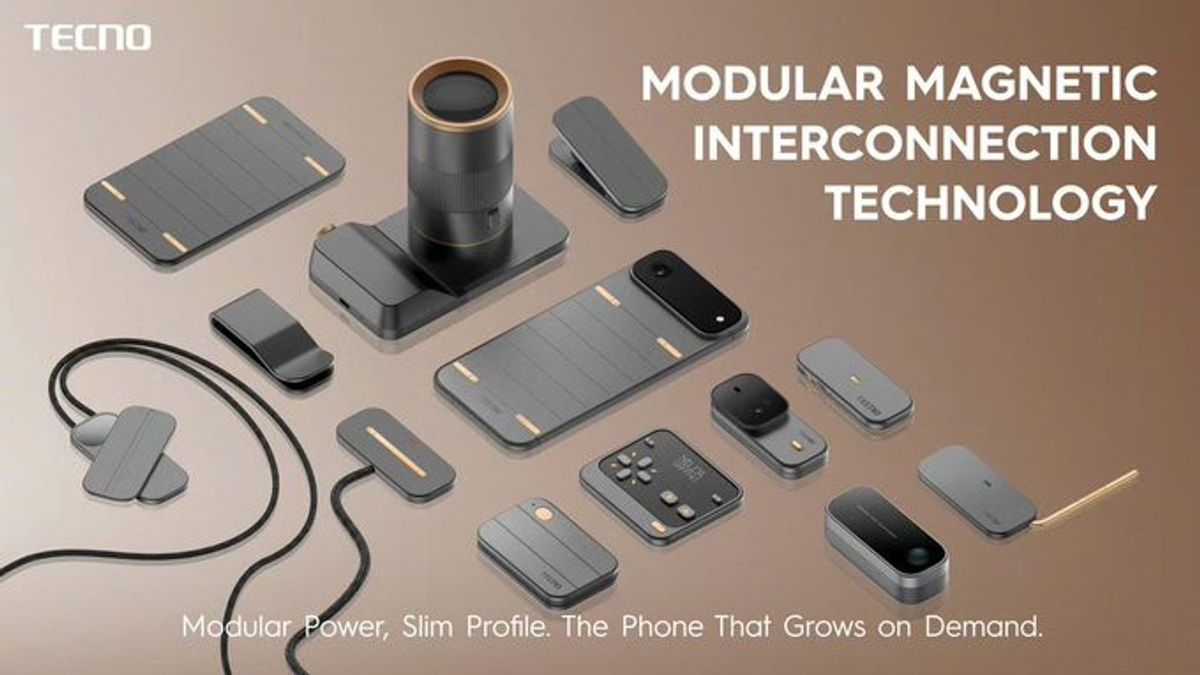


JAKARTA - Ahead of the 2026 Mobile World Congress, Tecno introduced a concept of a super thin modular phone with a thickness of only 4.9 mm. This device is built on a new system called Modular Magnetic Interconnection Technology, which is designed to redefine the way hardware expands on smartphones.
The Tecno Modular Phone concept carries a metal frame with a matte glass back panel that is visually divided into eight modular zones. These zones serve as a guide for installing magnetic accessories. Instead of large and heavy modules like the old generation modular approach, Tecno chose a slim and practical hot-swap format.
Some of the modules introduced include an ultra-thin 4.5 mm power bank, an action camera module for alternative shooting angles, and a telephoto lens module that uses the phone screen as a live viewfinder. This approach allows for increased functionality without turning the device into a technological "brick".
Technically, this modular system uses a combination of rectangular magnet arrays and pogo-pin connectors for power supply. Pogo-pins are small spring-loaded metal pins commonly used for power and data transfer in precision devices. In this concept, the connector helps maintain the efficiency of the electric current while managing heat better than some old modular prototypes.
Communication between modules and main devices is done through a combination of Wi-Fi, Bluetooth, and mmWave. mmWave or millimeter wave is a high-frequency spectrum that allows very fast data transfer over short distances. In this context, the technology can help camera modules or AI accessories process data with low latency.
Tecno showcases this concept in two design variants: the ATOM Edition and the MODA Edition. Both highlight a futuristic aesthetic that still maintains portability as a top priority.
Strategically, this modular approach tries to answer the modern smartphone dilemma: how to add capabilities - whether AI computing, long-distance photography, or battery life - without making the device thicker and heavier. Previous history of modular phones shows that consumers are reluctant to accept ergonomic compromises for flexibility.
The Tecno concept is still a prototype, but its approach feels more realistic than the modular experiment a decade ago. With a base thickness of 4.9 mm, the company seems to say: flexibility does not have to be synonymous with design compromise.
While the old-school modularity sounds like an ambitious science project that's too early, this latest version feels more like an adaptive evolution. In an era when smartphones are becoming more homogeneous, experiments like this serve as a reminder that the shape of the device has not reached the finish line. Sometimes innovation is not about adding features to one box, but giving users the option to put them together themselves
The English, Chinese, Japanese, Arabic, and French versions are automatically generated by the AI. So there may still be inaccuracies in translating, please always see Indonesian as our main language. (system supported by DigitalSiber.id)
Most Popular Tags
#Prabowo Subianto #donald trump #firearm #8791 #giias 2026Popular


