

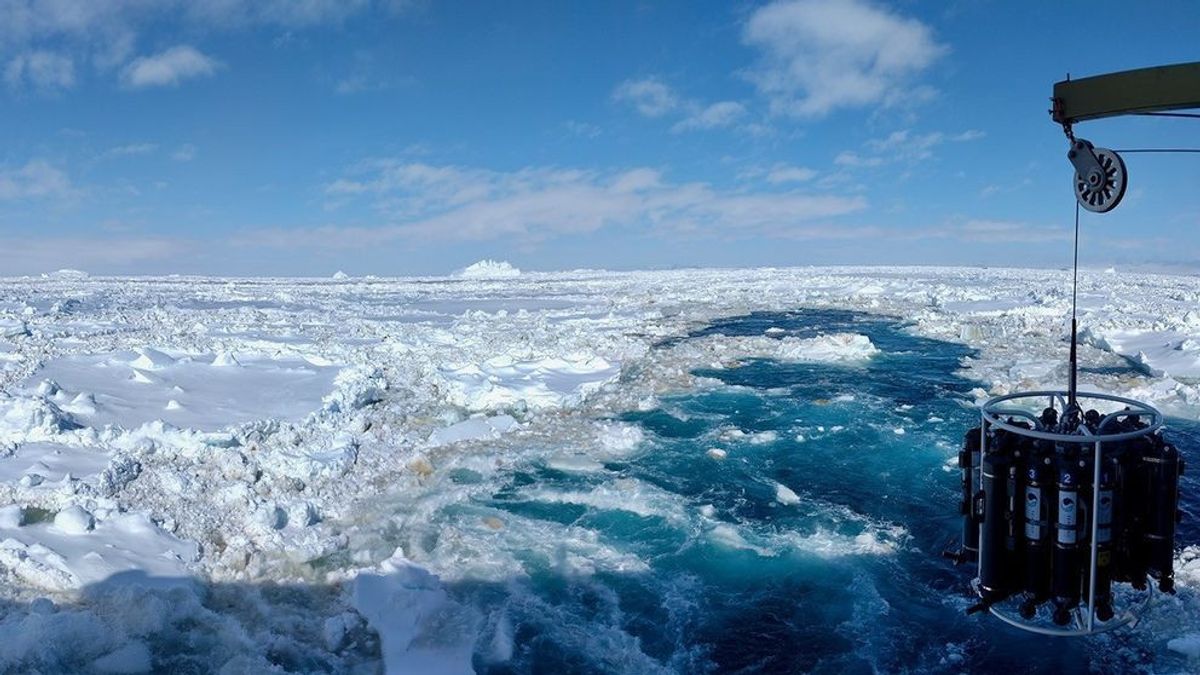


NASA and the University of Maryland researchers have collected water samples from the Antarctic sea. These samples will be studied to search for life beyond Earth.
Antarctica was deliberately chosen by scientists because the state of the sea water was considered the most similar to the conditions of the oceans outside Earth. This sample is believed to help scientists in finding potential life on ice planets such as Jupiter and Europa.
Scientists involved in this research believe that there are oceans of water hidden under the thick ice layer on a number of planets or moons in the solar system. This is supported by the discovery of carbon, nitrogen, and other energies in various space objects.
These compounds are the basic ingredients of life. This finding strengthens the belief that life exists on other planets, but scientists have not found this life to date.
This is because it is difficult to bring samples from outer space back to Earth. Meanwhile, the 'kriovolcanism' phenomenon on Enceladus, a moon of Saturn, which makes water under the surface erupt into space can be taken using a rover robot.
However, the return process is more complex than imagined. The journey from the sea on Enceladus to the vacuum of space can change or eliminate signs of life such as organic molecules.
Mariam Naseem and Marc Neveu, researchers who took samples in Antarctica, will study how seawater changes when it freezes in space. They will use a special simulator for their scenes.
However, to study this, they need natural samples from the dark and isolated environment on Earth so that their research results are more accurate. Therefore, they took water samples from the Antarctic ocean.
The research team has successfully taken samples of the Circumpolar Current at a depth of more than 1,100 meters right on New Year's Eve. Now, the samples are in the Maryland laboratory.
In the laboratory, samples will be divided into two parts to be analyzed directly and injected into a space simulator machine. Special chromatography techniques will be used to track changes in salts, amino acids, and fatty acids in the water.
The results of this research will help NASA determine how eruptions in space change the original marine material. These findings are expected to help scientists in detecting life beyond Earth.
The English, Chinese, Japanese, Arabic, and French versions are automatically generated by the AI. So there may still be inaccuracies in translating, please always see Indonesian as our main language. (system supported by DigitalSiber.id)
Most Popular Tags
#Prabowo Subianto #donald trump #Febrie Adriansyah #8791 #giias 2026Popular


