
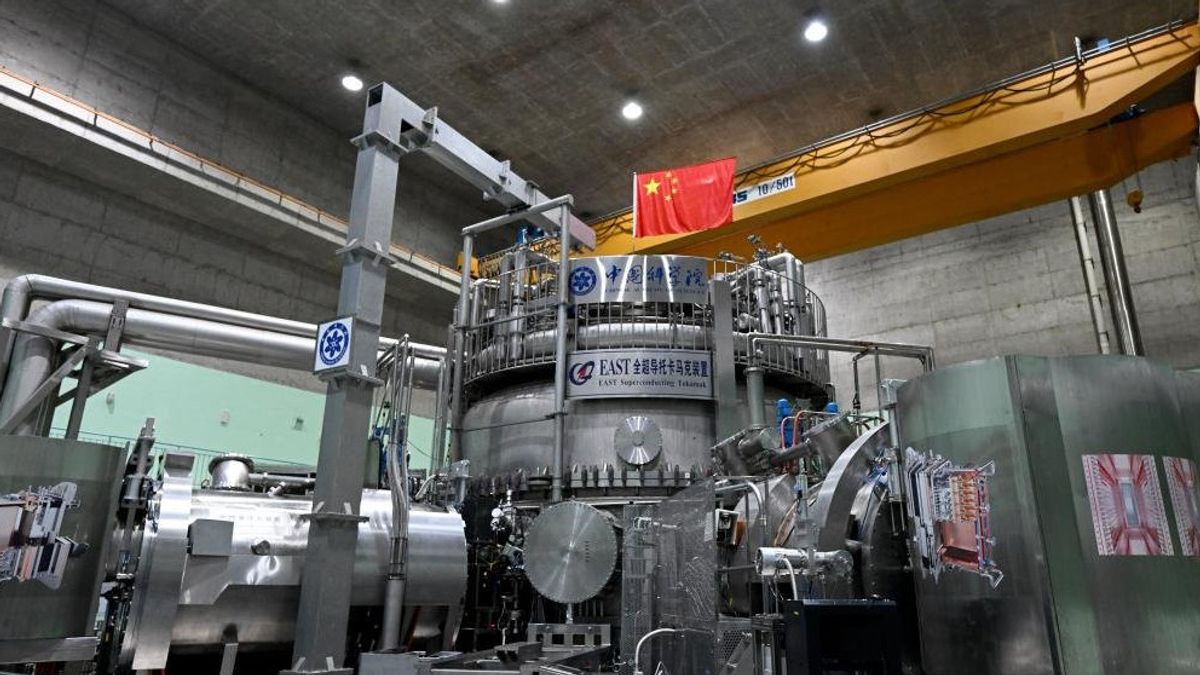


China has again made significant progress in the development of nuclear fusion energy. Researchers working on the Experimental Advanced Superconducting Tokamak (EAST), or often nicknamed the "artificial sun".
China has successfully operated the reactor beyond the plasma density limit that has for decades limited fusion experiments around the world. This achievement is considered to increase the efficiency of fusion reactors in the future.
EAST is a tokamak reactor located in Hefei and uses superconducting magnets to hold a plasma at very high temperatures. In the principle of fusion, the higher the plasma density, the greater the chance of a fusion reaction.
However, in most tokamaks, excessive density increases actually trigger instability, causing the plasma to collapse and come into contact with the reactor walls. This limit is widely known as the Greenwald limit.
The EAST research team assessed that the problem is not solely at the plasma density level. Researchers from the Institute of Plasma Physics, Chinese Academy of Sciences, found that the density limit is closely related to the influx of impurities into the plasma, in particular, metal particles detached from the reactor's inner wall. Tungsten, a material widely used in fusion devices, was identified as one of the main contributors to such impurities.
To understand and control this phenomenon, the researchers developed a model named Boundary Plasma-Wall Interaction Self-Organization (PWSO). This model was then tested directly on EAST by combining electron cyclotron resonance heating and the initial charged gas startup method. The approach was shown to be able to reduce the impact of tungsten on the plasma edge.
With more controlled impurity levels, the plasma was able to operate in a stable condition that the researchers called the "density-free zone". In this condition, the reactor was able to exceed the traditional density limit without triggering disturbances or instabilities. Experimental results also showed a strong consistency with the predictions of the PWSO model.
This finding has been published in the journal Science Advances and is considered to provide new guidance for the design of future high-density fusion reactors. Although a commercial fusion power plant is still a long-term goal, this achievement is considered to be able to answer one of the main practical challenges that have so far hindered the development of fusion technology with magnetic confinement.
The English, Chinese, Japanese, Arabic, and French versions are automatically generated by the AI. So there may still be inaccuracies in translating, please always see Indonesian as our main language. (system supported by DigitalSiber.id)


