
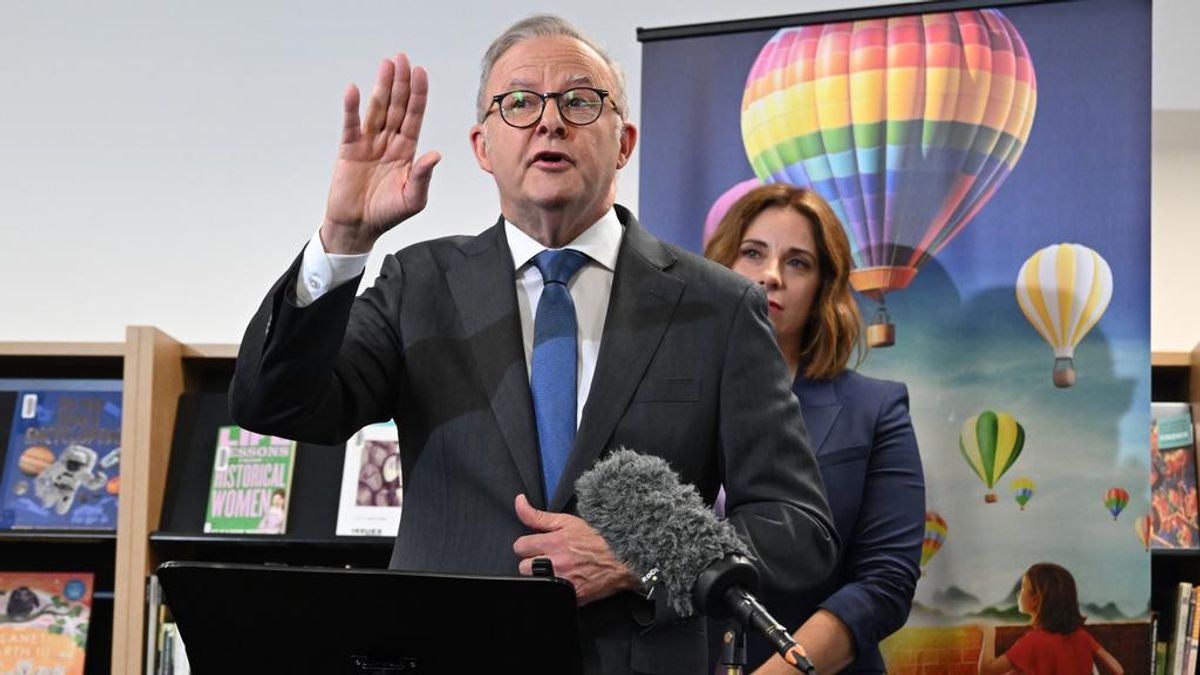


JAKARTA - Australian Prime Minister Anthony Albanese continues to defend the policy of banning the use of social media for citizens under 16 years. However, the country's timeline in the last two days has been filled with children who claim to be actively playing TikTok, Instagram, and YouTube.
Albanese said the initial phase of implementation would be a mess, but insisted the rule was designed to save the lives of a psychologically vulnerable young generation.
The ban, which has been in effect since Wednesday, December 10, requires ten of the largest platforms starting from TikTok, Meta's Instagram, to Alphabet's YouTube to block underage users or face fines of up to USD 49.5 million, equivalent to around IDR 549 billion. The government recognizes the platform needs time to prepare an age verification system, but ensures that the youth account cleaning process continues.
SEE ALSO:
-
 | TEKNOLOGI
Gim Petualangan 3D Big Hops akan Dirilis untuk PC dan Konsol pada 12 Januari
11 Desember 2025, 18:35 -
 | TEKNOLOGI
Makan Korban Lagi, Starbase Milik SpaceX Diselidiki Badan Keselamatan Kerja AS
11 Desember 2025, 18:05 -
 | TEKNOLOGI
Komdigi Fokuskan Layanan Internet Gratis untuk Daerah Terisolasi Banjir
11 Desember 2025, 17:05 -
 | TEKNOLOGI
YouTube Luncurkan Paket Langganan YouTube TV Baru, Kasih Lebih Banyak Genre
11 Desember 2025, 16:31

Albanese said in an interview with FOX Melbourne that closing more than one million accounts in one day is clearly not a simple task. He considered this move to be a global precedent because a number of countries including France, Denmark, Malaysia and the United States had expressed interest in imitating the Australian model. US Republican Senator Josh Hawley even immediately praised the policy.
Australian eSafety commissioners have asked all platforms to report the number of user accounts under 16 years before and after the rules apply. Australian Communications Minister, Anika Wells, emphasized that this step is important to ensure transparency and effectiveness of implementation.
Meta remains objected and reminded that age policy has the potential to push teens to poorly monitored internet corners. The company called interest in complying with the rules minimal so that the impact could be inconsistent. TikTok and Snap declined to comment, while YouTube, X, Twitch, Reddit, and Kick have not responded.
On the other hand, a wave of global reactions has emerged. US psychologist Jonathan Haidt, whose book, The Anxious Generation, became one of the main references to Australia's public debate, immediately appreciated Canberra's move through social media. UNICEF reminds that age regulations cannot be a single solution without improving platform design and content moderation.
Albanese, while visiting a school in Canberra, stated that the learning environment will be more conducive because students are not constantly fixated on gadgets. However, Google data shows VPN searches in Australia surged to their highest point in a decade. Free VPN provider hide.me recorded a 65 percent jump in visits before the rules came into effect.
While all platforms that enter the list must previously comply with these rules, a number of applications that are not covered by the ban actually skyrocket in downloads. The government emphasized that the list of platforms is dynamical' and can be expanded. Lemon8, an application belonging to ByteDance, immediately increased the minimum age limit to 16 years.
A new app called Yope claims fast growth of up to 100,000 users in Australia, with about half of them over 16 years of age. The company said it had notified regulators that its platform was more like a private messaging service than social media, so it was not included in the cover of the ban.
The direction of this policy story is clearly still moving, and the world is paying attention to how Australia's giant experiments are dealing with youth creativity that is too agile to just block.
The English, Chinese, Japanese, Arabic, and French versions are automatically generated by the AI. So there may still be inaccuracies in translating, please always see Indonesian as our main language. (system supported by DigitalSiber.id)


