
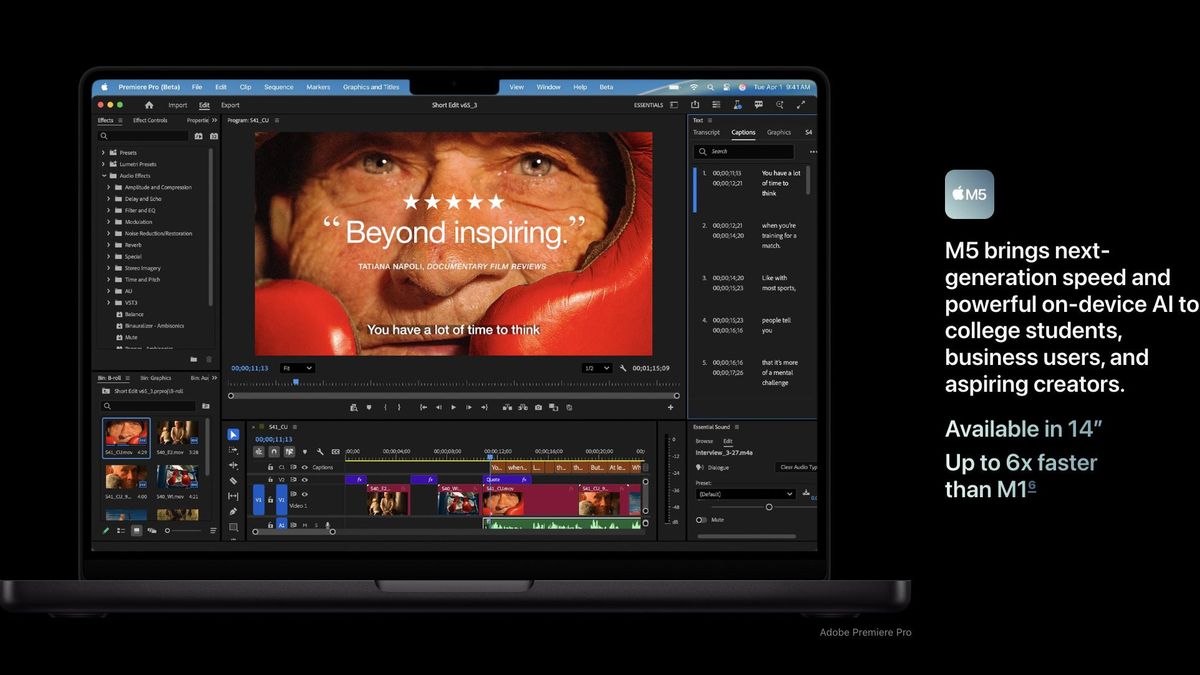


JAKARTA - Apple has again attracted attention with the launch of the MacBook Pro M5. Although its appearance has barely changed from the 2024 version, the deep demolition by iFixit reveals that this Cupertino-based company has actually made a number of important improvements to the inside, especially in terms of ease of improvement.
The iFixit team on Friday, October 24, released the results of a teasedown on the 14-inch MacBook Pro M5. At first glance, the design of this laptop seems identical to its predecessor who used the M4 chip. However, when the bottom of the casing opens, it can be seen that Apple is inserting some fine changes that show a new direction: it's a little easier to fix.
This change may be small, but illustrates Apple's move that is starting to pay attention to the engineering community and users who like to dismantle their own devices.
One of the biggest surprises came not from the hardware, but from the document. For the first time, Apple released an official repair guide on the same day as the product launch. In the MacBook Pro M5 guide, the first step emphasized is to unplug the battery management system (Battery Management System) cable before serving an important safety measure to prevent a short circuit.
SEE ALSO:
-
 | TEKNOLOGI
Bikin Konten Unik, Begini Cara Pakai Fitur Reverse Video di Aplikasi CapCut
26 Oktober 2025, 19:15 -
 | TEKNOLOGI
Halo: Campaign Evolved akan Dirilis 2026, Remake Penuh dengan Visual 4K Baru
26 Oktober 2025, 18:15 -
 | TEKNOLOGI
Teknologi Robotika Kolaboratif dalam Manufaktur: Keunggulan dan Manfaat Penerapannya
26 Oktober 2025, 18:05 -
 | TEKNOLOGI
Instagram Luncurkan Fitur Watch History untuk Temukan Riwayat Tontonan Reels
26 Oktober 2025, 17:17 -
 | TEKNOLOGI
Kawasan Indo-Pasifik Hadapi Peningkatan Risiko AI pada Infrastruktur Penting
26 Oktober 2025, 16:24
This move has actually been recommended by iFixit for a long time, but only now does Apple officially include it in its guidelines. This signal shows that the company is starting to recognize the increasing number of independent users and technicians who repair their own devices.
In terms of components, the most noticeable increase is in the battery system. The MacBook Pro M5 uses a 6-cell battery with a capacity of 72.6-year-old logistics the same as the previous model but with a slight change in the frame structure at the inside.
Now technicians no longer need to remove the trackpad to reach the adhesive tab below the middle battery cell. The tab serves to pull the battery out without having to use a solvent liquid or a prying device. While it still requires accuracy, this new method saves time and risks of damage.
However, the battery remains integrated with the top frame (top case), so it is not fully modular.
iFixit also found that most of the ports and cooling fans are modular in nature, meaning they can be replaced separately if they are damaged. This is a positive step, at least theoretically.
Unfortunately, in practice, almost all of these components are hidden under the main logic board (logic board). To achieve this, technicians must go through a "marathon releasing screws", unplugging cables, metal retaining, and heat shielding.
For example, cooling fans that often need to be cleaned or replaced can only be released after the logic board is fully lifted. iFixit said Apple could actually put fan seats on board without affecting performance, but the company seems to still choose complicated paths.
Replacement of the MacBook Pro M5 screen remains a careful job. The antenna bracket in the hinge area must be removed first, followed by a number of small P2 Pentalobe type screws that are easy to lose.
After the bracket is opened, then the hinge can be opened and the screen is separated from the body. Touch ID sensors must also be removed and re-calibrated using Apple Repair Assistant software.
Although Apple now provides automated calibration software, iFixit found that the Touch ID feature is not always perfectly reinstalled. Fortunately, other components such as trackpads and keyboard backlights are not in trouble.
In addition to the main component, iFixit noted a small change in the cable and bracket layout compared to the M4 model. Internal speakers still use adhesive, but now they can be released more easily with the help of isoprodic alcohol.
The trackpad section also continues to use small pillars and spacers whose positions must be maintained to fit when re-installed. Apple also simplifies internal protective and cable systems, which likely aims to increase the efficiency of the production process.
Interestingly, the hinge mechanism now has tighter tolerance and better alignment, possibly increasing endurance in the long term.
Overall, iFixit scored 4 out of 10 for the ease of fixting the MacBook Pro M5. This score illustrates the balance between high precision Apple design and the difficulty in accessing most of the essential components.
Battery access is indeed improving, official documentation is more open, but components such as fans, ports, and logic boards still require massive demolition.
Although it is not yet revolutionary, iFixit assesses these small steps signal a positive change of direction. Apple seems to be starting to think about sustainability and self-improvement, although it is still far from ideal.
The MacBook Pro M5 may look almost the same from the outside, but behind its elegant body there is a careful design evolution. With small improvements such as easier battery access and official repair guidance from day one, Apple shows that innovation doesn't always have to be striking sometimes in the form of one more accessible screw.
As iFixit said in his conclusion: This is not a revolution, but a small step towards a slightly friendlier MacBook future for those who dare to open it."
The English, Chinese, Japanese, Arabic, and French versions are automatically generated by the AI. So there may still be inaccuracies in translating, please always see Indonesian as our main language. (system supported by DigitalSiber.id)


