
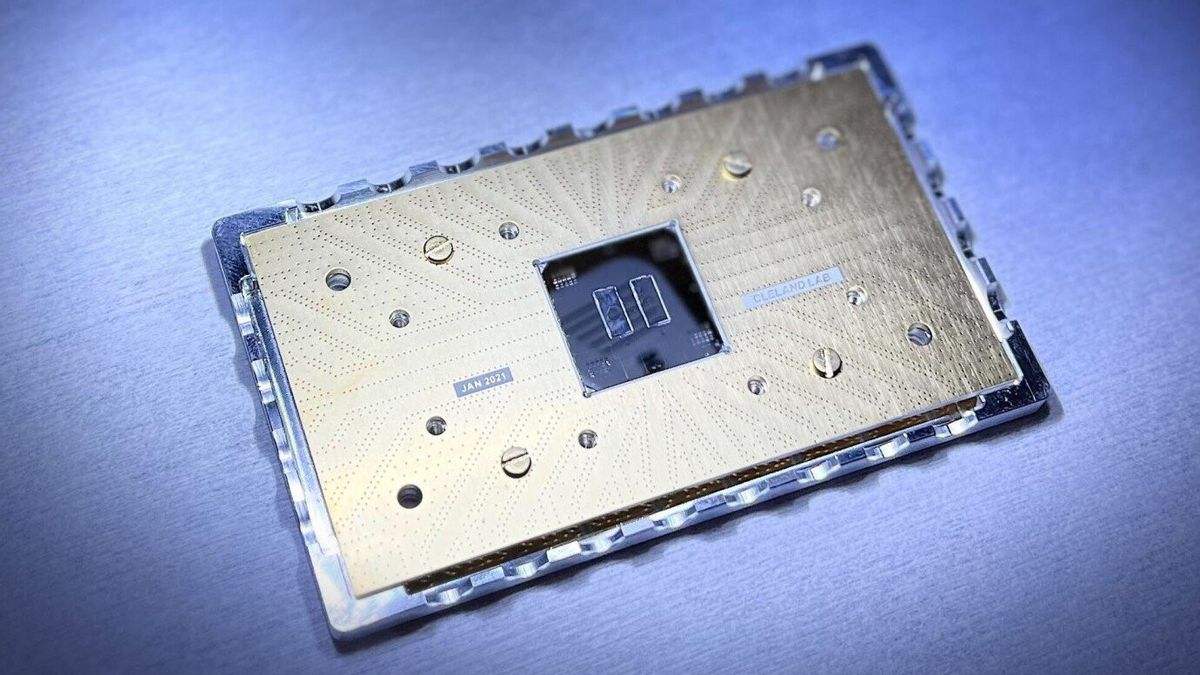


YOGYAKARTA - In general, quantum chip is known as a special hardware in which there are qubits (quantum bits) and a series of supports that allow quantum computing to be applied. Unlike classical bits that are only 0 or 1, qubits can be found in superposition and interconnected (entanglement), thus allowing for processing and computation in very large scales in a different way than classical computing. In this article, it will be discussed regarding quantum chips and their implications for data security.
Reporting from Security Info Watch, currently, quantum computing devices are still in the development stage, but the impact on encryption, data security, and cryptography has begun to become an important concern.
A number of cryptographic algorithms commonly used today, including RSA (Rivest-Shamir-Adleman), Elliptic Curve Cryptography (ECC), and other public key exchange systems, rely on the difficulty of finding answers to mathematical problems for classical computers. However, with quantum computing, in particular by utilizing Shors algorithms, problems such as large number factors or discrete logarithms can be solved much more quickly.
SEE ALSO:
-
 | TEKNOLOGI
Alibaba Luncurkan Layanan Chatbot AI Baru untuk Dorong Bisnis Konsumer
24 Oktober 2025, 03:05 -
 | TEKNOLOGI
Google Uji Fitur Edit Gambar Langsung di Overlay Gemini dengan Nano Banana
24 Oktober 2025, 07:05 -
 | TEKNOLOGI
Snapchat Luncurkan Fitur Imagine Lens Gratis untuk Buat Gambar dengan AI
23 Oktober 2025, 21:05
For example, one report states that quantum computer running Shors algorithms can harm public cryptography algorithms such as RSA, DH and ECC.
This has an impact, data encrypted with algorithms that are now considered secure can be accessed by parties capable of utilizing advanced quantum chips in the future. In addition, the existence of a steal now, crypt later' (steal now, decryption later) strategy becomes real: the data stolen today and stored in encrypted form can be completed when quantum technology matures.
Although symmetric encryption (for example: AES) is more resistant to quantum computing than public encryption, this does not mean it is unrestricted security. An algorithm like Grover's algorithm can speed up key search significantly, thereby reducing the level of effective symmetric key security.
For example, the key to AES-128 may not be strong enough to face quantum threats, and organizations are encouraged to switch to longer keys or quantum-resilient encryption technologies.
With quantum computing capabilities, stored data encryption (data at rest) or sent (data in transit) can be threatened. An article explains that communication via VPN, email, TLS/SSL protocols that use public cryptography algorithms can fall into the hands of intruders if quantum computers are strong enough.
Furthermore, digital signatures, electronic certificates, and authentication mechanisms that rely on public-key algorithms can be falsified or stolen their identities.
In addition, blockchain technology and digital assets are also at risk, because they rely a lot on public cryptography.
Re-identification of anonymous data: Anonymization and pseudonymization techniques that are currently considered safe can become vulnerable if quantum allows large-scale data analysis and processing to re-reveal individual identities.
Cyber and geopolitical wars: Countries or foreign actors who previously stored encrypted data can wait for the moment quantum maturing' to perform a mass description, resulting in threats to privacy, national security and the financial sector.
Tech inequality: Big companies and developed countries that have access to quantum technology will excel in security or attacks, while small organizations or developing countries can be left behind.
Quantum computer infrastructure that is truly capable of breaking' cryptography is currently still in the development stage and requires thousands to millions of qubits with very high error corrections.
Migration to quantum-resistant cryptography (post-quantum cryptography or PQC) requires large investments, complex system changes, and coordination, especially for organizations with older systems.
Since quantum threats are considered future', many organizations are delaying preparations, although the data stored today remains at risk in the future.
That's the review of quantum chips and their implications for data security. Hopefully useful. Visit VOI.id to get other interesting information.
The English, Chinese, Japanese, Arabic, and French versions are automatically generated by the AI. So there may still be inaccuracies in translating, please always see Indonesian as our main language. (system supported by DigitalSiber.id)


