
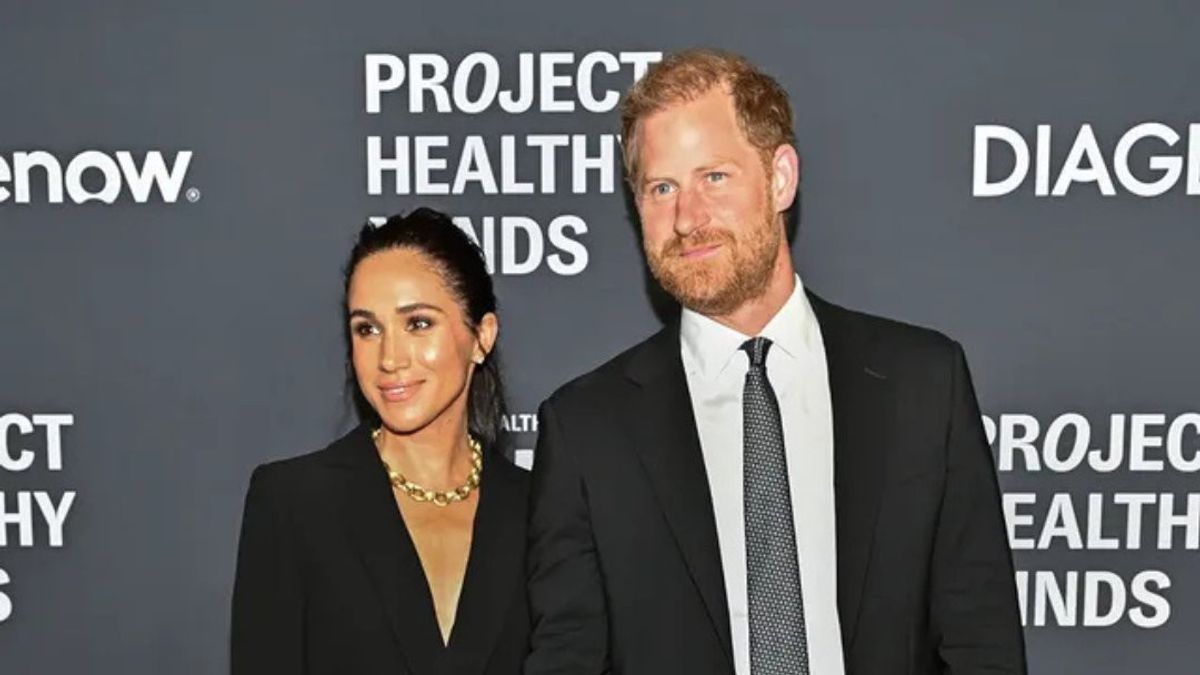


Warm atmospheres with Prosecco glasses and light conversations colored Project Healthy Minds' third annual Gala night in New York on Thursday night, October 9. When the closing dish was served, the event peaked: Humanitarian awards of the Year were awarded to Prince Harry and Meghan, Duke and Duchess of Sussex, on their move through the Archewell Foundation that formed The Parents Network "an initiative to support families affected by social media hazards."
Earlier this year, the organization held an event featuring the faces of young people on the giant phones screen of children who lost their lives in a situation their parents believed was related to the influence of social media.
The Gala event was organized by Project Healthy Minds, a non-profit that provides free access to mental health services, especially for young people who are struggling in a world that is increasingly dominated by technology. Through this event, it is clear how parents and adolescents think of social media and its serious impact on mental health.
SEE ALSO:
-
 | TEKNOLOGI
Google Bagikan Tips Cerdas Hindari Penipuan Online di Musim Promo
12 Oktober 2025, 17:51 -
 | TEKNOLOGI
Gim Horor Psikologis dari Kisah Nyata: Tenebrea akan Dirilis pada 2026
12 Oktober 2025, 17:02 -
 | TEKNOLOGI
Hakim Cabut Perintah OpenAI untuk Simpan Data ChatGPT Tanpa Batas Waktu
12 Oktober 2025, 14:28

I want to share one point, said Prince Harry while on stage with Meghan to receive an award. Four thousand. That's the number of families currently represented by the Social Media Victims Law Center.
According to Harry, this figure only represents parents who are able to connect their children's suffering with social media and have the ability to fight the richest and most powerful corporations in the world.
"We have witnessed an unregulated explosion of artificial intelligence, heard more and more stories from destroyed families, and saw parents around the world increasingly worried about their children's digital lives," he continued.
Harry accused big tech companies of spending millions of dollars covering up the truth, creating algorithms designed to "maximize data collection at all costs," and making children the primary target.
He also alluded to Apple's breach of user privacy, as well as Meta complaining about losing billions of dollars due to privacy restrictions. He warned about the dangers of AI, by exemplifying research in which researchers pretending to be children experience malicious interactions every five minutes with chatbots made by big tech companies.
"This is not content from a third party," he said. This chatbot is the company's own product, which is designed to implement their destructive internal policies.
That same night, The Parents Network announced cooperation with ParentsTogether, a family advocacy organization focused on children's online safety.
This isn't the first time Prince Harry has spoken out about the dangers of social media. In April 2025, he visited a young leader in Brooklyn to discuss the growing influence of technology platforms that are more concerned with profit than user safety. In January, Harry and Meghan also criticized Meta for weakening freedom of expression after the company changed fact-checking policies.
Various studies have also supported their concern that social media has proven to exacerbate the mental health crisis and cause a lonely epidemic among young people.
The next day, coinciding with World Mental Health Day, Project Healthy Minds held a festival and discussions about mental health. Several panels were held with the Archewell Foundation to discuss how social media has changed the childhood of the current generation.
The first panel titled 'How Is The Condition Of Young People In The Digital Age' was opened by Prince Harry. One of the panelists, Katie, shared a story about how since the age of 12, the For You page on TikTok was flooded with videos about extreme diets that ended up suffering from eating disorders.
Another panelist,tengic Sunderland of the Design It For Us organization, explained how she found that social media algorithms were deliberately designed to increase addiction and usage time, not for user safety.
The next panel, which was opened by Meghan and moderated by journalist Katie Couric, discusses how the current generation's childhood was 're-hacked' by social media. Psychologist and author of The Anxious Generation, Jonathan Haidt, explained that the level of child anxiety and depression increases, outdoor play time decreases, and social interactions plummet.
"Playing is an important part of brain development," said Haidt. "When children lose their playing time in childhood, they grow up to become more anxious adults."
Amy Neville, community manager of The Parents Network who lost her child due to drugs purchased through Snapchat, also shared a sad story and her struggle to sue the platform.
The panel closes with testimony from Katie, the mother of Katie, who admits that she doesn't realize that harmful content can 'come alone' to her child without being sought.
The conclusion from the whole event is clear: the need for concrete action.
Calls for stronger regulations, the responsibility of technology companies, and solidarity between parents echoed throughout the room.
"We can and will build a proper movement for all families and children," said Meghan closing that night. When parents unite, when the community moves together, change will come. And we've started to see it.
The English, Chinese, Japanese, Arabic, and French versions are automatically generated by the AI. So there may still be inaccuracies in translating, please always see Indonesian as our main language. (system supported by DigitalSiber.id)
Popular


