
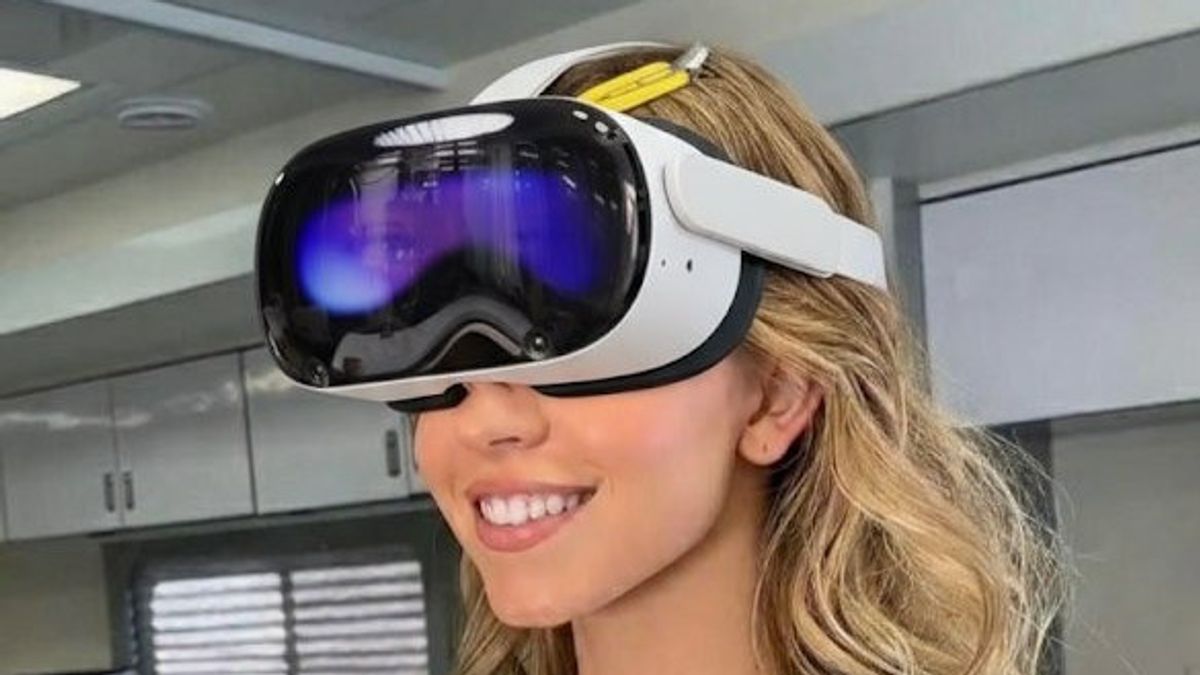


JAKARTA - A new study opens the door for people with stroke, ALS (Amyotrophic Lateral Sclerosis), spinal cord injuries, and other neurological disorders to control the Apple Vision Pro using only their brain power—without the need for brain implant surgery, as previously required.
Santa Barbara-based research company Cognixion is developing non-invasive brain-computer interface (BCI) technology that works in conjunction with Apple's accessibility features. They hope this technology can help millions of people with speech or mobility difficulties communicate and interact more naturally.
"Apple has set a global standard by making accessibility at the heart of every device, and Vision Pro extends that commitment to the world of spatial computing," said Andreas Forsland, CEO of Cognixion. "By combining Cognixion's non-invasive BCI technology and AI applications with Apple's accessibility features, we hope to unlock new levels of independence for those living with ALS, spinal cord injuries, strokes, and traumatic brain injuries."
According to data According to Cognixion, approximately 14 million Americans live with a neurological condition that causes chronic loss of physical ability, and nearly one million new cases are diagnosed each year.
This study will leverage the Gaze Tracking and Dwell Control technology already found in the Apple Vision Pro. However, Cognixion's innovation will add non-invasive brain sensors—ones that read neural activity without the need for implanted electrodes in the user's brain.
"This study focuses on the patient experience—what happens when advanced accessibility features are combined with new neural input methods," explained Chris Ullrich of Cognixion. "The Apple Vision Pro has an intuitive interface, and our goal is to leverage brain-sensing technology and AI to support millions of people with speech and mobility challenges."
Details of the study are listed on the U.S. National Library of Medicine website, and interested participants can register by emailing [email protected] with the subject line "Cognixion-spatial computing study."
This research has already begun and is scheduled to run through April 2026. While Apple is not directly involved, the company is also known to be researching how to use the Apple Vision Pro sensor to read brainwaves, specifically to support users' future mental and physical health.
This technology has the potential to be a major breakthrough in transforming AR devices into rehabilitation and communication aids for people with neurological disabilities—paving the way to a future where thoughts can truly replace movement.
The English, Chinese, Japanese, Arabic, and French versions are automatically generated by the AI. So there may still be inaccuracies in translating, please always see Indonesian as our main language. (system supported by DigitalSiber.id)
Most Popular Tags
#Prabowo Subianto #donald trump #Febrie Adriansyah #8791 #giias 2026Popular


