
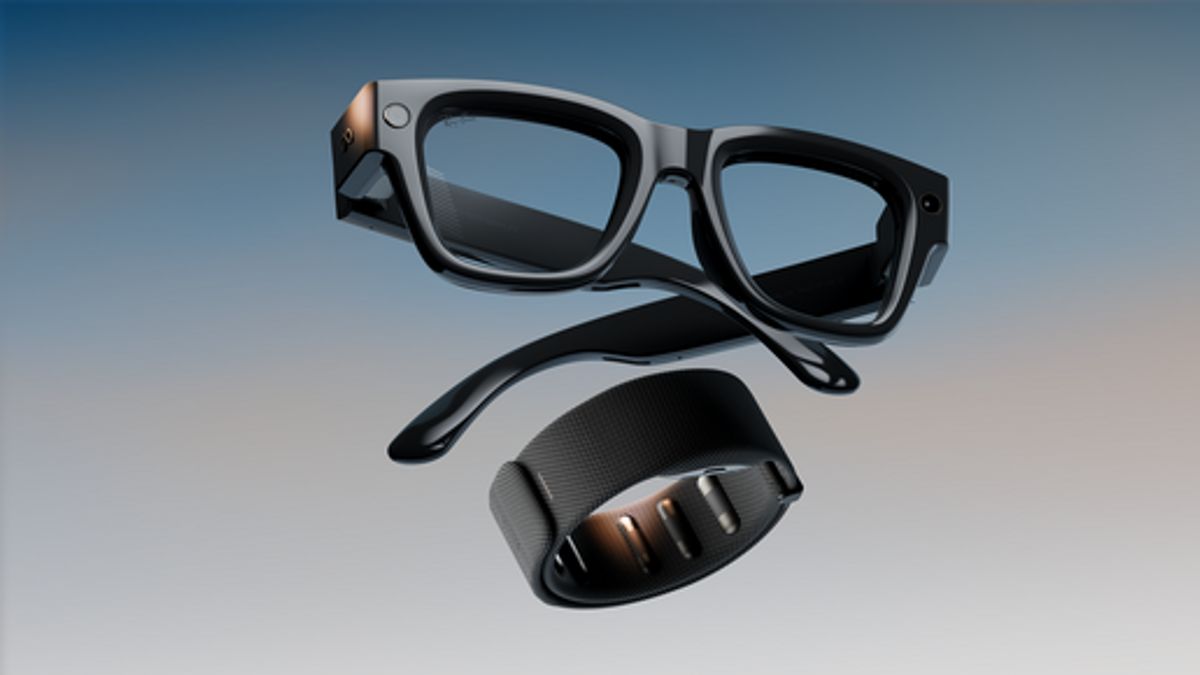


JAKARTA - Meta has just introduced their latest smart glasses, Meta Ray-Ban Display, which is equipped with an internal screen. However, although many people call this device Apple's competitor or even Apple Glasses' predecessor, that's not the case.
Apple had already introduced Vision Pro at the WWDC 2023 event as a mixed reality device dubbed spatial computing'. Vision Pro displays software into a real environment through a combination of cameras and two mini screens.
In the future, Vision Pro and the visionOS operating system are predicted to evolve into Apple Glasses with a true transparent lens of AR (augmented reality) devices. What Meta has to offer this time is clearly far from it.
SEE ALSO:
-
 | TEKNOLOGI
Fitur iPhone Eksklusif yang Tidak Ditemui dalam Android, Apa Saja?
21 September 2025, 17:15 -
 | TEKNOLOGI
Ponsel dengan Kamera Zoom Terbaik dengan Hasil Tetap Tajam Meski Malam Hari
21 September 2025, 16:35 -
 | TEKNOLOGI
4 Cara Mengatasi iPhone Lemot Setelah Update iOS, Yuk Ikuti Panduannya
21 September 2025, 12:40 -
 | TEKNOLOGI
Rapi dan Elegan! Berikut Ide Bio IG Aesthetic Bahasa Inggris yang Buat Kamu Kelihatan Menarik
21 September 2025, 11:40

Meta describes Ray-Ban Display as AI glasses', not AR or spatial computing devices. This product is a continuation of Ray-Ban Meta, which has already arrived with cameras and speakers.
Apple does not sell similar products and does not seem interested in competing with them in the near future. Although rumors emerged about Apple AI Glasses in 2026, the news is considered to have no solid basis. Moreover, the Meta smart glasses business also cannot be called a big success, with sales of around two million units from October 2023 to February 2025.
Meta tries to display these glasses as light and not striking devices. However, many think that the presence of cameras on the face actually feels invasive and interferes with privacy.
Ray-Ban Display actually only adds a small look to glasses with speaker and camera features. Although it sounds interesting, its function is not much different from existing devices, it even seems redundant for Apple Watch and AirPods users.
Meta has ambitions to make these glasses an AI-first device with third-party applications running live, not just smartphone accessories. However, history shows that efforts to bring replacement devices for AI-based smartphones often fail to penetrate the market.
Meanwhile, Apple Vision Pro is not just a notification performer, but an independent computer that can be used to expand the experience of using Macs and other Apple devices. Vision Pro positions itself to enrich the interface, not replace the smartphone.
Ray-Ban Display's Meta is more like an attempt to copy the smartphone interface element into a small screen in front of the eye, but has not been able to answer a fundamental question: for what?
On the other hand, Apple's development direction is clearly different. Apple's vision is to present Apple Glasses as a full AR device, with transparent lenses capable of projecting digital widgets, windows, and objects into the real world. The glasses will not stand alone, but rather work in an extensive Apple ecosystem from the iPhone, iPad, Home Hub, to Mac.
If it does materialize, Apple Glasses will be a device that is not only useful, but also attractive for everyday use.
Meta does present a product that is 'attractive' with Ray-Ban Display, but not necessarily 'usable'. This device is still far from the Apple Vision Pro level, especially from Apple Glasses' long-term vision.
While waiting for Apple's future AR glasses to materialize, Apple users can still enjoy the form of reality augmentation through a combination of AirPods Pro and Apple Watch two devices that have proven functional, private, and secure.
The English, Chinese, Japanese, Arabic, and French versions are automatically generated by the AI. So there may still be inaccuracies in translating, please always see Indonesian as our main language. (system supported by DigitalSiber.id)
Most Popular Tags
#Prabowo Subianto #donald trump #Febrie Adriansyah #8791 #giias 2026Popular


