


JAKARTA - Apple has officially introduced a new security feature called Memory Integrity Enforcement (MIE) on the iPhone 17 and iPhone Air. This feature is claimed to be the biggest breakthrough in memory security ever sent to a consumer operating system. Apple calls MIE an iPhone that prevents memory tricks that spyware usually uses to attack devices.
This feature was announced on September 9, 2025 by the Apple Security Engineering and Architecture team. MIE is the result of five years of hardware and software cooperation and is designed to block memory corruption-based attacks that have been the main weapon of advanced spyware such as NSO Group's Pegasus.
According to Apple, most iPhone users may never experience this kind of attack. The main targets of the attacks are usually journalists, activists, to company executives with a high risk of being tapped by firecracker spyware which costs millions of dollars.
SEE ALSO:
-
 | TEKNOLOGI
Apple Perpanjang Layanan Satelit Gratis di iPhone 14 dan iPhone 15 Hingga Setahun
10 September 2025, 20:08 -
 | TEKNOLOGI
Xbox Kembali Ramaikan Tokyo Game Show 2025, Bisa Coba ROG Xbox Ally yang Baru
10 September 2025, 19:35 -
 | TEKNOLOGI
Cara Mengaktifkan Fitur Mouse Keys: Kendalikan Kursor Tanpa Mouse
10 September 2025, 19:05 -
 | TEKNOLOGI
Apple Ungkap Tanggal Peluncuran iPadOS 26, Ini Fitur yang Akan Hadir
10 September 2025, 18:35 -
 | TEKNOLOGI
Sega Hadir di Tokyo Game Show 2025, Bawa Gim Sonic Sampai Persona 3
10 September 2025, 18:05
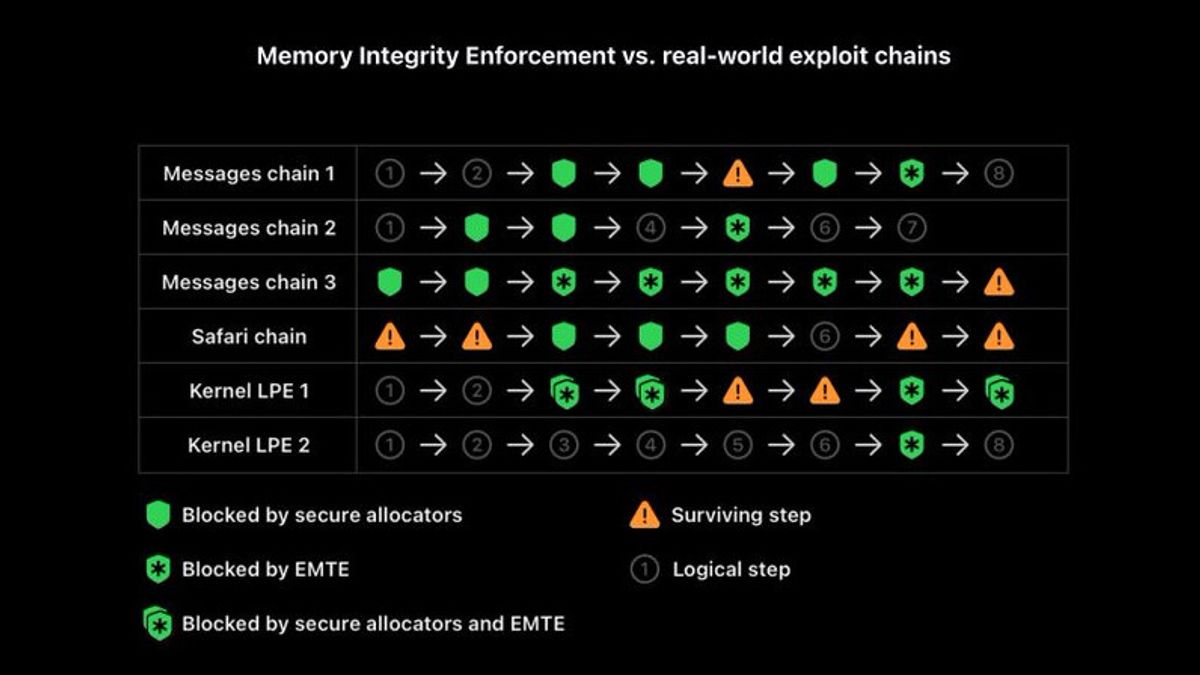
MIE was built on the foundation of Arm Memory Tagging Extension (MTE) which was first released in 2019. Apple teamed up with Arm to develop a stronger version, called Enhanced MTE (EMTE).
Each memory block now has a tag'' or a secret code. The hardware will verify whether the memory access request has a suitable tag. Otherwise, the system immediately blocks access and stops the process. As a result, bugs such as buffer overflow and use-after-free become much more difficult to exploit.
Apple also added a Tag Confidentiality Enforcement, which prevents hackers from trying to guess a secret code through side-channel attacks or speculative vulnerabilities like the one that happened in the Spectre attack.
To support MIE, Apple embeds dedicated logic, CPU space, and special memory on A19 and A19 Pro chips so that this feature runs in the background without sacrificing battery performance or power.
Not only protecting the system, Apple also opens EMTE access for developers through Xcodes. This means that third-party applications can be tested using the same security standards, so that the iOS ecosystem is getting stronger against memory exploitation.
Apple doesn't try to close any bugs, but raises the cost of attacks to make them less economical. Each exploit chain usually consists of several gaps being connected. With MIE, the chain was cut off early.
Apple claims that many exploits that could previously be used could not be repaired to penetrate this new system. Even some resilient' exploits become unstable and unreliable.
Ordinary users may not feel the difference, as the MIE runs automatically without disrupting performance or battery. However, for those who are targeted by spyware, such as journalists or activists, this feature can be a savior.
Unlike Google, which makes the MTE feature an option for high-risk users, Apple makes it defaultly active across the iPhone 17 and iPhone Air.
Apple concluded that no security was absolutely perfect. However, by making attacks expensive and fragile, they hope to force the group of spyware makers to step back and repeat strategies from scratch.
This innovation has the potential to change the map of the digital surveillance industry, as well as make the iPhone 17 one of the most difficult to hack phones at this time.
The English, Chinese, Japanese, Arabic, and French versions are automatically generated by the AI. So there may still be inaccuracies in translating, please always see Indonesian as our main language. (system supported by DigitalSiber.id)
Most Popular Tags
#Prabowo Subianto #donald trump #Febrie Adriansyah #8791 #giias 2026Popular


