

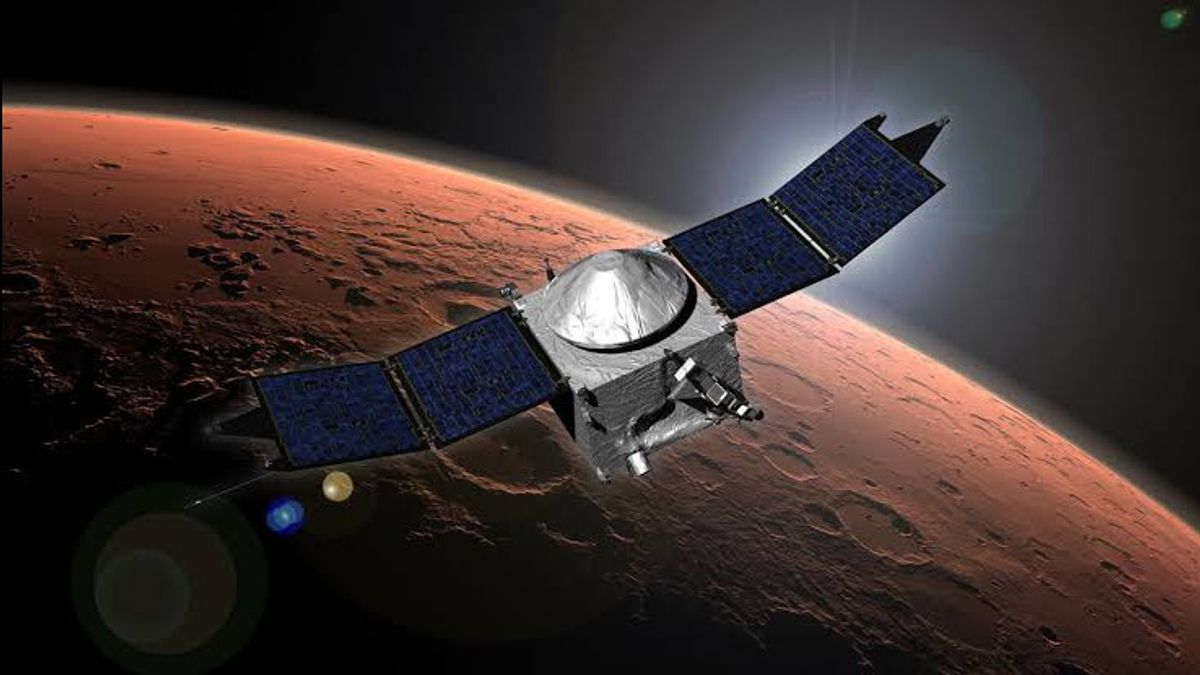


JAKARTA After a decade of wandering the space, NASA's MAVEN vehicle finally provided a report for the first time. The pilot explained about the sputtering process on Mars.
Sputtering is an elusive atmospheric release process for years. According to scientists, this process needs to be explored because it can answer questions about water loss on Mars.
The planet is believed to have water in the past because of various evidences found, such as dry river canals and cracked rock-filled areas. The area is believed to be a lake in the past, but the water dried up.
If Mars had adequate water in the past, its atmospheric state is believed to be fine, unlike the one found today. Therefore, the Martian atmosphere is believed to be eroded until the water is unstable and evaporates into space.
SEE ALSO:



To understand how this happened, scientists need to know the sputtering process. Observations of this process were not short so the MAVEN, short for the Mars Atmosphere Volatile Evolution, observed Mars for up to a decade.
Scientists also took advantage of three instruments carried by MAVEN, namely Solar Wind Ion Analyzer, Magnetometer, and Neutral Gas and Ion Mass Spectrometer. These three instruments measured the atmosphere of Mars on the day and night sides for years.
The data obtained by these three instruments can be used to create new argon maps. This map will reveal the presence of argons at the right altitude, where energetic particles hit the atmosphere and bent argons.
Observations of sputtering show that the Martian atmosphere is indeed lost due to the process. This atmospheric smoothing is believed to have occurred in early history of Mars, precisely when the activity of the Sun was much stronger.
"This result establishes the role of sputtering in the loss of the Martian atmosphere and in determining the history of water on Mars," said Shannon Curry, MAVEN's lead researcher.
The English, Chinese, Japanese, Arabic, and French versions are automatically generated by the AI. So there may still be inaccuracies in translating, please always see Indonesian as our main language. (system supported by DigitalSiber.id)


