

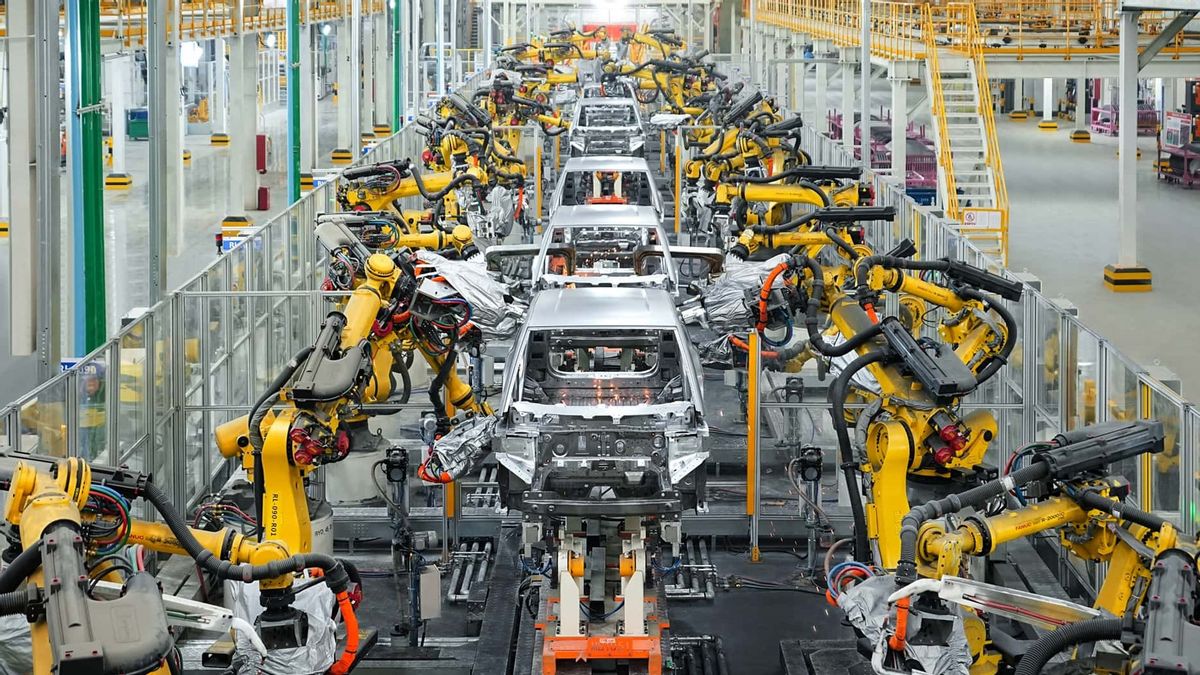


JAKARTA - Chinese electric vehicle manufacturer BYD has reduced its workforce to around 870,000 people by 2025. This figure is down around 100,000 employees or equivalent to 10 percent compared to before.
Launching Carnewschina, Wednesday, April 1, the company confirmed that this step was part of internal restructuring, efficiency improvement, and cost control, not as a result of weakening market demand.
The policy was taken as the electric vehicle industry focused more on operational efficiency as the next phase in global competition. In terms of financial performance, BYD posted revenue of 8039.6 billion yuan throughout 2025, with total shipments reaching 4.60 million units of vehicles, according to NBD.
Meanwhile, a Sina report said vehicle exports reached around 1.05 million units, marking the first time that BYD exceeded the 1 million unit figure for overseas shipments. Despite revenue growth, BYD's net profit was recorded at 326.2 billion yuan, down about 19 percent from the previous year.
This decline was influenced by price pressure in the domestic new energy vehicle (NEV) market, as well as the magnitude of sustainable investment in vehicle and battery technology development. Amid margin pressures, BYD has maintained research and development (R&D) spending at 634 billion yuan.
This step shows the company's commitment to developing electrification technology, battery systems, and charging infrastructure. Global expansion is also being strengthened through increased product variety and export volume.
On March 5, 2026, BYD launched the Blade Battery 2.0 with Flash Charging 2.0 technology. This system is claimed to be able to charge the battery from 10 percent to 70 percent in just about 5 minutes, and up to 97 percent in 9 minutes under standard conditions.
In line with the development of this technology, BYD raised its 2026 export target to 1.5 million vehicles, an increase of about 15 percent from the previous target. This step reflects the company's focus on strengthening international markets amid tight competition at home.
Meanwhile, sales of new energy vehicles (NEVs) in the domestic market fell 41 percent in February 2026, according to CarNewsChina. This decline was influenced by seasonal factors related to the holiday period in China, and occurred before the launch of Blade Battery 2.0, so it was considered a short-term fluctuation, not a structural change in demand.
The English, Chinese, Japanese, Arabic, and French versions are automatically generated by the AI. So there may still be inaccuracies in translating, please always see Indonesian as our main language. (system supported by DigitalSiber.id)


