

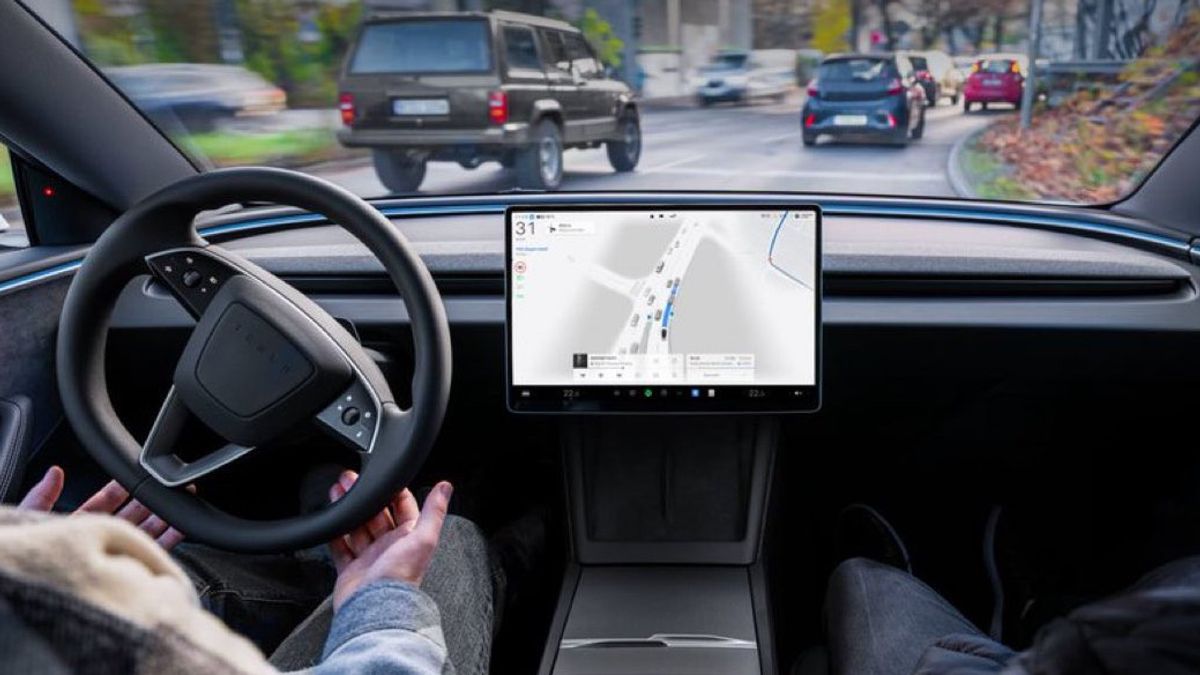


JAKARTA - Representatives from Euro NCAP, a vehicle safety assessment agency in Europe that is one of the global references, launched a sharp criticism of Tesla's Full-Self Driving (FSD) technology. The system, which has often been praised, is considered potentially dangerous and does not reflect the full responsibility of the manufacturer.
Euro NCAP Technical Director Richard Schram, in his statement to Australian and New Zealand media, said the technology would likely not receive a high rating if tested using current standards.
"(FSD Tesla) is impressive, but there is a big danger, namely relying too much on the system. What I want to see from Tesla is, 'this is really full self-driving, and we will be fully responsible for anything that happens forever,'" said Schram, quoted from the Drive page, Monday, March 30.
As an illustration, FSD (Supervised) allows compatible vehicles such as the Tesla Model 3 and Tesla Model Y to face a variety of complex driving conditions, ranging from urban roads, stopping at traffic lights, to automatic parking. This ability is supported by a camera-based system as well as high-speed data processing.
However, this technology is still in a legal gray area in a number of countries, including Australia. Tesla itself displays a warning for drivers to keep holding the steering wheel, but the rule is not always enforced consistently unless the system detects a lack of driver attention.
In Europe, FSD has not been widely marketed due to concerns about regulations and stricter safety standards. The road conditions and traffic rules that are different in each country within a relatively close distance are also a challenge for the implementation of autonomous technology.
According to Schram, the main problem lies in the naming of "Full-Self Driving" which is considered misleading. He emphasized that the system still places responsibility on the driver, not on the vehicle.
"If you want to call it automation, please, but that means you (car manufacturers) are responsible. To be fair, and not just about Tesla, in general no one is really self-driving, it's all an assistance system. Advanced assistance systems also still require driver involvement. If it's balanced, it's okay," he said.
In the future, the interaction between the driver and the active safety system will be the new focus in the Euro NCAP assessment, including by ANCAP. Starting in 2026, testing will include the durability of the driver monitoring system, particularly with regard to accuracy and tracking capabilities.
Meanwhile, for the rules planned to take effect in 2029, the agency is designing a more sophisticated testing method to assess the "intelligence" of the monitoring system. Active safety systems should only take action if they actually detect that the driver is unaware of potential dangers.
Euro NCAP assesses that if the system gives a warning only because the driver looks away for a moment or changes the radio channel, while still aware of the situation, then the technology is considered not to have been implemented optimally. The rules for 2029 are still in the development stage and will involve input from various automotive manufacturers before they are officially implemented.
The English, Chinese, Japanese, Arabic, and French versions are automatically generated by the AI. So there may still be inaccuracies in translating, please always see Indonesian as our main language. (system supported by DigitalSiber.id)
Most Popular Tags
#Prabowo Subianto #donald trump #firearm #8791 #giias 2026Popular


