

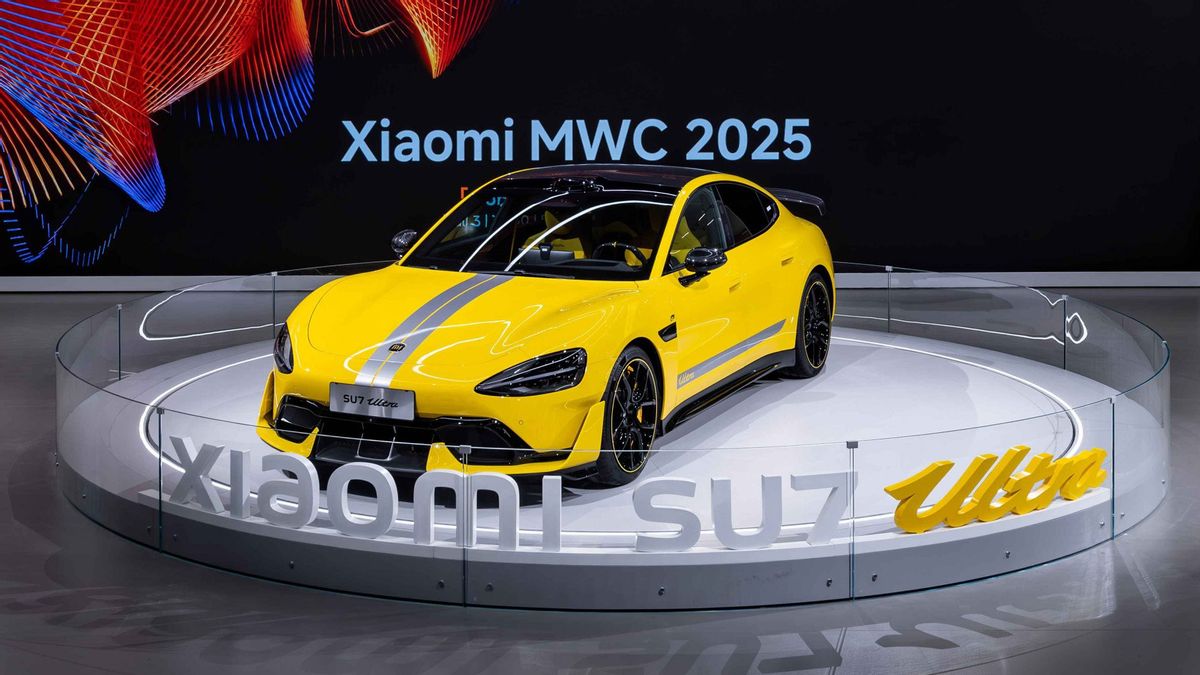


JAKARTA - The Kaifu District People's Court in Changsha, China, rejected a lawsuit for alleged fraud and breach of contract against an official Xiaomi dealer on February 12, 2026. The ruling was the first case to be completed regarding the SU7 Ultra carbon fiber engine option worth 42,000 yuan.
As quoted from Sina, Monday, March 2, the panel of judges did not grant the plaintiff's request for a double refund of the deposit of 10,000 yuan. In its ruling, the court stated that the purchase agreement signed on March 5, 2025 had been canceled as of September 13, 2025 by mutual agreement.
The case costs 800 yuan are divided, with 500 yuan borne by the plaintiff and 300 yuan being the obligation of Xiaomi. The judge considered promotional terms such as high efficiency air flow do not conflict with the function that has been verified as partial air flow discharge.
In addition, the court did not find any intention to deliberately mislead the public in statements related to the modification of the internal structure of the component. This matter started from the controversy over Xiaomi SU7 Ultra's dual-channel engine hood, which was marketed with the claim of replicating the function of the aerodynamic and cooling system of the prototype version.
Since May 2025, a number of owners have found that the internal structure of the production version is very similar to the standard aluminum hood, only with a plastic support plate. Independent testing even showed very little airflow from the vents when tested using a blower.
On May 8, 2025, Xiaomi admitted that the previous communication was unclear and confirmed the function of the component as an additional cooler for the front compartment. The company then offered refunds for consumers who had not received units, with an estimated waiting time of 30-40 weeks.
As compensation, Xiaomi also provided 20,000 loyalty points worth about 2,000 yuan. This decision in Changsha differs from the verdict of the Suzhou Intermediate People's Court in October 2025 which in one case stated that there was an element of fraud and ordered Xiaomi to pay compensation of 156,000 yuan.
To date, a number of similar lawsuits are still rolling in Nanjing and Suzhou. In the defense process, Xiaomi has submitted 84 pages of technical documents to prove the performance of the accessory.
The victory in Changsha came as demand for the SU7 Ultra plummeted. Monthly sales of the performance sedan fell sharply from more than 3,000 units to just 45 units in January 2026.
Even though the volume of the model has shrunk by 98.5 percent, Xiaomi EV still recorded 22,100 insurance registrations in January 2026, up 15 percent compared to the average for December. This ruling is considered an important precedent, given that Xiaomi is still facing more than 100 similar lawsuits in various regions of China related to the functional specifications of its premium accessories.
The English, Chinese, Japanese, Arabic, and French versions are automatically generated by the AI. So there may still be inaccuracies in translating, please always see Indonesian as our main language. (system supported by DigitalSiber.id)


