

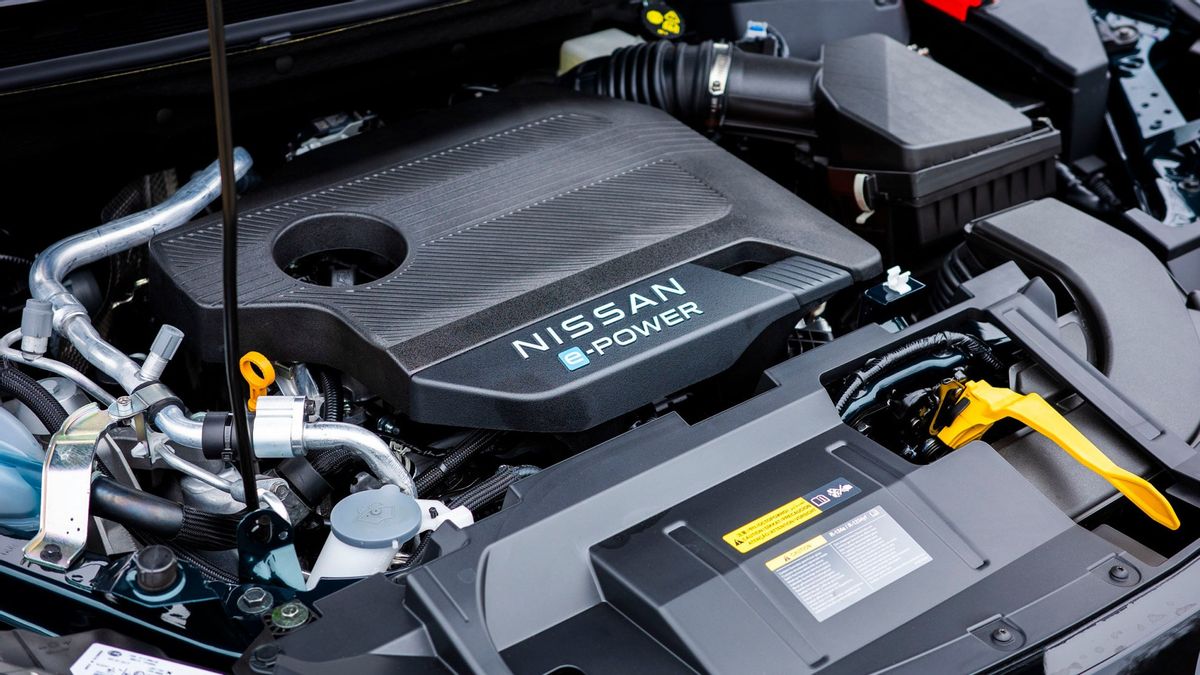


JAKARTA - Nissan is expanding its line of environmentally friendly cars. Although at this time the company does not yet have many major hybrid models of change to come in the next 12 months. The first step is the presence of Rogue Plug-In Hybrid, which is actually a Mitsubishi Outlander PHEV with a Nissan touch.
However, the most anticipated is the company's medium-term plan through the presence of the latest generation Rogue who will use Nissan's E-Power hybrid technology in the 2027 model. This is because it is different from the parallel hybrid commonly used by other manufacturers. Where, gasoline engines and electric motors can work together or separately. While E-Power carries the concept of a hybrid series, the gas engine does not immediately move wheels, but only produces electricity for driving motors or charging batteries.
This approach is similar to the BMW i3 REx concept, but its application to popular SUVs like Rogues is a unique move on the mass market. This technology will become the foundation of Rogue E-Power when launched, likely by the end of next year.
Gasoline engines work like generators, channeling energy through inverters to electric motors that drive wheels. SVP Nissan Americas as well as Chief Product and Planning Officer Ponz Pandikuthira, explains the fundamental differences in this system compared to conventional hybrids.
"The weakness of the hybrid series is when you are on toll roads with a speed of 75 mph (120km/hour), at that time the electric motor has not achieved its highest efficiency, but the internal combustion engine is the best," Pandikuthira said, quoted from The Drive, Friday, December 5.
"So, they have a coupling system that allows the upper axis of the internal combustion engine to move the final axis," he continued.
SEE ALSO:
-
 | OTOINFO
Pemilik Subaru Keluhkan Iklan yang Muncul di Layar Infotainment saat Mobil Melaju
05 Desember 2025, 16:13 -
 | OTOINFO
Pencapaian Mitsubishi di GJAW 2025 Lampaui Ekspektasi Catat 1.975 SPK
05 Desember 2025, 15:22 -
 | MOTOR
Yamaha Luncurkan X-Ride 125 Limited, Tampil Lebih Sangar dan Eksklusif
05 Desember 2025, 14:33
Pandikuthira also compared Nissan's approach to Honda's two motorbikes used on Civic and CR-V. Although Honda allows gasoline engines to connect directly to wheels at cruising speed, Nissan chooses a different road.
"Currently, we haven't done it. There are several main reasons for that. First, when you talk about machines connected to the drivetrain, there are many vibrations that appear when adding transmissions and thereby reducing speed, or locking couplings. This cost complexity goes into the system," he said.
"However, if we manage the calibration correctly, about how the internal combustion engine produces electrons, production rates, and battery emptying rates, we don't need that lockdown. That development delays us from bringing [the second generation E-Power system available in Europe] to the US, and we wait until the third generation," he explained.
This decision is a big bet for Nissan. Because, from 2017 to 2020, they had marketed the Rogue Hybrid in North America, but withdrew from the market. In that time, consumers turn to competitors who offer more hybrid options
The plug-in model became a bridge product before Nissan introduced its own hybrid self-made series. When next-generation Rogues come, the E-Power version will be the first variant to be launched, while a pure gasoline-engined model will follow later.
The English, Chinese, Japanese, Arabic, and French versions are automatically generated by the AI. So there may still be inaccuracies in translating, please always see Indonesian as our main language. (system supported by DigitalSiber.id)


