

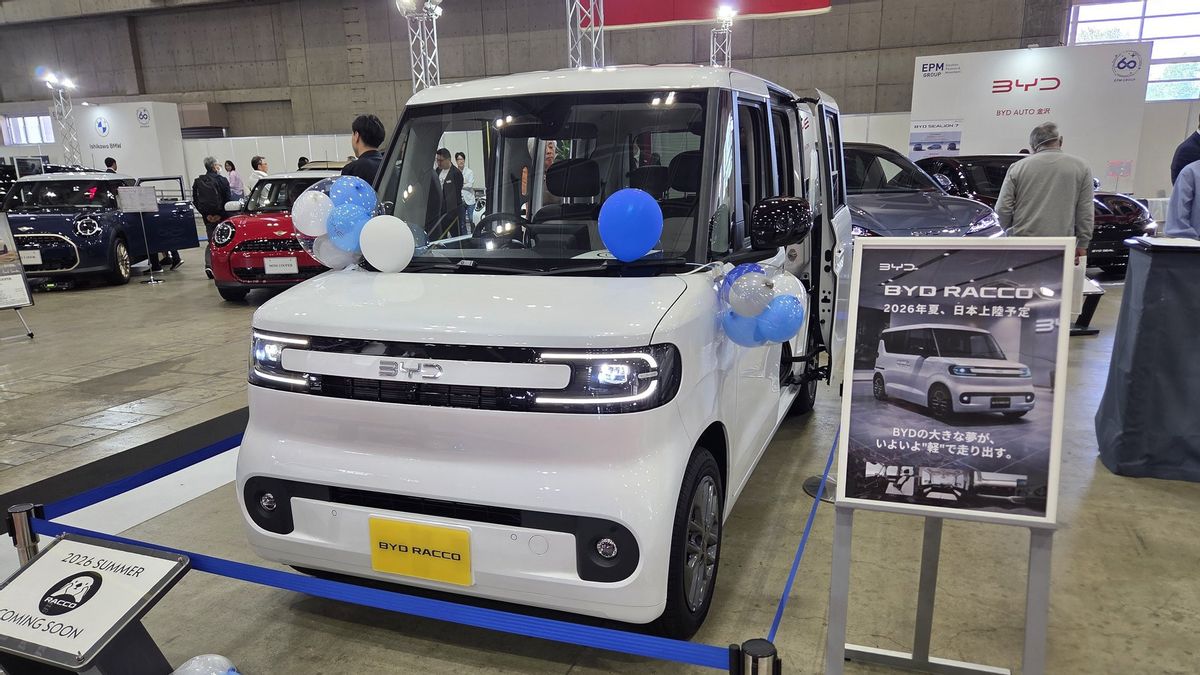


JAKARTA - BYD is preparing to enter the Japanese mini car market through the launch of an electric K-Car named Racco this summer. According to reports, the development of the model also involves former Nissan engineer, Hirohide Tagawa.
Launching from Nikkei, Monday, May 18, Tagawa is known to have a long experience in kei car projects in Japan. Racco was developed specifically to meet the strict regulations of the Japanese K-Car segment, ranging from vehicle dimensions, power limits, to taxation rules.
Despite having many limitations, this category remains the backbone of the Japanese domestic automotive market thanks to its efficiency in densely populated urban areas and relatively low operating costs.
Hirohide Tagawa himself is known to have spent around 25 to 30 years in Nissan since joining in the 1990s. He is known as one of the important figures behind the development of Nissan's kei cars across generations.
Tagawa is said to have contributed to the planning and development of various compact Nissan models, including the Dayz and Sakura. The latter became a milestone for Nissan when it entered the mass market for electric K-Car cars in 2022, while the Dayz became one of the company's main kei platforms in Japan.
After leaving Nissan, Tagawa reportedly joined a project to develop electric vehicles for the Japanese market with BYD Auto Japan. His presence is considered important because the development of K-Cars in Japan requires very specific engineering expertise, especially in terms of space efficiency, production costs, and compliance with local regulations.
Racco is the first BYD project that is specifically designed for the Japanese K-Car market, not just an adaptation of an existing global electric vehicle platform. This small electric car is designed for urban use with a number of quite competitive specifications.
Racco is rumored to carry a lithium iron phosphate (LFP) battery with a capacity of 20 kWh with a WLTC range of around 180 km. In addition, this car also supports DC fast charging up to 100 kW and is equipped with Level 2+ driver assistance systems as standard features.
In terms of design, Racco is said to have a rear sliding door and a high body to facilitate access in narrow street areas and limited parking lots commonly found in Japanese cities. Previously, Racco had been touted as BYD's strategic move to penetrate the Japanese K-Car market, which has been dominated by local manufacturers such as Suzuki and Nissan.
Competition in the Japanese small electric vehicle segment is also expected to become increasingly tight in the coming years. For price, Racco is expected to be priced from around 2.5 million yen or equivalent to Rp. 278 million.
The English, Chinese, Japanese, Arabic, and French versions are automatically generated by the AI. So there may still be inaccuracies in translating, please always see Indonesian as our main language. (system supported by DigitalSiber.id)


