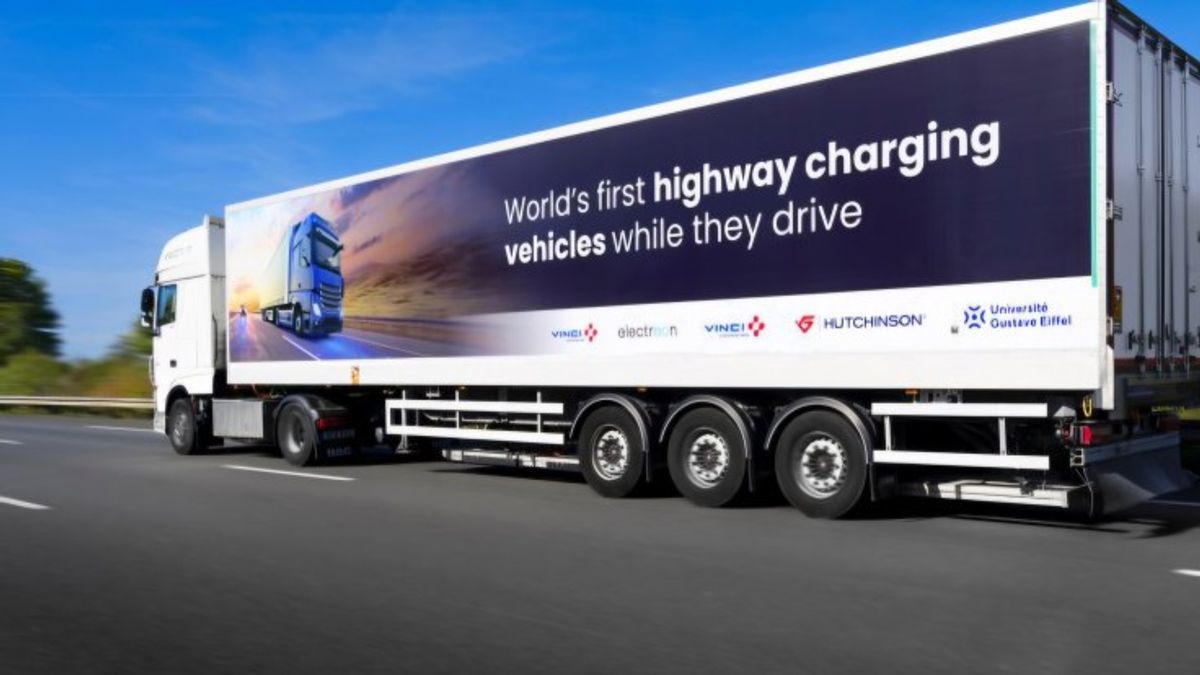


JAKARTA France started its first toll road trial in the world capable of charging wireless electric vehicles while traveling. This innovative project is carried out on the 1.5 kilometer Autoroute A10 section near Paris and is a major step towards a sustainable mobility era.
The initiative, called 'Charge as You Drive', utilizes copper coils planted under the road surface to transfer electrical energy through a magnetic field to vehicles equipped with special recipients, as reported by ArenaEV, Saturday, November 1. In this way, cars, buses, and electric trucks can continue to move while charging batteries without stopping at charging stations or plugging in cables.
Preliminary testing results show the system is capable of powering up to more than 300 kilowatts, with an average of about 200 kilowatts in stable condition. The incredible power of 300 kW is equivalent to Tesla's newest and strongest plug-in charging station, such as Tesla's V3 Supercharger.
At that speed, the driver can increase significant travel distance in just a few minutes. The difference is very significant, the driver does nothing, the car only drives through a special lane, and the battery is fully charged.
This technology can solve the biggest problem blocking its own battery electric car. In addition, it is considered strong enough to keep the fully loaded truck loaded during the trip, as well as prove the huge potential of dynamic wireless charging systems for long-distance transport.
The project was initiated by toll road management company VINCEI Autoroutes, in collaboration with Electreon, Hutchinson, and the University of Gustave Eiffel. The goal is to create a charging infrastructure that can cut the need for large batteries in electric vehicles and reduce charging times significantly.
If it is successfully implemented widely, the system can reduce its dependence on conventional charging stations and accelerate the adoption of electric vehicles across Europe.
SEE ALSO:
-
 | EKONOMI
Bos VinFast Sebut Pabrik di Subang Diprioritaskan Suplai Pasar Domestik
01 November 2025, 12:55 -
 | OTOINFO
BYD Catat Rekor Baru, Sealion 06 Capai 100.000 Unit Hanya dalam 100 Hari
01 November 2025, 09:57
Although promising, this technology still faces a number of challenges.
The high cost of development, integration with the national electricity grid, and billing systems for users are the main concern. In addition, this trial is still limited to a small scale, so that mass implementation is estimated to be carried out in the next few years.
However, the success of this trial shows a new direction in the development of electric transportation infrastructure. The highway is no longer just a connecting route between regions, but can function as an active energy source that keeps vehicles moving non-stop.
The English, Chinese, Japanese, Arabic, and French versions are automatically generated by the AI. So there may still be inaccuracies in translating, please always see Indonesian as our main language. (system supported by DigitalSiber.id)
Most Popular Tags
#Prabowo Subianto #donald trump #2026 World Cup #venezuela #Bhayangkara hut #konflik timur tengahPopular