

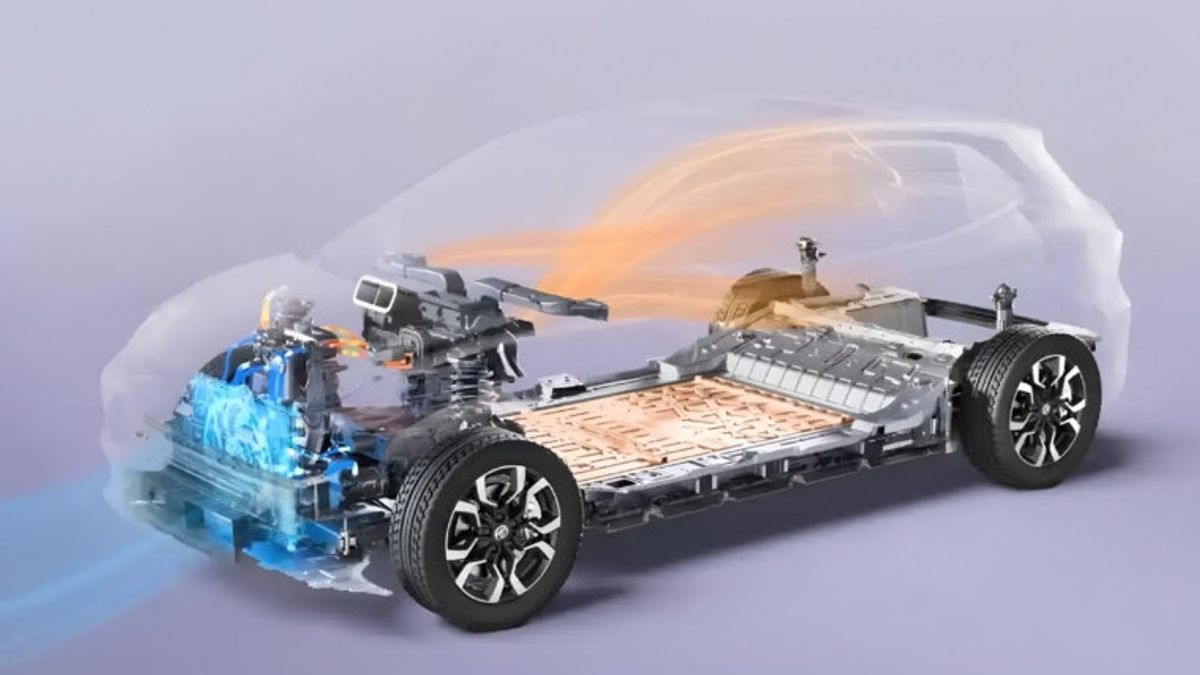


JAKARTA The Chinese government is preparing to standardize the naming of a semi-solid-state' battery popular in China's electric vehicle (EV) industry. This type of battery will soon be officially referred to as solid-liquid batteries' (dense-liquid batteries), according to a report from Yicai, as continued by CarNewsChina, Tuesday, October 28.
This change in naming aims to reduce confusion between semi-solid-state technology and full-solid-state (full-dense batteries), both of which attract great interest amid the rapid expansion of China's EV industry.
The solid-liquid battery contains solid and liquid electrolytes, where the solid component typically covers more than 90 percent. The design is considered safer and has a higher energy density compared to conventional lithium-ion batteries, as well as remains compatible with existing production lines. These batteries are widely viewed as a transitional step towards a full solid-state system, which still faces major challenges in terms of material, cost, and large-scale production.
Solid-State Battery Market Soars
The proposed name change comes amid intensive market activity. China's Solid-State Battery Index (BK0968) almost doubled from 1,288.8 to 2,426.32 points between April 9 and October 9, before closing at 2,277.83 on October 24. Analysts attributed this stock price spike to accelerating government policy support and real research progress.
In February, the Ministry of Industry and Information Technology (MIIT) and seven other government departments listed solid-state batteries as the top national research priorities. Since then, central and regional authorities have repeatedly emphasized the importance of this technology in various policy documents, conferences, and industry standards.
Target Of Mass Commercialization 2025
A number of leading Chinese automotive manufacturers, including IM Motors, Roewe, and MG (all under SAIC), plan to introduce vehicles equipped with semi-solid batteries or now called solid-liquid "starting in 2025. 2025 is often often referred to by analysts as the "first year of mass installation" of this technology.
In the next three years, solid-liquid battery technology is expected to expand from premium to middle class models and potentially reach a price segment below 200,000 yuan or equivalent to IDR 467 million.
Nonetheless, solid-liquid batteries still face challenges, including higher production costs and lower charging efficiency than conventional lithium-ion packages. Analysts expect these issues to improve as material production and maturation scale increases.
The English, Chinese, Japanese, Arabic, and French versions are automatically generated by the AI. So there may still be inaccuracies in translating, please always see Indonesian as our main language. (system supported by DigitalSiber.id)


