

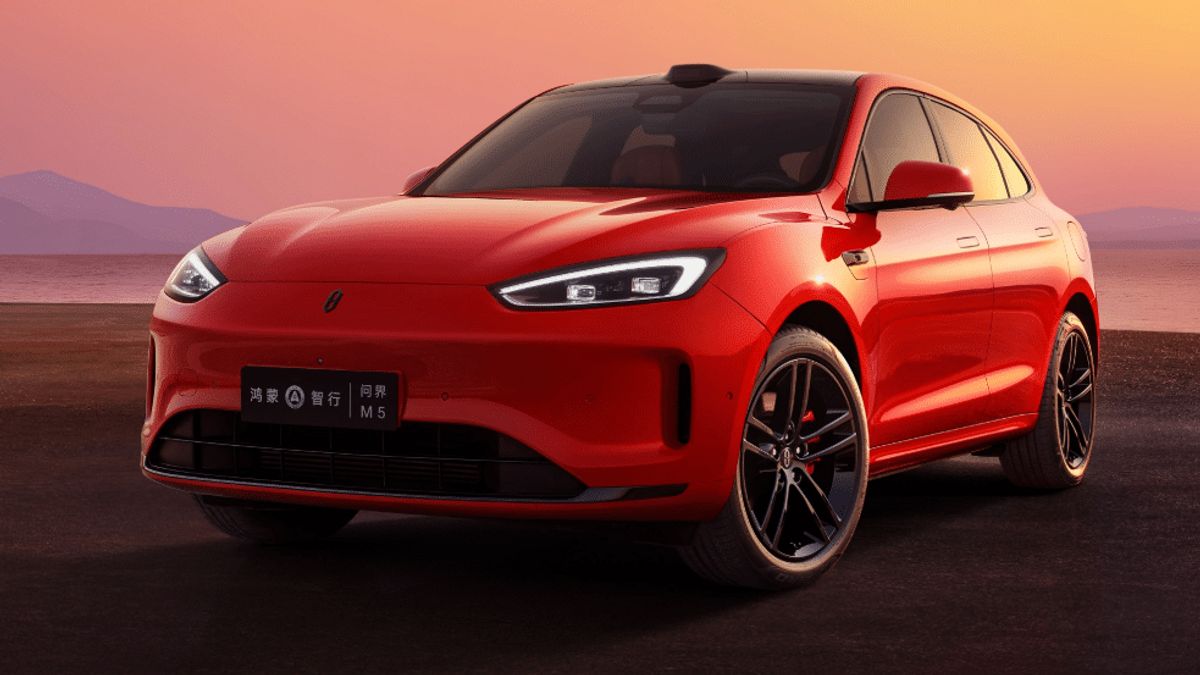


JAKARTA - The Chinese government has tightened the tax incentive policy for new energy vehicles (NEV) which will take effect from 2026. In the latest regulations, plug-in hybrid vehicles (PHEVs) must have a pure electric distance of at least 100 kilometers to meet the requirements for exemption from the purchase tax.
This policy was jointly announced by three major Chinese institutions, namely the Ministry of Industry and Information Technology, the Ministry of Finance, and the State Tax Administration. The three set new technical standards for NEVs that will receive tax incentives in the period 2026 to 2027.
Quoting from Carnewschina, Tuesday, October 14, previously PHEV was only required to cover an electrical distance of about 43 kilometers. However, through this new rule, the threshold rose to a minimum of 100 kilometers.
In addition, vehicles weighing below 2,510 kilograms are required to have fuel consumption of less than 70 percent of the standard limit, while for weights above 2,510 kilograms, a maximum of 75 percent is set.
Electric energy consumption must also be below 140 to 145 percent of the standard limit, depending on the weight of the vehicle. For pure electric vehicles (battery electric vehicles), energy consumption now refers to the latest national standard GB 36980.1-2025, which is said to be eleven percent tighter than before.
SEE ALSO:
-
 | OTOINFO
Tak Ada Laporan Kerusakan, Toyota Tetap Tarik 55 Ribu Unit Model Ini, Kenapa?
14 Oktober 2025, 17:18
This new standard aims to boost energy efficiency and accelerate the transition to low emission vehicles. This rule will be effective from January 1, 2026.
Vehicles that have been registered in the tax exemption catalog until December 31, 2025 and still meet technical requirements will automatically be entered into the 2026 catalog. However, models that fail to meet the new provisions will be removed from the list of incentives.
Vehicle manufacturers were also given until December 12, 2025, to submit an incompatible model update. Analysts estimate that about 40 percent of the PHEV models circulating in the Chinese market currently have an electric range of less than 100 kilometers.
This means that many models must update technology or potentially lose government tax incentive support. Several premium models such as Aito M5 with an electrical distance of 230 kilometers, BYD Tang DM-i 175 kilometers, and Li Auto L8 to 225 kilometers are confirmed to still meet the new threshold.
In contrast, the middle class popular models such as BYD Qin Plus, Qin L, and Geely Galaxy A7 are in danger of losing their eligibility if they do not immediately improve battery performance. Secretary General of the Chinese Passenger Car Association (CPCA) Cui Dongshu explained that this new policy is in line with the rapid advancement of electric vehicle technology in the country.
This adjustment is in line with the increase in NEV distance and technological developments. This step encourages the industry to shift from scale expansion to high quality development," said Cui.
With this new policy, China's automotive industry is expected to hold a massive promotion at the end of the year to spend the stock of PHEV models that do not meet the 2026 standard. This policy is also a strong signal that the Chinese government is increasingly serious about encouraging the adoption of pure electric vehicles in the coming years.
The English, Chinese, Japanese, Arabic, and French versions are automatically generated by the AI. So there may still be inaccuracies in translating, please always see Indonesian as our main language. (system supported by DigitalSiber.id)
Most Popular Tags
#Prabowo Subianto #donald trump #2026 World Cup #Febrie Adriansyah #8791Popular


