
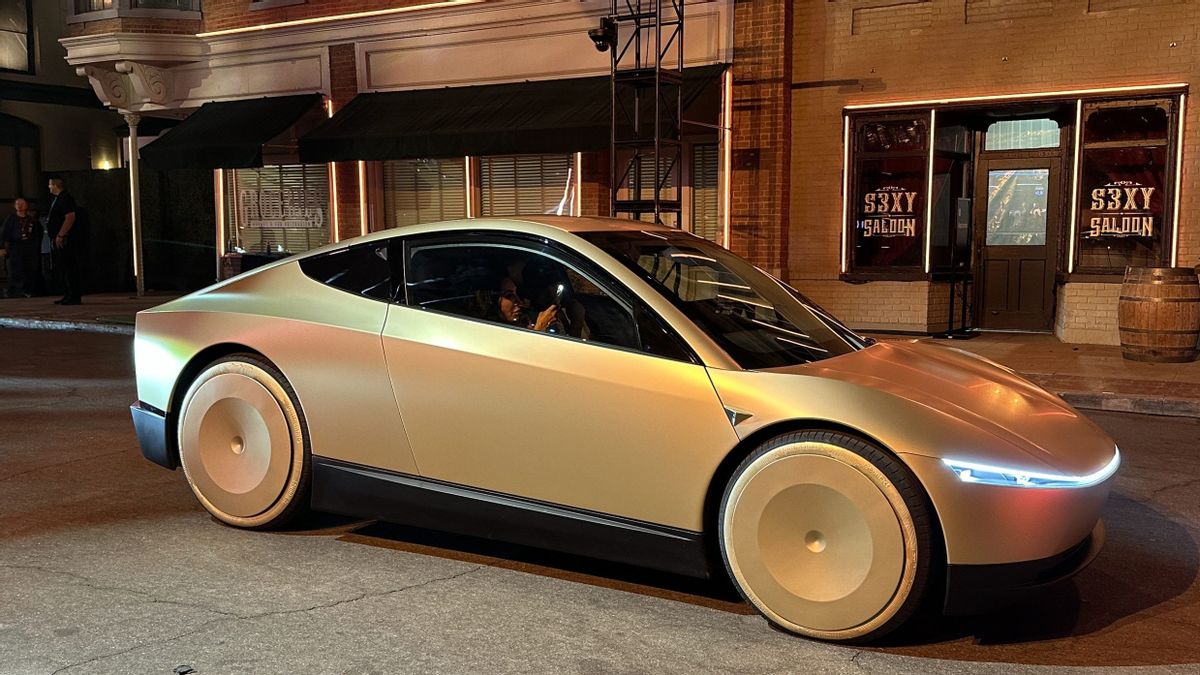


JAKARTA Elon Musk and Tesla are indeed known for their ambitious targets that often grab the world's attention. However, big ambitions are often accompanied by delays and changes in direction, as happened at the launch of the Cybertruck which was delayed repeatedly and drew controversy related to design, performance claims, to the quality of its production.
Now, the spotlight is back on the long promised robotaxi project. Although it was doubtful, Tesla is set to start a trial of its first robotaxi service in Austin, Texas, at the end of June, on schedule. This was revealed directly by CEO Elon Musk on Tuesday, May 20.
This step was taken amid intense scrutiny from US regulators regarding safety aspects, which are still a major concern in the development of autonomous vehicles.
In an interview with CNBC and quoted from Reuters, Wednesday, May 21, Musk stated that the electric vehicle manufacturer will launch about 10 self-driving cars in several parts of the city, and will increase it to about a thousand in the coming months.
"We're actually going to launch not across Austin's territory, but only in the safest part," Musk said.
Successful robotaxi trials are essential for Tesla, as Musk has shifted the company's focus from building a cheaper new EV platform to the launch of the robotaxi and humanoid robot Optimus services. Most Tesla valuations rely on this bet.
"The only thing that matters in the long term is autonomy and optimism," Musk told CNBC.
SEE ALSO:
Autonomous vehicle technology is indeed difficult to commercialize, with strict regulations and large investments forcing many companies to give up. Those who are still in competition, including Alphabet's Waymo, face tighter scrutiny.
The US National Highway Traffic Safety Administration (NHTSA) has investigated collisions involving Tesla's advanced Full Self-Driving (FSD) driver assistance software under poor road visibility since October. Last week, US road safety regulators asked Tesla to answer questions about the launch of its paid robotaxi service to assess how the cars would operate in bad weather.
Musk also said that Tesla is in talks with major automakers to license FSD software that is expected to underlie their robotaxi.
To support Musk's vision of broader artificial intelligence, Musk's xAI startup has increased its data center capacity to train its more advanced models, and its supercomputer cluster in Memphis, Tennessee, called "Colossus," is touted as the largest in the world.
"xAI will use one million advanced Blackwell chips from Nvidia in a new facility near Memphis," Musk said.
"As long as Nvidia is better than what we made, we will continue to buy from Nvidia," he said.
xAI purchased a one million-square-foot property in Southwest Memphis, Tennessee, the Greater Memphis Chamber of Commerce said in March.
Musk, who combined xAI with his social media platform X in March, said that the merger between Tesla and xAI was not under consideration but "not impossible," although it would require shareholder approval.
The English, Chinese, Japanese, Arabic, and French versions are automatically generated by the AI. So there may still be inaccuracies in translating, please always see Indonesian as our main language. (system supported by DigitalSiber.id)
Most Popular Tags
#Prabowo Subianto #donald trump #Febrie Adriansyah #8791 #giias 2026Popular


