
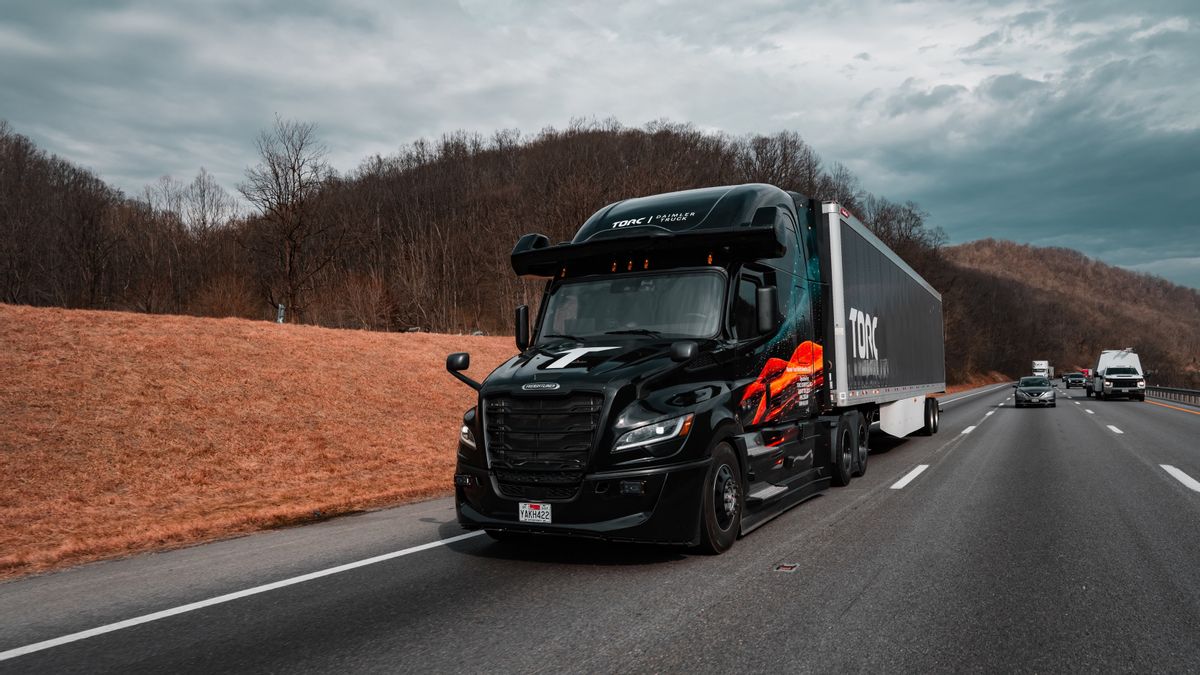


JAKARTA - Daimler Truck North America (DTNA) has just started mass production of its fifth-generation Cascadia Freightliner truck specifically designed to operate autonomously. This revolutionary move marks a significant jump from a modification prototype to a fully ready-to-driven commercial vehicle behind the wheel.
This good news is becoming increasingly evident with the delivery of Cascadia's first autonomous units to Torc Robotics, a DTNA subsidiary that focuses on developing self-driving technology. These advanced trucks are equipped with various sensors needed to reach the SAE Level 4 autonomous level, which means the vehicle is capable of handling all aspects of driving under specified operational conditions.
"Daimler Truck North America installed all important computing and censorship devices during the vehicle production process," explained the manufacturer in the manufacturer's media room, quoted Friday, April 25.
This preparation is said to allow Torc Robotics to seamlessly integrate their virtual drivers after delivery.
SEE ALSO:
-
 | OTOINFO
Geely Ikuti Auto Shanghai 2025 dengan Bawa Inovasi Terbaiknya, Apa Saja?
25 April 2025, 10:18 -
 | OTOINFO
Tarif Impor di AS Diberlakukan, Hyundai Alihkan Produksi Tucson ke Alabama
25 April 2025, 09:20 -
 | OTOINFO
AS Permudah Aturan Keselamatan untuk Kendaraan Otonom, Tuai Reaksi Beragam
25 April 2025, 08:17
Torc Robotics itself plans to conduct a series of intensive trials on various routes in Texas, Arizona, and New Mexico. One of the main routes to focus is the I-35 route connecting Dallas and Laredo, a corridor with a very high volume of goods delivery. In addition, Torc is also building a special hub for autonomous trucks in the Dallas-Fort Worth area, which will be the center of their testing activities.
"Our strong collaboration with Daimler Truck spanned six years in order to advance the future of freight transport. The full integration of Torc autonomous drivers with Daimler Truck's Freightliner Cascadia platform created the first physical AI autonomous truck solution in the industry. This will open up tremendous value for our customers by addressing the main issues in the industry and presenting clear opportunities to generate revenue and drive meaningful transformation across the industry," said Torc CEO Peter Vaughan Schmidt.
Previously, Torc had successfully conducted driverless trials on multi-path tracks in Texas. In the coming months, they will increase the intensity of testing on highways with real traffic. The target is clear, namely launching commercial operations of SAE Level 4 autonomous trucks by 2027, connecting various logistics centers.
Although the initial commercial route is expected to be centered in Texas, other autonomous technology developers are also racing to realize routes between states.
While citing from Autoweek, one of Torc's competitors, Kodiak Robotics, has even launched autonomous trucks operating in mining areas for sand shipments, although under different road conditions with heavy traffic on highways.
Daimler Truck and Torc Robotics' move clearly shows the seriousness of the automotive industry in realizing a more efficient, secure, and perhaps cheaper vision of future goods transportation. We'll just have to wait for the next breakthrough!
The English, Chinese, Japanese, Arabic, and French versions are automatically generated by the AI. So there may still be inaccuracies in translating, please always see Indonesian as our main language. (system supported by DigitalSiber.id)


