
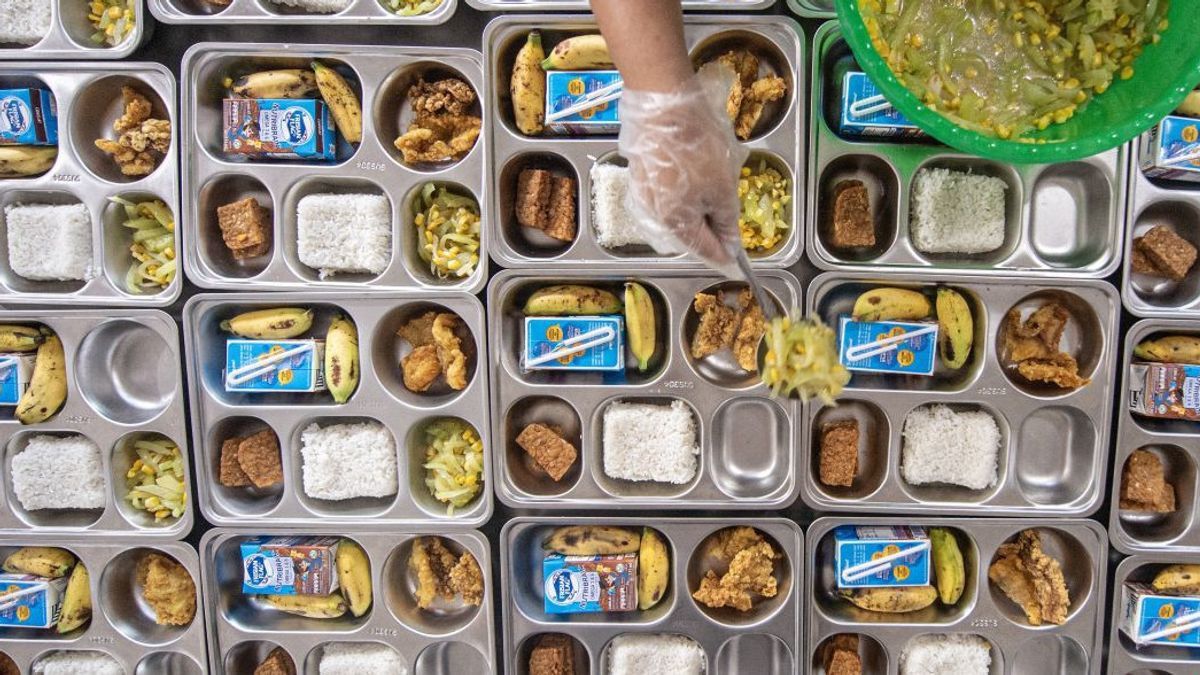


The Free Nutritious Meal program is not being tested for its intentions. The intention is hard to deny. Hungry children must eat. Malnourished children must be helped. Pregnant women, toddlers, and poor families must be reached first by the state.
MBG also has a strong political effect. The Poltracking Indonesia survey released in early April 2026 recorded public confidence in the Prabowo-Gibran government at 75.1 percent. From the 74.1 percent of citizens who are satisfied with the government's performance, Free Nutritional Meals are said to be one of the driving factors.
However, public support does not mean that all questions are resolved. What is being tested now is how the state runs this program. BGN said that the managed budget reached IDR 268 trillion. As much as 93 percent was allocated directly for MBG assistance. Of the approximately IDR 249 trillion program budget, 70 percent is said to be for raw materials. The rest is for operations, including electricity, vehicles, and volunteer salaries.
That's people's money. Every rupiah must be clear. Not only out of the state treasury, but really to the plate of children who need it.
Here, the evaluation of MBG becomes important. The evaluation is increasingly urgent because the country is tightening spending. The government is also facing rising prices, from non-subsidized fuel to plastic raw materials which are also affected by the Middle East conflict and supply chain disruptions in the Strait of Hormuz.
President Prabowo Subianto is said to have started directing MBG to be more targeted. Deputy Chairman of the MPR Eddy Soeparno appreciated this step. He said that priority must be given to children who really need it, especially when the state's fiscal space is not loose.
This direction makes sense. MBG should not be a uniform program for everyone. Children from poor families and students in underdeveloped areas should definitely be reached first. But should children in private secondary schools and elite in big cities get the same priority?
Here the government must dare to choose. MBG is needed. But not everyone has to accept it.
Based on UNICEF data 2024, Indonesia has around 84.2 million children under the age of 18, or almost a third of the total population. The number is large. However, their conditions are not the same.
There are children who live in a family that is able. There are also those who grow up in poor homes, food-prone areas, and environments with poor nutritional access.
This means that the main target of MBG is clear. The vulnerable group of nutrition. Not all children, in all schools, with the same treatment.
BGN targets 82.9 million children to receive MBG by 2026. BGN Head Dadan Hindayana in July 2025 said there were already 6.2 million beneficiaries. This scale is politically large. But the bigger the program, the greater the risk of leaks, wrong targets, and difficult to monitor.
The KPK has given a warning. The MBG program is said to have a number of corruption-prone points. One of the most basic notes is that there is no measurable indicator of success. The baseline nutritional status and achievement of beneficiaries are also not fully strong.
"This is not a small technical matter. Without indicators, the state only distributes food. Not improving nutrition.
Controversy also came in waves. There is an issue of electric motorcycles for SPPG operations. BGN denied the figure of 70,000 units and said that the realization of the procurement of 21,801 units out of a total of 25,000 units was ordered in 2025. There is also a spotlight on the price and e-purchasing mechanism which is considered difficult to monitor by the public.
Not finished with the electric motorcycle, another spotlight emerged. There is a budget for event organizers of Rp. 113.9 billion, video conference of Rp. 5.7 billion, to clarify the needs of 19,000 cows which are said to be only simulations. BGN has an explanation. But the public still has the right to ask, are all these expenses more urgent than ensuring that children's menus are decent, the kitchen is safe, and the recipients are really right?
The case of suspected poisoning should also not be considered a minor disturbance. In a program of this size, child safety must be the first fence. One wrong dish can damage public trust.
MBG should not be more busy taking care of vehicles, online meetings, EO, and supporting devices, but forget about the contents of the child's plate.
"This program must be returned to its original purpose, namely feeding those who really need it. The government should not be ashamed to make corrections. It is from the correction that the public can see that this program is really being maintained.
Free nutritious meals are necessary. But MBG should not be wasteful of targets. Poor children must be prioritized. Meanwhile, elite schools in big cities, affluent families, and groups that are not at risk of malnutrition, should not be placed in the first line.
Because fair does not mean that everyone gets the same share. Fair means that those who need it most must be prioritized first.
The English, Chinese, Japanese, Arabic, and French versions are automatically generated by the AI. So there may still be inaccuracies in translating, please always see Indonesian as our main language. (system supported by DigitalSiber.id)
Most Popular Tags
#Prabowo Subianto #donald trump #firearm #8791 #giias 2026Popular


