
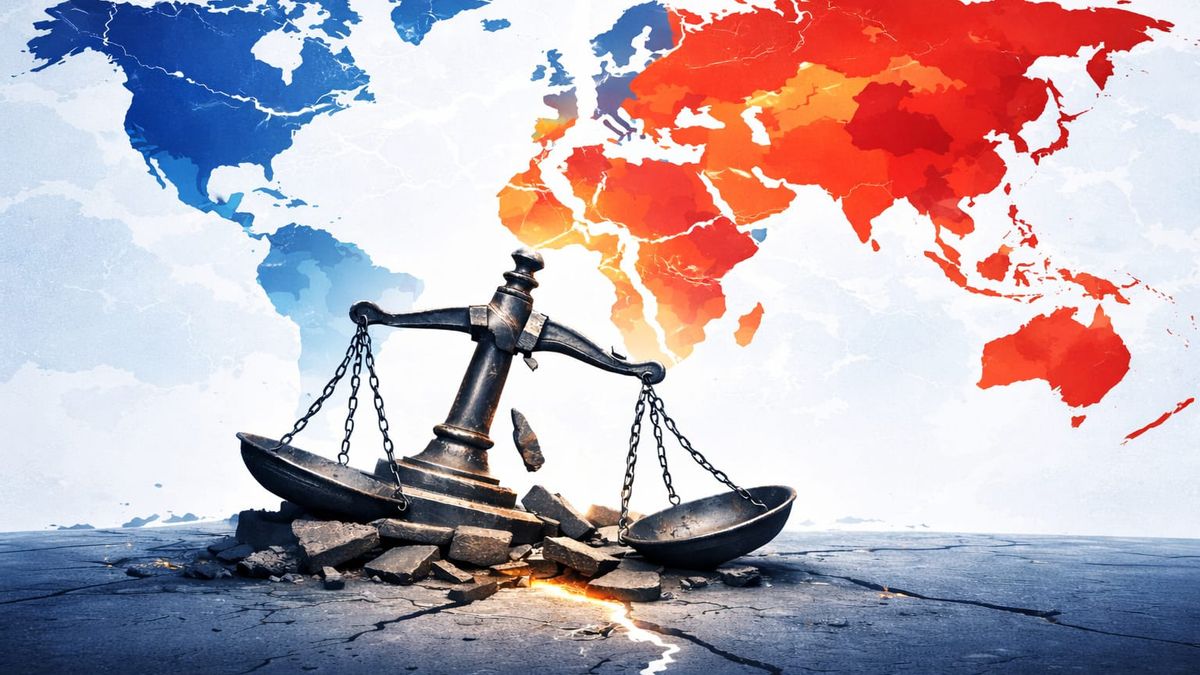


The United States' attack on Venezuela shocked the world. Not because of its military strength, but because of the precedent. A sovereign country was attacked. Its president was claimed to have been arrested. The world was forced to watch without clear international legal mechanisms.
Similar to the Hollywood movie story, the military operation was announced directly by the President of the United States, Donald Trump. Washington claimed to attack targets in the Venezuelan region and said President Nicolas Maduro had been arrested in the operation. The detention photo was even released to the public, as if confirming the unilateral success.
Trump accused Maduro of being involved in drug crimes. However, to date, the accusation has not been accompanied by open evidence that has been tested in international courts. There is no cross-border legal process. There is no mandate from the United Nations Security Council.
In fact, Article 2 (4) of the Charter of the United Nations explicitly prohibits the use of force against the territorial integrity and political sovereignty of other states. This principle is reinforced by the United Nations General Assembly Resolution 2625 (1970) on the Declaration on Principles of International Law, which affirms the prohibition of intervention and the use of force in international relations. In the framework of this law, the use of military force against Venezuela - if carried out without the mandate of the UN Security Council - potentially contradicts the basic principles of international law.
UN Secretary-General Antonio Guterres, through spokesman Stephane Dujarric, called this aggression a dangerous precedent. The statement is important, because international law stands on the basis of sovereignty and equality of states. When these principles are openly violated, the foundations of the world order are shaken.
China strongly condemned the United States' actions and called it a serious violation of state sovereignty. Malaysia expressed similar criticism. Vice President of Venezuela Delcy Rodríguez asserted that Nicolas Maduro remains the president of Venezuela, while rejecting the claims of the United States. He warned that what happened in Venezuela could befall any country in the region if this practice of unilateral use of force is allowed.
The Indonesian government monitors the condition of Indonesian citizens through the Indonesian Embassy in Caracas and emphasizes the importance of respecting international law and the UN Charter. This attitude is a recognition that this issue goes beyond bilateral conflicts.
The main problem is not who Nicolas Maduro is. The fundamental question is the way. A president of a sovereign country is claimed to have been arrested by another country through a military operation, without international legal processes, without a court, and without global approval. If this practice is justified, international law loses its legitimacy. Strong states have the potential to act as world police. Accusing, attacking, and arresting unilaterally. The principle of the rule of law is replaced by the rule of power.
Donald Trump's statement admitting that extreme options were once considered further clarifies the direction of the policy. Power is placed before the law. Diplomacy and multilateral mechanisms are set aside.
Not long after the military operation, another issue emerged. The United States began talking about managing the Venezuelan oil industry. The global market responded quickly. Oil prices fluctuated. The world read signals of broader interests.
Venezuela has the largest oil reserves in the world. This fact is difficult to separate from the geopolitical context. In global history, when weapons are spoken, resources often become the ultimate goal.
This attack should be seriously criticized, not only for Venezuela, but for maintaining a fair global order. If the world chooses to be silent, then this precedent will be repeated with different forms and targets.
Today it's Venezuela. Tomorrow it could be another country. It doesn't have to be a small or weak country. It just has to have opposing interests.
When a president of a sovereign country can be arrested without international legal process, then no country is really safe. Moreover, the world is unstable. The Russia-Ukraine war is dragging on. Palestine - Israel is burning.
In Southeast Asia, the conflict between Thailand and Cambodia is not yet completely calm. If unilateral military action is justified, sovereignty only applies to the strong. When international law is no longer respected, world chaos can potentially spread. If you want to be extreme, it has the potential to trigger World War III.
The English, Chinese, Japanese, Arabic, and French versions are automatically generated by the AI. So there may still be inaccuracies in translating, please always see Indonesian as our main language. (system supported by DigitalSiber.id)
Most Popular Tags
#Prabowo Subianto #donald trump #2026 World Cup #Febrie Adriansyah #8791Popular


