
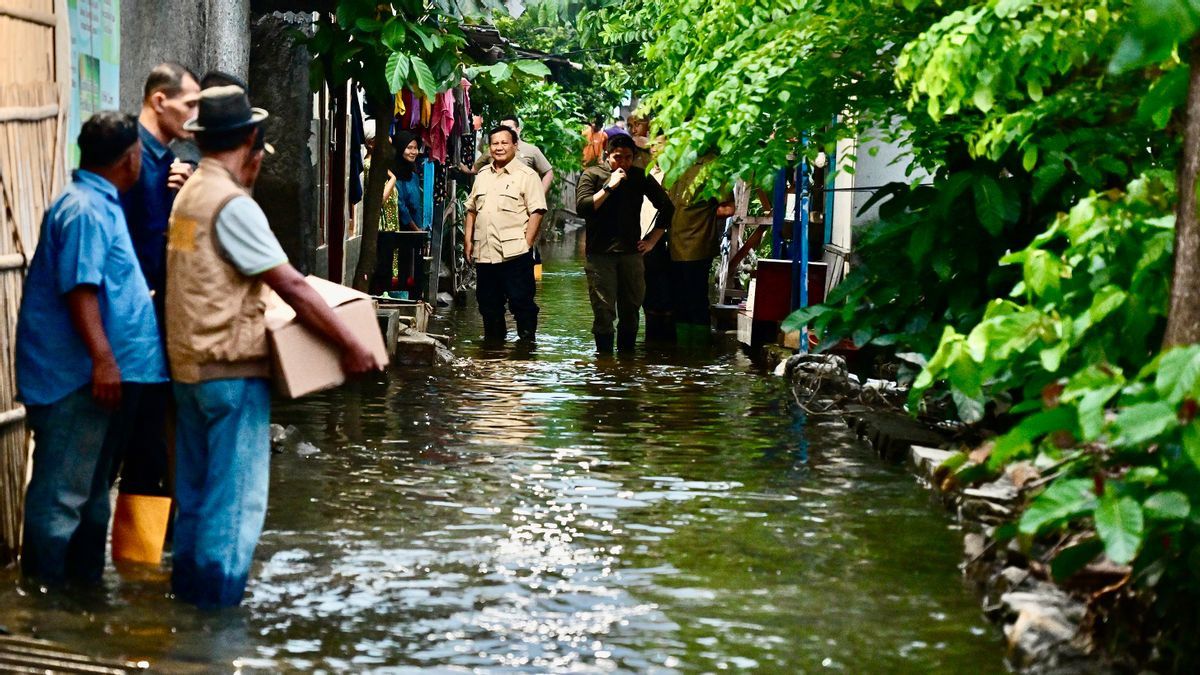


Last week, thousands of residents of Jakarta and Bekasi were relocated due to floods that inundated their homes up to three meters deep. This disaster was not simply a natural phenomenon, but the result of human greed, sacrificing the environment for short-term gain.
Reportedly, since 2010, the 15,000-hectare upstream of the Ciliwung River Basin (DAS) has been designated as a protected forest and water catchment area. However, data from the Ministry of Environment shows that by 2022, 8,000 hectares of this land had been converted to agricultural and residential areas, with illegal expansion reaching 1,500 hectares. The riverbed has even been converted into resorts and tourist attractions without permits.
The impact of the floods also extended to education. A total of 114 schools in Bekasi, from elementary to high school, were inundated. Thousands of students were forced to suspend classes, while the local government promised to repair facilities according to the extent of damage. However, promises alone are insufficient if the root of the problem is not addressed.
In Jakarta, the Ciliwung canal project, touted as a solution, has been called into question for its effectiveness. Residents of Kebon Pala are still experiencing two-meter-high flooding, raising doubts about the utility of the multi-billion-rupiah project.
After the water receded, another impact emerged: mountains of garbage piled up in Cililitan Kecil, East Jakarta. Residents worked together to clean up the mud and trash, while PPSU officers were overwhelmed by the ever-increasing volume of waste.
As the lyrics of Ebiet G. Ade's song "Berita Untuk Kawan" suggest, "Maybe God is getting tired of seeing our behavior, always making mistakes and proud of our sins." The question is, is this disaster simply a test of nature, or is it a consequence of our arrogance in managing the environment?
The flooding in Greater Jakarta (Jabodetabek) is not just a natural phenomenon. It is a consequence of poor environmental management and a disregard for regulations. If this pattern continues, the disaster will become an annual cycle that worsens. It's a cliché that repeats itself every flood season. The solution is actually the same. The community and government must act more decisively: stop environmental destruction, strengthen regulations, and never let greed overwhelm our city again.
The steps taken by Coordinating Minister for Food Affairs Zulkifli Hasan and West Java Governor Dedy Mulyadi to close four illegal tourist attractions in the Puncak area, including Hibiscus Fantasy, which stands on 21 hectares of Gunung Mas tea forest land, are commendable. The building had a permit for only 4,800 square meters, but its expansion has doubled.
Environment Minister Hanif Faisol Nurofiq promised to prosecute the owners of illegal buildings who contributed to this disaster. This is also commendable. However, legal action alone is insufficient if enforcement remains weak. Land conversion remains rampant, and illegal construction continues to be allowed to occur.
Officials must immediately take concrete steps and set an example. Don't act foolishly and become the target of netizens' criticism. Like Jakarta Deputy Governor Rano Karno, who was pushed into a rubber boat when the floodwaters were no deeper than his knees. President Prabowo should be like him, who stepped down without a rubber boat.
The English, Chinese, Japanese, Arabic, and French versions are automatically generated by the AI. So there may still be inaccuracies in translating, please always see Indonesian as our main language. (system supported by DigitalSiber.id)


