
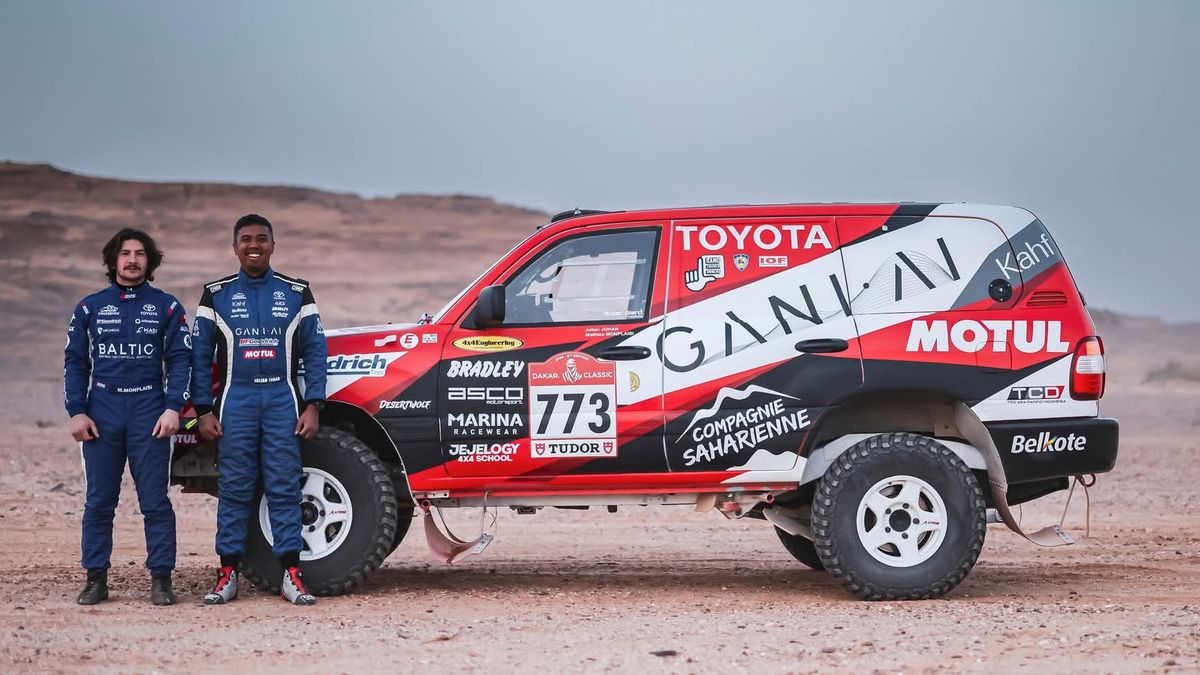


Yanbu Desert on the Red Sea coast is the end point of an unusual long journey for Indonesian motorsport. In this city, Julian Johan, who is familiarly called Jeje, together with Shammie Zacky Baridwan completed the 13th stage of the 2026 Dakar Rally. This achievement, at the same time, recorded history as the first racer from Indonesia who managed to reach the finish line of the world's toughest rally event.
The 2026 Dakar Rally takes place from January 3, covering about 8,000 kilometers in 13 stages across a variety of extreme terrain, ranging from deserts, rocky tracks, open savannahs, to marathon stages that demand physical and mental endurance without compromise. Every day presents a different challenge, both in terms of navigation, weather, and time pressure.
Jeje and Shammie compete in the Dakar Classic category, a class that does not emphasize speed alone. Timeliness, consistency, and the ability to survive under pressure are the determining factors. Small mistakes in reading the rhythm or navigation can result in penalties second by second.
The final result reflects this toughness. Jeje closed the Dakar Classic in fifth place in the overall standings with a score of 1,357 points and finished third in the H2 class. Driving a 2001 Toyota Land Cruiser 100 with co-driver from France, Mathieu Monplaisi, Jeje made his debut in Dakar without previous experience in rally events with similar difficulty levels.
Meanwhile, Shammie and navigator Ignas Daunoravicius finished in seventh place in the general standings with a score of 1,393 points and took third place in the H1 class. In the midst of the ups and downs of one stage to another, Shammie recorded an important moment in the history of national motorsport, namely the victory in Stage 11, making him the first Indonesian to win a stage of the Dakar Rally.
Dakar Classic has a different race pattern from conventional rallies. There is no competition for who is the fastest from start to finish. Participants must maintain a certain average speed, comply with coordinate points, and enter the radius of the waypoint with precision. Too fast or too slow are both at risk of penalties.
"This is not a start to finish quickly. It is precise," said Shammie, describing the character of the race that requires more calmness and accuracy.
Physical and mental pressure is present from early morning. From the bivouac to the starting point, the distance can reach tens of kilometers before the race starts. Desert temperatures in the morning can drop to single digits, then jump sharply during the day. There is no official lunch break, only snacks and fruit in the car, while the racers have to wear wearpack for hours.
In one stage, Shammie was at the lowest point when his car was stuck in the sand. The evacuation process was carried out alone with the navigator, getting in and out of the car many times in the midst of a drained physical condition.
"Our energy is at the end. But we rest for a while, then we go again," he said.
The process took more than three hours, approaching the maximum limit of the stage. But Dakar did not stop waiting. The next stage still has to be carried out on the same day.
In the midst of that pressure, Stage 11 became a turning point. The regularity-format stage with a relatively flat track and minimal handicap opens up opportunities for riders who are able to maintain a consistent rhythm. The new victory was confirmed when Shammie arrived at the bivouac and saw the welcome of other participants.
For Jeje, Dakar is also a lesson about self-limit and strategy. With a non-turbo car and limited power, a half-and-half approach is not possible. He chose a ready-to-race car package from the French team, Compagnie Saharienne, which provided vehicles and technicians at a cost of around Rp3 billion.
The presence of Jeje and Shammie marked Indonesia's return to the Dakar Rally after 15 years. The last time Indonesian racers appeared was in 2011 through Kasih Hanggoro, while previously Tinton Soeprapto took part in the Dakar in 1990.
At the finish line in Yanbu, there was no excessive celebration. All that was left was a tired body and the realization that Indonesia is now listed in the Dakar Rally finisher list.
For Jeje and Shammie, this achievement is not just about ranking, but about completing the choices made with all its limitations.
"Never look at what the state gives us. But there is proof that we give to the state, at least for our children, or the people we love," said Shammie.
The English, Chinese, Japanese, Arabic, and French versions are automatically generated by the AI. So there may still be inaccuracies in translating, please always see Indonesian as our main language. (system supported by DigitalSiber.id)
Most Popular Tags
#Prabowo Subianto #donald trump #2026 World Cup #Febrie Adriansyah #8791Popular


