

JAKARTA - Academics and researchers criticize the strengthening of the role of the military in the civil space in the era of the government of President Prabowo Subianto and Vice President Gibran Rakabuming Raka. They assess that the symptoms of remilitarism are beginning to appear through the expansion of the role of the Indonesian National Army (TNI) in various non-defense sectors, ranging from food, national strategic projects, to government governance.
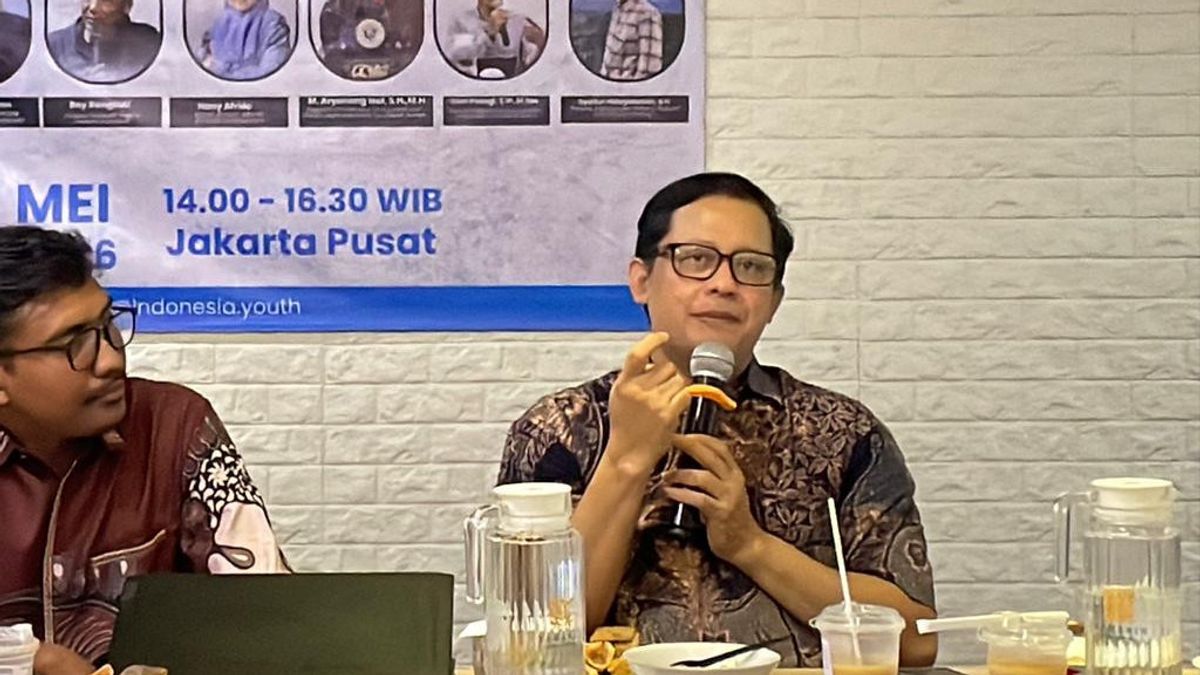
The criticism emerged in a public discussion entitled "Remilitarism and the Future of Indonesian Democracy: Revealing the Reform of the Defense Sector, Civil Supremacy, and Threats to Human Rights" which was held in Jakarta, Friday, May 29.
Social-political academic at the State University of Jakarta (UNJ), Ubedilah Badrun, assessed that the current phenomenon of remilitarism is a serious threat to democracy and human rights (HAM). According to him, the return of the military to civilian spaces is contrary to the principle of democracy which places civil supremacy as the main foundation of the state.
"Militarism means the revival or return of the military in civilian spaces. It is very contrary to the principles of democracy and human rights," said Ubedilah.
He assessed that this tendency could not be separated from the genealogy of the current political power which was considered still carrying the romance of the New Order.
"His socio-political imagination still carries the shadow of the past. There is a romanticism towards the New Order era which is considered subjectively beautiful," he said.
According to Ubedilah, this situation makes the involvement of the military in various civilian sectors increasingly considered reasonable. In fact, he said, the 1998 reform was born to limit the dominance of the military in civilian and political life.
In addition to democracy, Ubedilah also highlighted the human rights issue which was considered incomplete. He said the re-emergence of a militaristic approach has the potential to worsen the quality of Indonesian democracy.
"When the actor of gross human rights violations in the past becomes President, then we are experiencing a setback as a nation," he said.
Meanwhile, the Head of the Indonesian Laboratory 2045 (LAB 45), Jaleswari Pramodhawardani, assessed that what is happening now is not just the return of the dual function of the ABRI as in the past, but a new form of militarization that is more subtle and systematic.
"What we are witnessing today is not the return of the military, but the re-blooming of a tree whose roots were never really uprooted," said Jaleswari.
According to him, the government has always used the logic of efficiency to involve the military in various civilian issues, ranging from food, development, to national strategic projects.
"Every time there is a difficult problem such as land regulation, food distribution, infrastructure development in remote areas, the answer always comes: just involve the TNI, then everything will be fine," he said.
However, Jaleswari warned that this approach is dangerous because it obscures the chain of civil accountability in a democracy.
Public policy and governance researcher, Gian Kasogi, also assessed that there was a systematic expansion of the defense sector through various state regulations throughout 2024-2026.
According to Gian, the series of regulations form a "blueprint of power" that expands the military's functions into various civilian sectors.
"Democracy today collapses quietly. It creeps through articles, new bureaucratic structures, and the expansion of seemingly administrative authority," said Gian.
He highlighted a number of regulations such as the revision of the 2025 TNI Law, the establishment of the National Defense Council (DPN), the Forest Area Enforcement Task Force, to the construction of 750 Territorial Development Battalions which are considered to expand the legitimacy of the military in the domestic space.
"When one circle controls food logistics, communication intelligence, cyber networks, territorial battalions in hundreds of districts, to the largest mining holding, then it automatically turns into a very large political capital," he said.
Director of the Indonesian Madani Circle (LIMA), Ray Rangkuti, assessed that one of the main agendas of the 1998 Reformasi, namely returning the TNI as a professional army, is now beginning to experience setbacks.
"Going back to the barracks is a term to show the importance of the TNI as a professional soldier," said Ray.
According to him, the reform of the security sector for 25 years has actually run quite well because the TNI focuses on the function of state defense. However, the situation changed after the revision of the 2025 TNI Law which expanded the interpretation of Military Operations Other than War (OMSP).
"Now the TNI can go anywhere. Take care of beggars, food, corn, food estates, agriculture, and various other civilian spaces," he said.
Meanwhile, the Manager of the Indonesia for Global Justice (IGJ) Program, M. Aryanang Irsal, highlighted the involvement of security personnel in national strategic projects related to large investments and international corporations.
According to Aryanang, the pattern of violence against indigenous people and local residents in various strategic projects shows the increasing strength of the relationship between the economic oligarchy and the state security approach.
"What we are seeing now is a kind of cross-marriage between the global oligarchy, the local oligarchy, and military actors," he said.
Legal and strategic litigation researcher Saiful Hidayatullah also criticized the construction of the Territorial Development Battalion as well as the involvement of the TNI in the Red and White Village Cooperative program.
According to him, the placement of the military in criminal, food, and village cooperatives is a mistake because the task is in the civil sphere.
"The task of dealing with crime is a civilian task, in this case the task of the police, not the army," he said.
Saiful assessed that the presence of the military in civilian spaces actually made the public feel afraid.
"The presence of the TNI through this territorial battalion of development makes residents afraid. This is a way to make people afraid," he said.
The English, Chinese, Japanese, Arabic, and French versions are automatically generated by the AI. So there may still be inaccuracies in translating, please always see Indonesian as our main language. (system supported by DigitalSiber.id)