

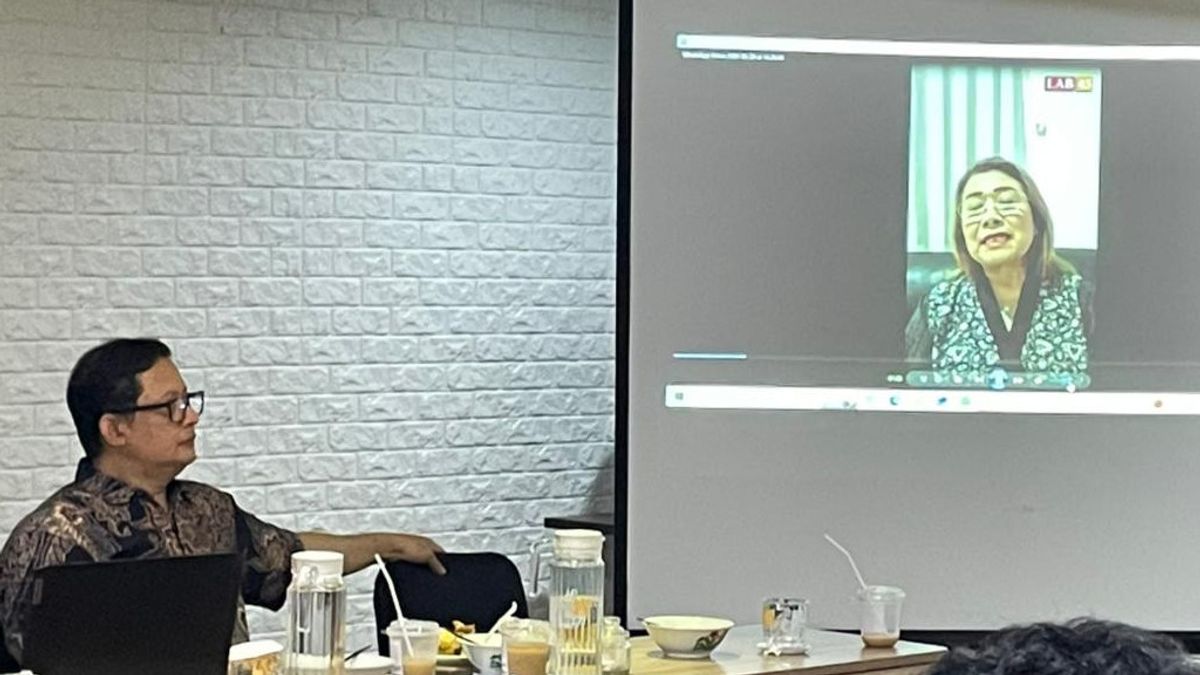


JAKARTA - Head of the Indonesia 2045 Laboratory (LAB 45) Jaleswari Pramodhawardani assessed the involvement of the military in various civilian sectors today shows a pattern that leads to the militarization of civil governance in Indonesia. According to him, this condition no longer merely reflects the return of the New Order-style dual function of the military, but a new form that is more subtle and systematic.
Jaleswari made the statement in a public discussion entitled "Remilitarism and the Future of Indonesian Democracy: Revealing the Reform of the Defense Sector, Civil Supremacy, and Threats to Human Rights" in Jakarta, Friday, May 29.
In his presentation, Jaleswari revealed the logic that the government has often used to involve the TNI in various civilian affairs, ranging from national strategic projects (PSN), food estates, handling the Papua conflict, to development programs in the region.
"Every time there is a difficult problem such as land regulation, food distribution, infrastructure development in remote areas, the answer always comes: just involve the TNI, then everything will be fine," said Jaleswari.
According to him, the reason that the government often uses in involving the military is because the TNI is considered disciplined, fast, has a network to the farthest corners, and is considered more efficient.
However, Jaleswari considers that this approach is dangerous for democracy because it obscures the principle of civil accountability.
"Democracy is about accountability, about mechanisms, about who can be held accountable," he said.
He gave an example, when soldiers are involved in food management, national strategic projects, or cooperative development, the chain of civil responsibility becomes blurred.
"When there are indigenous people whose land is confiscated, when there are farmers who protest, who should they complain to? To the regent, minister, or battalion commander?" said Jaleswari.
According to him, this situation creates a condition called "the rule of nobody", namely when all parties only carry out orders so that no one can really be held accountable.
Jaleswari emphasized that the current problem is not merely remilitarism because the reform of the security sector after 1998 is considered to have never been truly complete.
He alluded to a number of issues that have not been resolved, such as the revision of the Military Justice Law, military business, to a political culture that still sees the army as a solution to various civilian problems.
"What we are witnessing today is not the return of the military, but the re-blooming of a tree whose roots were never really uprooted," he said.
On that occasion, Jaleswari also highlighted the existence of the National Defense Council (DPN) which he considered to have serious implications for the Indonesian constitutional democracy system.
According to him, the DPN has the potential to consolidate defense, intelligence, and security issues in one power table without clear oversight mechanisms.
"Who controls the table? Who checks the decision? Who can cancel it?" he said.
He reminded that democracy was built on the principle of checks and balances because power always has the potential to be misused.
In addition, Jaleswari also highlighted the existence of the Forest Area Enforcement Task Force (PKH), the construction of 750 Territorial Development Battalions, to the dominance of military and ex-military elements in a number of strategic state institutions.
According to him, this condition is slowly forming a "parallel state" that runs alongside the civil state but uses the logic of the military chain of command.
"A country that runs in parallel with a civilian state, but with the logic of chain of command and a different culture," he said.
Jaleswari also assessed that a number of TNI's involvement outside the defense function had the potential to be in conflict with Law Number 34 of 2004 concerning the TNI.
He emphasized that Article 7 of the TNI Law which regulates military operations other than war (OMSP) does not explicitly mandate the TNI to manage food or cooperative development.
"If there are presidential instructions or presidential regulations that assign the TNI to areas not regulated by law, then we are witnessing a violation of the law that is legalized through executive decisions," he said.
According to Jaleswari, the current democratic setback does not come through military coups or tanks in the streets, but through administrative policies that emerge slowly through various regulations and task forces. "Perpres for Perpres, Inpres for Inpres, task force for task force," he said.
At the end of his presentation, Jaleswari reminded the importance of the role of the younger generation in maintaining democracy and the reform agenda in Indonesia.
"It takes young people who are brave enough to say what it is. This is our common task as children of the nation to improve the condition of the nation," he said.
The discussion also featured a number of other speakers, including LIMA Indonesia Director Ray Rangkuti, social-political analyst at the State University of Jakarta Ubedilah Badrun, lecturer at the National University of Firdaus Syam, to legal and strategic litigation researcher Saiful Hidayatullah.
The English, Chinese, Japanese, Arabic, and French versions are automatically generated by the AI. So there may still be inaccuracies in translating, please always see Indonesian as our main language. (system supported by DigitalSiber.id)
Most Popular Tags
#Prabowo Subianto #donald trump #Febrie Adriansyah #8791 #giias 2026Popular


