

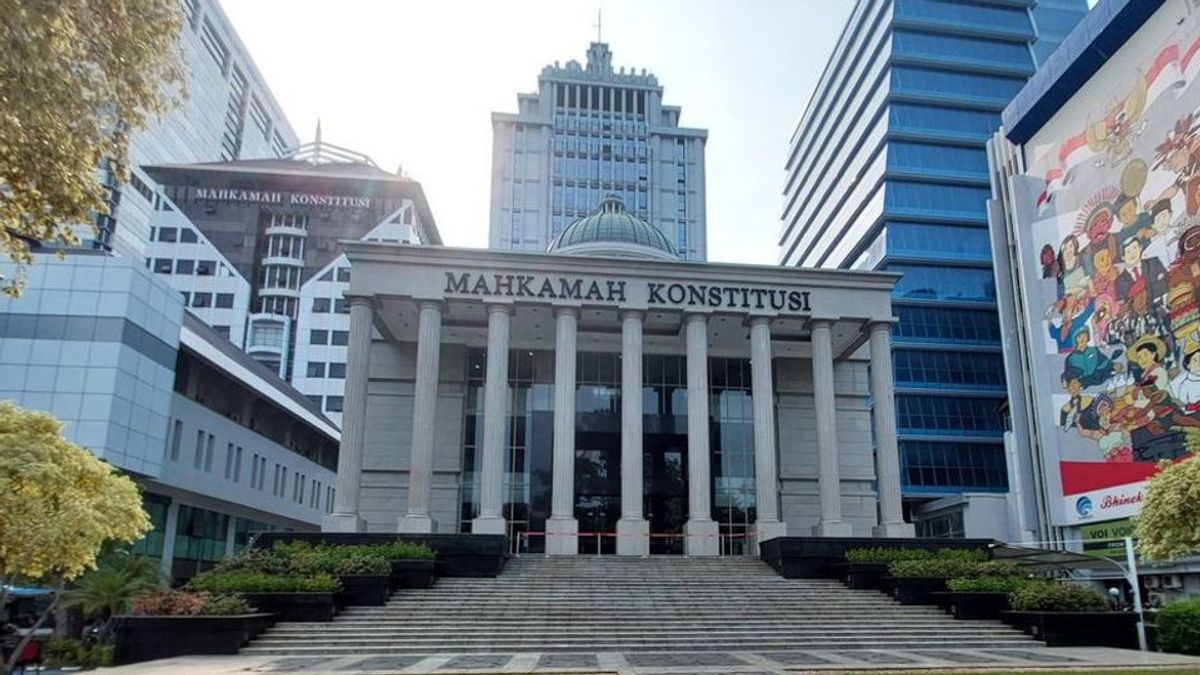


JAKARTA - The test of the material of Law Number 37 of 2004 concerning Bankruptcy and Debt Payment Suspension (PKPU) submitted by Yuli Chandra Dewi, wife of bankrupt debtor Rachmat Agung Leonardi (RAL), at the Constitutional Court (MK) is considered legally inappropriate. The application questions the provision on the separation of property between husband and wife in bankruptcy cases.
The Expert Staff of the Minister of Law for Economic and Social Affairs, Wisnu Nugroho Dewanto, emphasized that in the Indonesian legal system, the unity of property is a legal consequence of marriage that is not accompanied by a separation of property agreement as stipulated in Article 35 paragraph (1) of Law Number 1 of 1974 concerning Marriage.
"In the Indonesian legal system, the existence of a joint property is a legal consequence of a marriage that is not accompanied by a property separation agreement," said Wisnu in a trial at the Constitutional Court Building, Jakarta.
According to him, all the property in marriage becomes one unit of family wealth. Therefore, when one of the spouses is declared bankrupt, the common property is legally included in the bankrupt boedel as regulated in Article 23 and Article 64 paragraph (1) of the Bankruptcy Law and PKPU.
Wisnu also said the argument of the applicant who claimed not to know or approve of her husband's debt was a factual issue that should be proven in the case process in the commercial court.
A similar view was expressed by Lecturer of the Master of Law Study Program, Faculty of Law, University of Gadjah Mada, Nien Rafles Siregar, who was present as an expert on bankruptcy.
"In a marriage that adheres to the unity of property, then the common property can also be part of the bankrupt property if one party has debts related to the common interest," he said.
He assessed that if every legal action of a husband or wife in marriage must always have the consent of the spouse, it would be difficult to implement in practice.
"This application has the potential to cause difficulties in practice. If every action of a husband or wife who is bound by marriage and property union must always get the consent of the partner, it will be very difficult to implement," he said.
On the other hand, the Rachmat Agung Leonardi Curator Team assessed that the legal steps taken by Yuli Chandra Dewi led to a pattern of vexatious litigation or repeated lawsuits that were allegedly aimed at hindering the bankruptcy process.
One of the curators, Yefta P. Kaligis, said Yuli had made five parallel legal efforts at the same time, ranging from civil lawsuits, police reports, judicial review to the Constitutional Court, reports to the National Police Criminal Investigation Unit, to pre-trial at the Denpasar District Court.
"The real evidence of the vexatious pattern, where even though Yuli's police report has been SP3 because there is not enough evidence, he still filed a pretrial," said Yefta.
He said that these various legal steps were considered disruptive and delayed the ongoing bankruptcy process.
According to Yefta, the Curator Team has taken various steps to secure the bankrupt assets, including opening a secretariat in Bali and Jakarta, installing a public seizure board, sending more than 90 coordination letters to a number of institutions, winning cassation, and carrying out asset auctions.
The curator team also admitted that they were actively reporting the alleged transfer of assets by the debtor, his wife, and third parties to law enforcement.
Meanwhile, the Legal Team of the RAL creditor, I Putu Subada Kusuma, regretted that the bankruptcy process became protracted due to various additional legal steps taken by the Yuli Chandra Dewi party.
"We regret that this bankruptcy process has been protracted because of other legal steps taken by RAL's wife," he said.
On the side of the applicant, Yuli Chandra Dewi's lawyer, Bahyuni Zaini, assessed that Article 23 and Article 64 of the Bankruptcy Law still adopted Article 119 of the Dutch Civil Code (BW) which was considered irrelevant after the birth of the Marriage Law.
"Article 23 and Article 64 in our opinion adopt Article 119 of the Civil Code which is no longer valid under the Marriage Law," said Bahyuni.
According to him, the debt agreement should only bind the party who made it so that the wife who did not sign the agreement could not be held responsible for her husband's personal debt.
Another lawyer, Virza Roy Hizza, also assessed that the simple proof mechanism in the commercial court was not properly applied to the couple's debt case.
For information, Rachmat Agung Leonardi alias Yongki was declared bankrupt by the Surabaya Commercial Court through Decision Number 4/Pdt.Sus-PKPU/2023/PN Niaga Sby dated March 27, 2023. Yongki is recorded to have a debt to 189 creditors with a total liability of IDR 514 billion.
The English, Chinese, Japanese, Arabic, and French versions are automatically generated by the AI. So there may still be inaccuracies in translating, please always see Indonesian as our main language. (system supported by DigitalSiber.id)
Most Popular Tags
#Prabowo Subianto #donald trump #Febrie Adriansyah #8791 #giias 2026Popular


