

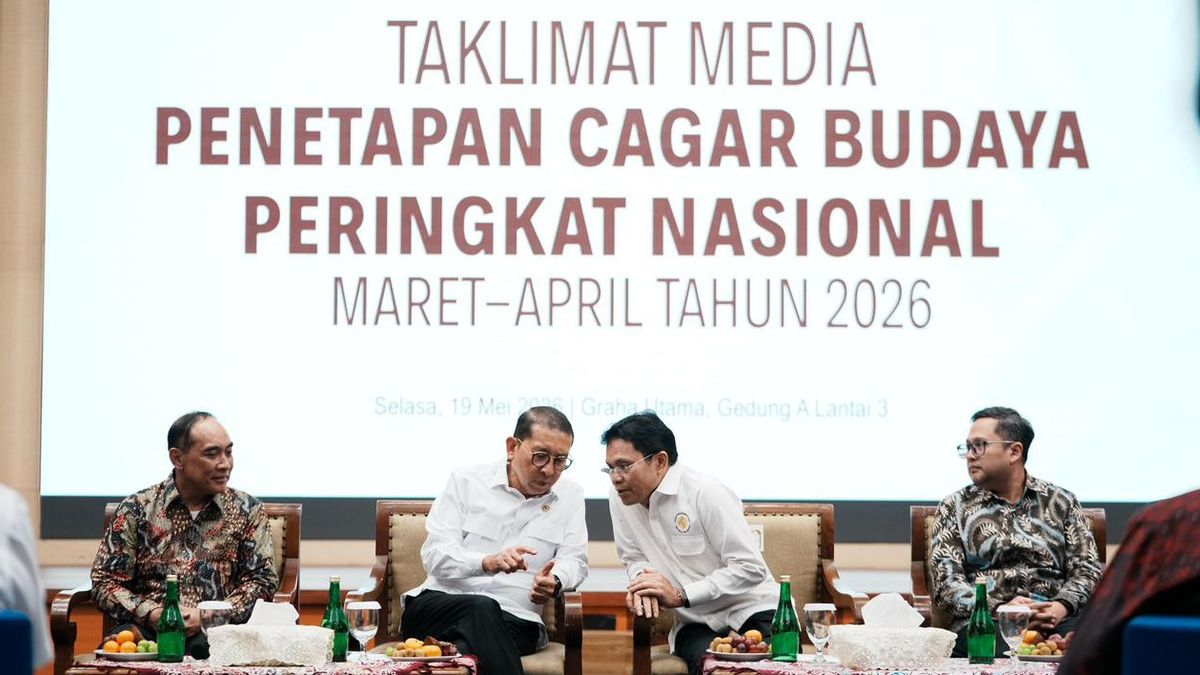


JAKARTA - The Ministry of Culture has designated 430 objects as National Heritage Sites throughout March-April 2026. This number exceeds the total determination during the previous eight decades which only reached 313 objects.
Minister of Culture Fadli Zon said this acceleration was needed because Indonesia's cultural wealth was very large, while objects that received national protection status were still limited.
"We have designated 430 National Level Cultural Heritage. This exceeds the number of cultural heritage that has been designated for 80 years," said Fadli at the Main House of the Culture Ministry Complex, Jakarta, Tuesday, May 19, 2026.
With this addition, the number of National Level Cultural Heritage has now become 743 objects. The government targets 1,750 objects to be determined throughout 2026. This means that the current achievement is only 24.6 percent. There are still 1,320 objects that must be pursued through the next six plenary sessions by the National Cultural Heritage Expert Team or TACBN.
Of the 876 proposals that entered, 430 objects have been recommended. In detail, 32 objects from local governments, 682 objects from repatriation or the return of cultural objects from abroad, and 162 objects from the Indonesian National Museum collection.
At the first plenary session, March 31-April 2, 2026, a number of objects were recommended to be national cultural heritage. Among them are four collections of Dubois fossils from the Leiden Biodiversity Natural History Museum, including Homo erectus fossils in the form of a skull roof, molar, thigh bone, and Pseudodon vondembuschianus trinilensis.
Other objects on the list are the Metaduno Cave Site in Southeast Sulawesi, the Great Mosque of Banten, Rante Pallawa in South Sulawesi, and the Canggal Inscription collection of the Indonesian National Museum.
In the second stage trial, April 27-30, 2026, the TACBN recommended the Muara Takus Percandian Site in Riau, the Ancient Palopo Mosque in South Sulawesi, the Bank Indonesia Building in Aceh, 335 objects from the 1894 Lombok War booty from the Rijksmuseum Amsterdam, and two Cogan Regalia of the Kingdom of Riau-Lingga.
Fadli assessed that the objects repatriated should immediately be given national protection status. Many of them have a high historical value, including sculptures, inscriptions, and important objects that are now stored in the National Museum.
He also touched on the importance of efficient management of cultural heritage. According to Fadli, cultural heritage is not enough to be recorded and guarded. Historical sites can also be developed as living heritage that drives cultural tourism, religious tourism, and community economy.
He gave an example of Borobudur Temple and Prambanan Temple, which are now not only tourist destinations, but also art performance spaces, tourism sports, and creative economic activities.
The Ministry of Culture said that this determination was the basis for strengthening the protection, care, conservation, development, utilization, and training of cultural sites. The government also prepared the discussion of the next object, including the Maha Tape Painting, Puputan Badung, Puputan Klungkung, and the collection of the Indonesian National Museum.
The English, Chinese, Japanese, Arabic, and French versions are automatically generated by the AI. So there may still be inaccuracies in translating, please always see Indonesian as our main language. (system supported by DigitalSiber.id)


