



JAKARTA - The formation of the National Defense Council (NDC) through Presidential Regulation Number 202 of 2024 has attracted attention from academics, observers, and public policy researchers. The existence of the NDC is considered to have the potential to create overlapping authorities to the risk of concentration of power in the executive circle.
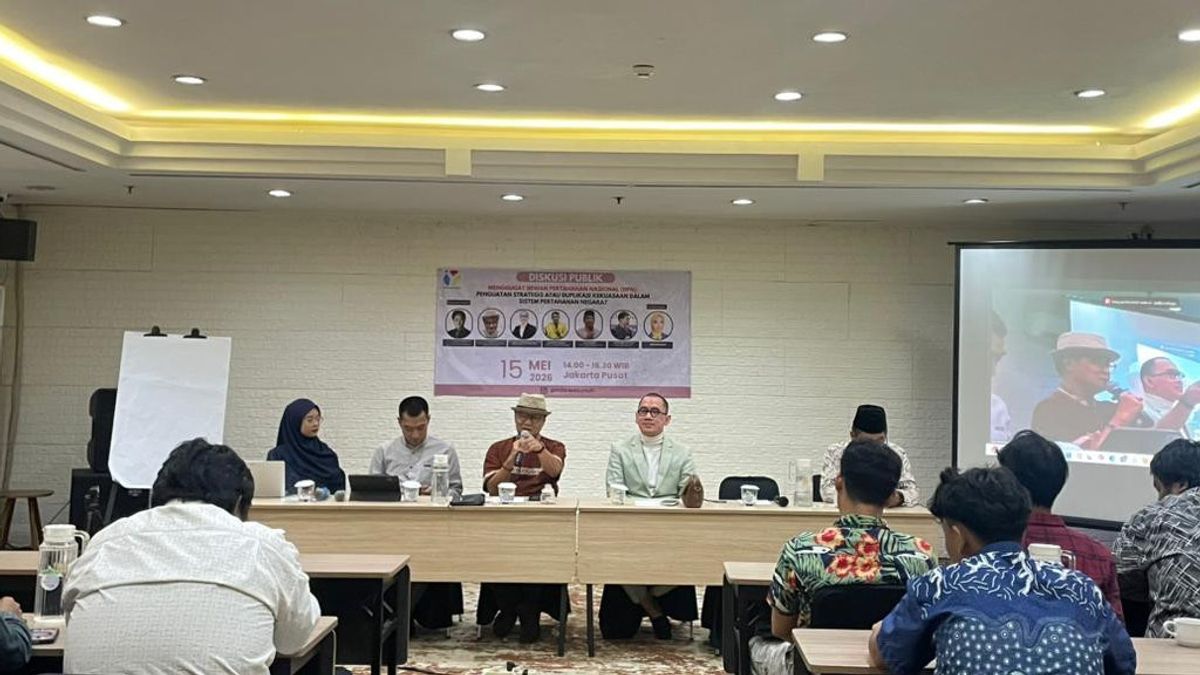
The spotlight emerged in a discussion of the Indonesia Youth Congress entitled "Challenging the National Defense Council or DPN: Strategic Strengthening or Duplication of Power in the State Defense System?" in Jakarta, Friday, May 15.
The discussion featured a number of speakers, including military observers and international relations academics Connie Rahakundini Bakrie, political science academic Firdaus Syam of the National University, law faculty academic Muhammad Reza Zaki of Binus University, political observer Ray Rangkuti, and public policy and good governance researcher Gian Kasogi.
Military observer Connie Rahakundini Bakrie assessed that there were five constitutional risks from the formation of the DPN. One of them is the potential for overlapping authority with the Ministry of Defense, TNI, and Lemhannas.
"Overlapping institutional governance will cause confusion in strategic decision-making in the security and defense sectors of the country," said Connie in a discussion held hybridly via Zoom connection.
In addition, Connie assessed that the existence of the DPN has the potential to strengthen the consolidation of power in the hands of the president so as to erode the checks and balances mechanism.
He also highlighted the weakness of democratic accountability due to the lack of DPR oversight and public participation in the process of formulating defense policies.
According to Connie, another problem lies in the unclear institutional position of the DPN, whether it is only a coordinator, advisor, or actually becomes a new center of power in the defense sector.
"This can create a duality of authority," he said.
Connie also highlighted Article 3 letter f in the DPN Presidential Decree which regulates other functions that the President can give to the DPN. He assessed that the provision was very problematic because it had the potential to become a "global sweeping article".
"The potential for abuse and expansion of the mandate is very open. The question is not whether or not the DPN is needed, but the design of the institution risks violating the principles of constitutional democracy," he said.
Meanwhile, political science academic at the National University Firdaus Syam questioned the urgency and function of the establishment of the DPN.
According to Firdaus, the public has not received adequate explanations regarding the difference in the functions of the DPN compared to existing defense and security institutions.
"The existence of the DPN should be criticized by the public. Its institutional design is unclear. What is the DPN for? What is the difference between it and other defense and security institutions?" said Firdaus.
He also highlighted the potential for waste of state funds because the institution would use state funds without clarity on the agenda and policy direction.
Firdaus assessed that Article 3 letter f has the potential to open up room for abuse of authority because it gives room for the President to provide additional functions to the DPN.
"This article has the potential to give rise to abuse and expansion of the mandate," he said.
On the other hand, public policy and good governance researcher Gian Kasogi assessed that the main problem of the DPN was not in the urgency of its formation, but in the design of the authority which was considered too centralized.
According to Gian, the structure of the DPN needs to be critically tested so that there is no blurring of the boundaries between the functions of formulating policies, managing information, and providing strategic advice to the President.
"In a healthy system, we don't wait for abuse of power to happen. We have to test the design of the institution from the beginning. The question is, does the DPN really strengthen the system or does it concentrate power in one hand?" said Gian Kasogi.
The English, Chinese, Japanese, Arabic, and French versions are automatically generated by the AI. So there may still be inaccuracies in translating, please always see Indonesian as our main language. (system supported by DigitalSiber.id)
Most Popular Tags
#Prabowo Subianto #donald trump #2026 World Cup #Febrie Adriansyah #8791Popular


