

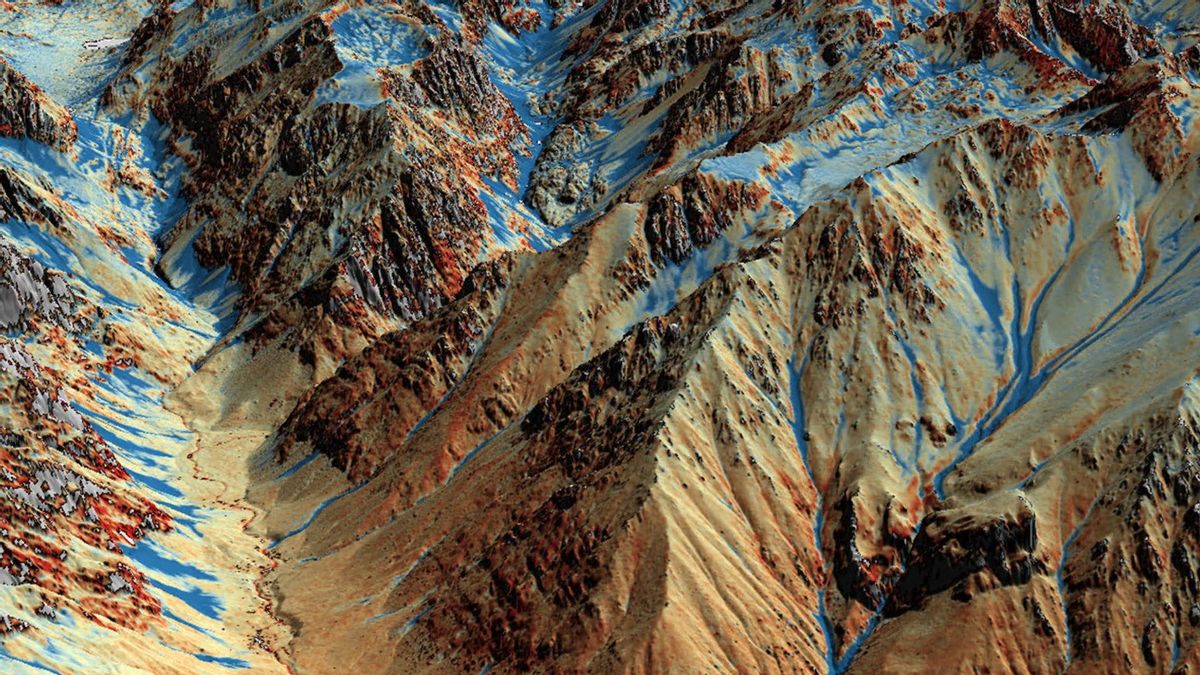


JAKARTA - The Sierra Nevada Mountains in California still look white from the air. However, laser sensors on special Airborne Snow Observatories show a different reality. it turns out that the snow pile in the western United States has shrunk sharply.
Launching a report by The Guardian, Wednesday, May 13, the latest data from the snow monitoring mission showed an alarming condition. Snow in the western mountains of the US, which has been an important source of water, is at a very low level.
"It's definitely a dry year," said Airborne Snow Observatories CEO Tom Painter.
Painter, who developed the technology at NASA, uses lidar to measure snow depth. Lidar is a long-distance scanning technology using laser pulses. In this mission, the device fired about 800 thousand pulses per second.
The result is a three-dimensional map of snow depth with an accuracy of up to 3 centimeters. The data also shows how much water is stored in the snow pile.
In the western United States, mountains are often called "frozen reservoirs". When the snow melts, the water flows into rivers, reservoirs, settlements, and farmland. Therefore, the amount of snow determines the water supply of millions of people.
This year, the signals are bad. The US Drought Monitor recorded more than 60 percent of the 48 major US states were hit by drought. This is the largest spring drought since monitoring began in 2000.
Climate Central said the total water stored in the snowpack in the western US this winter hit the lowest level in records. Even though, the period should be the annual peak of water storage from snow.
"In March, the faucet was closed, and it happened throughout the western US," Painter said.
He said the loss of snow this year has never been seen in the record. In California, the snow pile on April 1 was only 18 percent of the average and continued to decline after that.
Nevada's deputy climatologist, Tom Albright, said the snowmelt in the mountains came two months earlier than usual.
"We hope to ask him to stay a little longer," Albright said, quoted by The Guardian.
Early discharge carries two major risks. First, the land and vegetation dry out faster so that the risk of forest fires increases. Second, large reservoirs in the Colorado River that are already low do not get enough snow supply.
"When we don't have a snowpack, we lose water too quickly, then face a very long dry season," Albright said.
When asked what his biggest concern was in the coming months, Albright replied briefly: "Fire."
Experts say the water systems in the western US have been built for decades on the assumption that snow will stay in the mountains until midsummer. Now, the climate crisis is beginning to change that pattern.
"In the future, years like this will happen more often and may no longer be considered unusual," Albright said.
The English, Chinese, Japanese, Arabic, and French versions are automatically generated by the AI. So there may still be inaccuracies in translating, please always see Indonesian as our main language. (system supported by DigitalSiber.id)
Most Popular Tags
#Prabowo Subianto #donald trump #2026 World Cup #Febrie Adriansyah #8791Popular


